
The Marketer’s Growth Mandate
The discipline of marketing is ”directing the human desire that leads to economic expansion.” –Edwards D. Jones, Michigan School of Marketing (1902)

More People.
More Often.
For More Money.
With the dawn of AI driving the most significant shift of the century, modern marketing is more capable than ever before. Yet amid the sheer possibility, the discipline has never been more confused about what it stands for.
This was not always the case. Since the inception of the discipline in 1902, marketing primarily functioned as a growth engine. Nearly a century later in 1999, Sergio Zyman, the CMO of Coca-Cola, who built one of the most effective marketing machines in history, said it plainly:

“Marketing is about selling more stuff to more people, more often, for more money.”
More people. More often. For more money.
Somewhere between Zyman’s era and ours, marketing got distracted by its own complexity. The proliferation of channels and the obsession with immediate-return marketing let go of what it was built for: the mandate to grow the business.
Today, the marketing function is a feat of specialization. Roles are siloed into performance marketing, brand strategy, CRM, social, SEO, content, influencer, data and analytics, and marketing technology. Each discipline has its own metrics, dashboards, agencies, and definitions of success.
AI is accelerating this specialization. Marketers must now feed models and train systems in addition to persuading the humans and organizations that choose and consume. And while AI enables us to produce significantly more ideas and content at speed, it has not yet made us more strategic. We’ve become so focused on “How did this campaign perform?”
This question matters, but it is not enough. The single most important growth anchored question is:
“How are all of these things, together, changing customer behavior and driving the business forward?”
The reckoning is getting harder to ignore. Budgets are shrinking, and marketing’s seat at the executive table is becoming less secure.

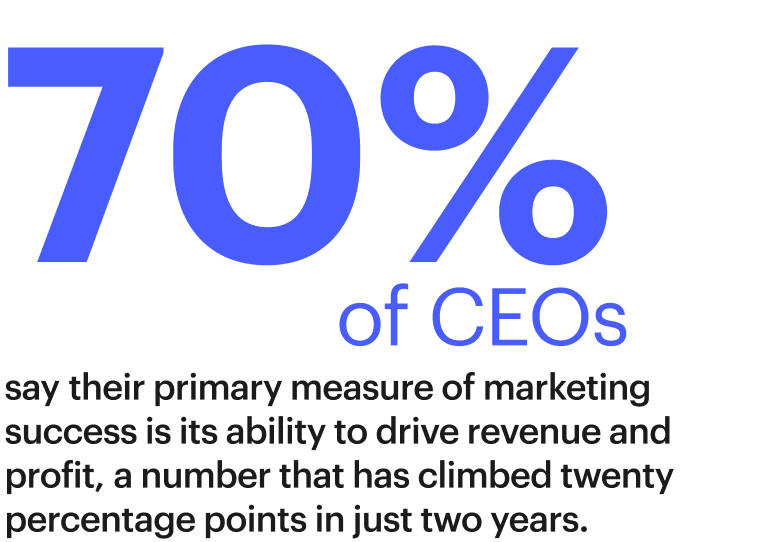
On the other side of that gap sits a marketing function where only 35% of marketers describe revenue and profit growth as their primary responsibility.
This gap is the central crisis of the modern marketing profession.
Perhaps it’s no surprise that marketing investment has declined from 11% to 7% of revenue, that 55% of marketers cite short-termism as their No. 1 challenge — a figure that has risen thirty percentage points since 2022 — and that resources are being stripped back accordingly.
This is where we are today, and the only way out is back to where we started — to the original mandate of delivering growth.
This chapter of Prophet’s Modern Marketing Playbook asks us to reconsider some of the marketing fundamentals, refreshed for the modern AI era but grounded in the science of what works to deliver customer-centered growth.
The AI Revolution in Action
Imagine starting a growth strategy with the desk research already done, not because someone worked through the weekend, but because the market, competitive and performance monitoring, already run on their own feeding a live picture. Instead of a quarterly decks, an always-on system maps out future facing growth scenarios.
While much of AI’s potential in marketing has focused on efficiency, there is equal value in amplifying human thinking in the upstream strategy and planning tasks, particularly in deeper faster intelligence, agentic AI enablement and workflow velocity. These AI capabilities enable modern marketers to digest more, codify best in class thinking and compress previously long cycles into just a few weeks.
Check out Prophet’s Augmented intelligence AI Accelerator Network to see how we are doing this in practice


Each function with a seat at the table owns a distinct contribution to the business. Finance owns capital allocation. Sales owns conversion. Product owns the solution. Marketing’s unique contribution is knowing the customer better than anyone else and using that knowledge to engineer the behavior change that will grow the business.

Zyman’s philosophy is the heart of any marketing strategy: grow the customer base, increase purchases with current customers, or increase spend per occasion.
More Customers
How do we increase the number of customers?

To Buy More
How do we get our current customers to buy more or more often?

To Spend More
How do we encourage our customers to trade up?

What customer habit or perception do we need to change or reinforce? What is the scale of behavior change needed to deliver business outcomes? How many, how often, how much?

Are our brands worth paying more for?
The strongest marketing organizations do this deliberately. In our research, 86% of leading marketing organizations report having a shared understanding of the customer across the entire business. Leading marketers also far more likely to be responsible for customer insights — 86% compared with 50% among less effective organizations. This deep empathy and understanding is the spark that unlocks the shift in habit, perception, or need at scale. Uncovering these deep insights remains THE critical moat.
A winning marketing strategy then connects that understanding to measurable business outcomes. The 82% percent of leading organizations tie customer data directly to measurable business outcomes, compared to 59% of others, have made customer behavior the starting point of their growth planning. They then work backwards from a revenue target to understand how many people need to change their behavior to deliver the growth outcomes. This kind of funnel math enables teams to identify the scale of their ambition, to clearly signpost to the organization marketing’s role in growth, and to test whether the resources available are sufficient.
This matters because sustained growth rarely comes from squeezing more value out of a small group of loyal users alone. A widely cited body of evidence from the University of Melbourne’s Ehrenberg-Bass Institute shows that brands grow by reaching and recruiting the broadest possible customer base. With most businesses losing around 30% of their user base each year, this means living in an almost constant posture of recruitment.
But recruitment does not always mean acquisition is the only answer. For some businesses, the largest opportunity may be increasing frequency. For others, it may be expanding spend per occasion or shifting customers toward higher-value offers. The discipline is knowing which behavior matters most and why.
When marketers define and quantify customer behavior change as the driver of growth, they earn a seat at the table. They are no longer defending campaigns after the fact. They are shaping the growth agenda from the outside in.
Owning the customer is the first imperative because every other decision depends on it. Once marketers know whose behavior must change, the next question is where that behavior can change.
The AI Revolution in Action
It has never been easier for marketers to own the customer narrative.
AI has already significantly shifted how we build customer insights getting deeper, broader and faster at a dizzying
pace. Digital twins [on platforms such as consumer.ai] built
on real audience signals, AI powered video collection [such as Listen Labs] – mean we can ask the “why” questions more effectively than ever. We can scale 10s of interviews to 100s and 100s of quantitative inputs to 10,000, getting results within a few days [or less].
These insights can easily be democratized into specialized agents to create a single source of truth to drive cross functional decisioning.




Once marketers know whose behavior must change, growth comes from identifying the needs, moments, problems, and occasions where the brand can become more relevant.
“If you don’t know where you are going, then any path will do.” This can be as true for modern marketers as it was for Alice in Wonderland. In a world of infinite choices, deciding which path will deliver the strongest outcomes – and which won’t – becomes even more critical.
Where to Play: Defining the Frame of Reference
Growth often stalls because marketers narrowly define their “Where to Play,” focusing exclusively on direct competitors within a fixed category. But limiting the frame to the category as it appears only ever surfaces more ways to compete for the share you already hold. Significant growth requires expanding the purposes and occasions you serve, always anchored back to the customer need those occasions are answering.
Customers don’t think in terms of categories, but in problems to solve, and in the occasions where those problems show up — and how brands can help them solve them. This is achieved by rethinking the Frame of Reference and quantifying the Total Addressable Market (TAM): what market do we play in, and how big is that opportunity? Here, customer centricity becomes marketing’s superpower.
Consider two in-market examples:
Baileys Irish Cream: From “Holiday Liqueur” to “Adult Sweet Treat.”
Historically, Baileys operated in the “special occasion liqueur” category, served over ice after Christmas dinner. By reframing the market opportunity around “adult indulgence” and “liquid dessert,” they were able to source growth from desserts, chocolates, ice cream, coffee moments, and other premium treat occasions.

Adobe: From “Design Software” to “Marketing Infrastructure.” In the late 2000s, Adobe was primarily known as “creative software” (Photoshop, Illustrator, InDesign) for designers. This was a powerful position, but a revenue ceiling capped by saturation with that group.
As the software market moved toward SaaS, Adobe reframed its full value proposition, bypassing design departments to tap into the much larger CMO customer base. Adobe became a full-stack engine supporting digital customer experience, personalization, and content creation with an all-in-one, connected ecosystem.
The AI Revolution in Action
Reframing a category sounds good in a workshop and then often goes nowhere. The payoff is uncertain and to get there is resource intensive and can take a prolonged period of testing- neither of which work in today’s compressed environments.
AI can solve this tension by going both deeper and faster, systematically interrogating and pulling in a wider range of data than was possible. This means that marketers can quickly open the aperture in a way that makes it much easier to test options and quickly abandon or re-think.
Always on anthropological platforms [such as Quilt.AI] can dig into how people actually describe their problem across culture, not in industry definitions, while agents can ingest and analyze higher volumes of data- across public, syndicated and propriety sources. Together these can deliver growth scenarios, sizing and validation in weeks.
Check out Prophet’s Uncommon Growth Labs, for places we have helped clients do just this.



Once “Where to Play” is defined, the job becomes mapping how to get there. Owning the growth moves means deciding which actions will change behavior, how much investment they require, and how success will be measured.
From there, the task is to drive specific actions with the identified growth audiences:
- WHAT are the precise jobs to be done with them? What behavior, belief, habit, or decision must shift? For example: increase awareness of a specific attribute.
- WHERE will the volume come from? Which competitors, substitutes, behaviors, or non-consumption moments will source the growth?
- WHY will customers believe in the brand? What is the brand’s advantage, proposition, proof, or experience that makes the behavior change credible?
Before selecting what to do, marketers must pass through a gate of investment sufficiency.


F — Future-Back Innovation: Developing tomorrow-ready offers, services, and go-to-market approaches — running at two speeds, executing today’s business model while preparing for market shifts five years out.
O — Offers & Occasions: Designing a complete architecture of products and services that cover unmet needs and map directly to the specific occasions in which customers purchase.
R — Route-to-Market & Channels: Optimizing where and how customers interact with the brand. Whether selling B2B industrial minerals or lipstick, the product must be easy to buy, friction-free, and present where customer behavior is shifting.
W — Whole-Journey Engagement: Mapping and prioritizing activities across the entire customer ecosystem — balancing resources across awareness, consideration, performance, purchase, and ongoing customer experience, rather than over-indexing on one stage.
A — Amplified Category Voice: Upweighting competitive presence with breakthrough, memorable marketing — modeling spend so overall investment matches ambition (growth usually requires a spend share greater than market share), commanding disproportionate attention.
R — Reinvigorated Brand Value: Updating the brand to stand for something distinctive, memorable, and relevant, with a clear promise and consistent reasons to believe across all touchpoints.
D — Digital Demand Generation: Deploying modern, digitally driven engines to actively drive, capture, and convert pipeline — turning general brand awareness into targeted, measurable commercial transactions, while maintaining a balanced brand-performance mix.
Growth usually comes from pulling several of these levers at once — carefully balancing them to get to optimal outputs. The discipline is building a portfolio that matches the customer behavior change, the occasion opportunity, the competitive context, and the level of investment available.
That is why brand and demand must work together.

Short-term pressure has pushed many organizations toward demand capture at the expense of demand creation. Performance marketing feels easier to measure, faster to optimize, and simpler to defend. But when performance activity becomes disconnected from brand building, companies risk harvesting demand that already exists while failing to create future demand.
Our own research in Brand & Demand Love Story found that 90% of winning marketing teams integrate upper and lower funnel. Our work with The Multiplier Effect,” found that marketing effectiveness is highest when brand and demand work together, driving 90% higher ROI versus performance alone, increasing the effectiveness of performance marketing by 51%, and building brand pricing power and resilience.
The often-cited benchmark from Benet and Fields, says roughly 60% brand to 40% demand remains directionally useful, with variation across industries.

Measurement must reflect both. Leading organizations are able to hold short-term and long-term KPIs at the same time. In our research, 84% of leading marketing organizations can manage short- and long-term KPIs simultaneously, compared with 57% of average organizations, underscoring the importance of building an evidence-based leading and lagging metric system.
HubSpot offers a useful example of multiple growth moves working together. Originally known as an inbound marketing and CRM pioneer, HubSpot expanded from marketing tool to AI-led customer platform. Its CMO used nearly every growth lever at once: Future-Back Innovation to build Breeze AI, new modular Offers & Occasions for scaling companies, and Whole-Journey Engagement through HubSpot Academy — reinforced by shifting Route-to-Market toward agency partnerships, an Amplified Category Voice through the INBOUND conference, and a sustained Digital Demand Generation engine.
The result was not one isolated campaign. It was a connected growth system that expanded the customer base, increased average revenue per customer, supported multiproduct adoption, and created significant incremental volume via partner networks.
But even the strongest set of growth moves will be unsuccessful if the organization does not understand, fund, and execute them.
The AI Revolution in Action
Agent driven workbenches that have assigned individual workflow tasks as human led, automated or augmented, and connected them together to ensure a seamless handoff- one to then next can be a game changer in plotting how to win.
Picture multiple growth moves on the table, and for once, knowing which one actually pays off before anyone commits. Often teams default to whatever’s easiest to execute, not what delivers best against the strategy. Having a solid strategy as a foundation and historical data and marketing forecasts as input, tasks such as budget planning (i.e., does this budget match this ambition?) can be largely automated, while agents can be programed to generate multiple options, identifying the upside and risks of each.
Check out Prophet’s partnership with Lyzr and our work building out new operating models and workbenches



A strategy that cannot be clearly explained will not
be executed.


Alignment is a critical part of marketing’s growth challenge. It needs to be intentional and structured, building buy-in and confidence through a few practical, fundamental actions. The first is speaking the language of growth. Marketing leaders need to frame outcomes in terms of revenue, not activity metrics, to build trust with other leaders.
“I have an active seat at the table, and work to shape Marketing’s role in response to our overall enterprise goals and help shape our commercial deliverables. Marketing needs to be equally accountable for revenue we are generating.” –ALICIA TILLMAN, CMO, Delta Air Lines
Next is co-creation — building the marketing strategy in collaboration with Finance, Sales, Product, the C-suite, and other functions. Our research has shown that winning marketing teams consistently report stronger cross-functional relationships — not just with the typical sales groups, but much more broadly: Finance (+66%), IT (+71%), Product (+41%).

“We are focused on bringing the organization on board and showing them what good looks like. In our case, we did the work in a small working group to get alignment and prove the case.”
–DIPTI KACHRU, CMO, Broadridge
And finally is marketing the marketing strategy. This requires simplicity, repetition, and internal storytelling. A complex strategy must be repeated consistently across every stakeholder conversation, every planning cycle, and every board update — making sure the strategy becomes shared language, which leads to execution.
HubSpot’s phrase “solve for the customer — not just their delight, but also their success” is a good example of strategic language that became organizational language. It was simple enough to remember, broad enough to guide decisions, and specific enough to reinforce a customer-led growth philosophy.
Dove’s Campaign for Real Beauty offers another lesson. After having rejected the real beauty campaign idea, the marketing team created a film specially targeted at the 12 men on the Unilever board- using their own wives and daughter to demonstrate the intense pressure they felt about the pressure they felt from internal beauty standards. By making the emotional reality of beauty standards visible and undeniable, the team helped the organization understand why the strategy mattered. Once the universal insight was clear, the organization could align behind a creative platform that went on to unlock significant growth and reshape the cultural conversation around beauty.
The AI Revolution in Action
With the exception of measurement dashboards, most of the work of aligning and inspiring an organization around a single vision, remains a uniquely human task, but with the burden of the work to get there reduced, leaders can focus on listening to their cross functional partners, ensuring a growth strategy that will resonate.
Supported by dashboards that automate the leading and lagging metrics and the plethora of AI content tools that can be repurposed from customer facing activity into internal comms, the entire week before the board presentation can be spent in rehearsing the conversation, instead of rebuilding slides that existed somewhere else.

The Through Line
Sometimes, when everything is changing, it’s good to go all the way back to the beginning.
When marketing was conceived as a discipline at the start of the 20th century, it was defined as:
“Directing the human desire that leads to economic expansion” — and that’s still the job today.
— Edward D. Jones, Michigan School of Marketing, 1902
That is still the job.
Getting Started: The Questions That Change Everything
- Can you state your growth mandate in two sentences? What customer behavior are you changing, for whom and toward what business outcome? Have you quantified the scale of change needed?
- Do you truly own the customer insight in your organization? How are you making the understanding of who your customer, what drives them and how they behave, an enterprise asset?
- Have you framed the market so that you are increasing the size of the pie, not just competing for share?
- Is your plan pointed at how to change customer behavior? How will you bring more customers, more frequency or more spend per occasion- what are the insights and competitive advantages that will get you there? Do you have sufficient funds to deliver the scale of behavior change needed?
- Have you identified a collection of growth moves? Thinking beyond communications to the full F.O.R.W.A.R.D marketing mix?
- Are you generating future and incremental generating demand, not just capturing existing demand? What is the budget split? If performance is winning by default, customer trust and brand value may be eroding.
The AI Revolution in Action
AI is your force multiplier in all of this, without it, it is unlikely that there will be resources of patience to deliver against the needs of a rigorous growth strategy- so the same questions must be asked of AI capabilities.
Have you deployed all the AI resources at your disposal to help you go deeper and broader, building scenarios and integrating customer insights- all more quickly than before?
Are you building competitive advantage- using proprietary data sources, and proprietary agent- widely scaling across teams and functions to ensure best in class thinking and operations?

Modern marketing demands a connected system that delivers growth, protects brand, and drives measurable impact at pace. Talk with our experts about how to navigate this AI-accelerated era and build the playbook that works for your organization.
Contact us to learn more about Prophet’s
Marketing Excellence solutions.

Authors

Kate Price
Partner & CMO Practice Lead

Scott Davis
Chief Growth Officer

Adam Tremblay
Partner, Brand Practice Lead

Alex Whittaker
Partner, London

Bernhard Schaar
Partner, Berlin

Virginia Ngai
Associate Partner, Hong Kong