

The AI-Powered Consumer: Why Use Is Surging While Sentiment Slides
Consumer AI use is skyrocketing. But enthusiasm? It’s quietly heading in the other direction.
The AI-Powered Consumer: Why Use Is Surging While Sentiment Slides
Consumer AI use is skyrocketing. But enthusiasm? It’s quietly heading in the other direction.
Prophet’s latest AI-Powered Consumer Study, based on roughly 2,000 consumers in China, Germany, Singapore, U.K. and the U.S., reveals just how mainstream this technology has become and AI’s growing influence in everyday life as consumers’ deep and personal advisors.
Yet, as usage surges, new questions and complexities are emerging. Our new research reveals we’ve arrived at a fascinating moment: While consumers are embracing AI’s capabilities, they are also seeking greater trust, value and human connection from these innovations. This signals a landscape of enormous possibility, where the real challenge is harnessing AI to deliver both breakthrough utility and experiences that truly resonate.

What We Learned:
01
AI usage is exploding in ways nobody predicted.
About 73% of consumers are now using GenAI, up from 45% in 2024. And they are not just using it for search but for tasks like uploading medical records for health advice or simulating future versions of themselves to predict how their purchase decisions will affect them over time. More than half view autonomous agents taking action on their behalf (e.g., making smart purchases) as genuinely helpful.
02
But at the same time, enthusiasm is falling.
Despite growing use, overall excitement about GenAI has declined. As AI becomes part of daily life, consumers fear a loss of the human experience, with the majority of consumers anxious about losing human connection and concerned about AI driving decision-making that requires human judgment.
03
The next frontier is already becoming visible.
Consumers want AI that understands them deeply and simply works in the background on their behalf – proactive, ambient and emotionally intelligent. Two-thirds want AI that anticipates their needs without being asked. The era of prompt engineering has given way to something more intuitive and human-like, and we already see the major AI platforms innovating in this area.

What does this mean for businesses?
AI agents will soon know your consumers on a deep and personal level, naturally embedded into their daily lives as key advisors and decision-makers. Today’s businesses need to win with both consumers and their agents to drive growth and create experiences that deliver both indispensable utility and emotional connection.
Consumers Are Using GenAI in Ways That Were Previously Unimaginable. And They Are More Than Ready for Agents.
Consumer GenAI use jumped from 45% to 73% from early 2024 to 2026 and has grown in every market. But what’s even more striking is the incredibly varied nature of how AI is being used. Before they shop, people are searching for product recommendations, making pre-purchase search the top use case across all five markets, cited by 61% of consumers. When it comes to new product discovery, 41% of consumers use AI to discover products they didn’t even know existed but have the potential to solve problems in their lives.
GenAI adoption surges across generations with millennials continuing to lead

Base: General population, 18+ years old. Gen-Z 18-27 (863), Millennials 28-43 (1733), Gen-X 44-59 (1520), Baby Boomers 60+ (1319)
But the story doesn’t stop at pre-purchase. Consumers are using AI throughout the entire journey. At purchase, for example, 29% say they use AI to monitor discounts and make purchase decisions. Post-purchase, 37% use AI to create product reviews. We also see consumers using AI in ways that many of us may never have predicted from the average consumer. Examples include:

“I’ve set up a specific prompt sequence in Gemini that helps me plan my trip itineraries and find more local spots instead of just the usual touristy malls.”
–Gen Z, Singapore

“I’ll use Claude or ChatGPT to run through “what-if” scenarios when I’m weighing a big purchase. When I was debating a VR headset, I had AI help me weigh the long-term utility versus initial excitement. It helped me stay grounded and avoid impulse buys.”
– Millennial, U.S.

“I recently used AI to upload my X-ray results and asked for an interpretation – it helped me prepare for when my physician gave me a call later that day.”
– Boomer, U.S.
AI use is more personal and sophisticated than many expected, and people are increasingly willing to share deeper, more personal data when the value is clear. This shift challenges brands to keep pace as consumers turn to AI for meaningful, data-driven experiences that go beyond the traditional engagement models most brands are currently delivering.
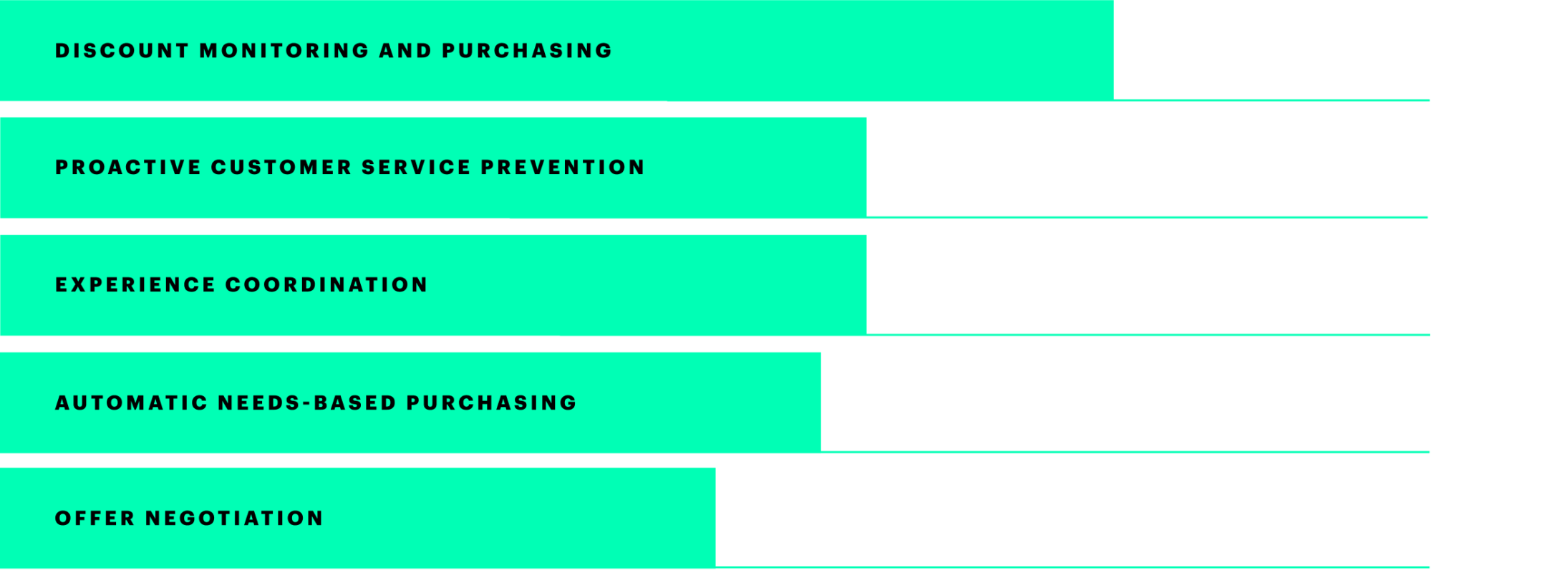
When it comes to agentic AI – the systems that take autonomous action on a consumer’s behalf – consumer appetite is real, with 54% of people already viewing these agents as helpful. Here are the top five use cases consumers want, reflecting the demand for agentic AI, particularly in the commerce space.
Top 5 Agentic Use Cases Consumers Want


“I can’t imagine using a search engine again. AI seems to anticipate what I want and need”
– Boomer, UK

“I can’t imagine using a search engine again. AI seems to anticipate what I want and need.”
– Boomer, U.K.
Brands face a real threat. The risk of disintermediation is rising, with AI agents increasingly positioned to own more of the consumer relationship and make decisions on their behalf. The landscape continues to evolve rapidly—for example, OpenAI recently pivoted to scale back native in-app purchasing, while Google continues to invest in new agentic features (e.g., DoorDash delivery through Gemini). But through this rapid change, one thing is clear: Agentic use cases such as those above present clear potential to deliver value to consumers, and therefore likely where we can expect to see innovation continue to shift.
As AI becomes woven into daily life, businesses must design for both humans and AI agents —integrating seamlessly within consumers’ evolving agentic ecosystems. To unlock competitive advantage, leaders also need to innovate their own AI-driven businesses and experiences. Through these evolutions, success depends on evolving operating models that actively manage and empower both human and AI agents. Winning organizations will proactively upskill talent, adapt business processes, and embed dynamic human–AI collaboration at the core.

What This Means for Marketers and Business Leaders
Design for humans and their agents. As AI agents take a greater hold in consumers’ lives, the potential impact on direct-to-consumer engagement is enormous. With consumers continuing to rely on and delegate to AI agents, who may be getting to know them on a deep and personal level, brands need to reimagine how they will attract, engage, and win with both consumers and their agents.
Own the agent, own the relationship. Brands also need to decide where to offer their own agents to consumers, providing a critical advantage in driving full-journey engagement and data capture.
Prioritize AI change management and shifts in operating model. Building and/or integrating with AI agents for real consumer value requires a significant organizational shift, actively rethinking roles, capabilities, and ways of working around human/AI collaboration models.
The imperative for brands is to deliver distinctive value that meets consumers’ aspirational use cases, or risk losing direct access to their audiences. The brands and platforms able to create genuine, scalable value for consumers — and the agents acting on their behalf — will shape the next era of growth.
But what do businesses need to do to actually deliver that distinctive value? We explore this question in the next section by examining a key tension for consumers as this technology permeates daily life.
A Paradox Emerges – Usage Is Growing, While Enthusiasm Declines


28%
Average increase in adoption of AI use cases along the consumer journey

30%
Fewer consumers believe GenAl will be so integrated into their lives that they’ll rely on GenAl for most decisions

Here is the tension at the heart of this research: consumers are using AI more than ever, but they’re feeling less good about where it’s all heading.
Overall excitement about GenAI has dropped approximately 7% since our previous 2024 study. More significantly, the belief that GenAI will become so integrated into daily life that consumers will rely on it for most decisions has fallen by a striking 30%, signaling a meaningful shift in consumer psychology.
This trend signals that GenAI has entered what Gartner calls the “trough of disillusionment,” the natural dip in enthusiasm that follows inflated expectations in any technology cycle. But with AI, there’s a specific emotional driver that makes this moment distinct: people feel anxiety over the impact that AI might have on humanity and fear the loss of the human experience.


“I use AI to help me track and set alerts on price shifts – but I do wonder if I’m now losing out on actually enjoying the experience of shopping. It’s also a fear of losing the ability to be spontaneous, without a screen telling me the best time to click buy. I don’t want to reach a point where I can’t make a simple decision without asking the app first.“
– Singapore, Gen-Z
A mistake would be to interpret this data as a reason to slow down AI investment. AI brings enormous benefits to consumers, as shown by the accelerated adoption we observe. But what this data does signal is the need to redirect AI investments, from delivering yet another chatbot focused on efficiency to innovation that speaks to this core tension for consumers, offering real value with both functional and emotional benefits.
The brands winning right now are doing just that, deploying AI to solve genuine pain points while elevating trust and empathy in the brand relationship through the experience delivered.
Some favorite examples:
ASOS
ASOS recognized that online shopping can be high-anxiety and isolating, with uncertainty around fit, style, and self-expression creating real barriers. Its AI features address not just the transactional side, but the emotional experience too. Virtual Try-On lets shoppers upload a photo or choose from 20 diverse AI-generated models spanning a range of body types, sizes, and skin tones — reducing self-doubt and making the experience more inclusive. Style Match lets users upload images of friends or creators to instantly find similar looks, transforming shopping from a solitary task into something social and culture-driven. Together, these features blend utility with empathy, earning ASOS a more meaningful place in consumers’ lives and building ongoing engagement.


BANK OF AMERICA
Bank of America’s Erica is an example of how AI can address functional consumer needs while building a more trusted, empathetic brand, using a strategy Bank of America calls “High tech, high touch.” For consumers, money is a highly emotional topic often intertwined with self-worth and identity. Erica acts as an always-on, proactive financial copilot, providing insight and guidance along consumers’ key moments of truth (e.g., proactively detecting fraud, flagging spikes in monthly bills, or recognizing a milestone toward a financial goal). Under the hood, sentiment models monitor markers of frustration, allowing AI to adjust its tone and escalate to a human specialist when needed. Interactions focus not only on executing financial management tasks but providing peace of mind, which strengthens the brand resonance and relationships.
STARBUCKS
Starbucks’ Green Dot Assist found a meaningful way to use AI to augment staff rather than displace them, improving service by elevating the human warmth that defines hospitality. These AI agents work alongside baristas, providing instant access to recipes, equipment troubleshooting and operational information. That speeds service and improves accuracy, enabling staff to focus on what humans do best — delivering genuine, emotionally resonant service.

What This Means for Marketers and Business Leaders
Do not stop at utility and efficiency — generate emotionally resonant value propositions, and invest behind the experience. Look beyond delivering yet another chatbot and focus on how AI can help solve real consumer pain points. The winning formula for agentic value propositions is both functional utility and human experience.
Think of AI as a critical layer augmenting consumers’ ecosystem (not the whole story). Brands navigating this well are treating AI as an integrated layer within an omnichannel journey. It should augment human and community interaction, not replace it.
The Next Frontier: Emotionally Intelligent, Ambient, Anticipatory AI
We asked consumers about emerging AI capabilities that do not fully exist yet, and the responses painted a clear picture of where the next wave of consumer AI is heading.
Three connected themes came through strongest:


Emotionally Intelligent AI.
67%
of consumers want AI that guides purchase decisions based on their personal values and preferences – not just price.

That’s slightly more appealing than purely price-driven agent decisions (60%). Among heavy AI users, 47% already envision GenAI providing emotional support and companionship “similar to a trusted friend.” People want to feel understood.

Ambient AI.
62%
of consumers want AI that quietly notices things in their environment, and provides help proactively, vs. having to constantly ask the AI questions.
That’s slightly more appealing than purely price-driven agent decisions (60%). Among heavy AI users, 47% already envision GenAI providing emotional support and companionship “similar to a trusted friend.” People want to feel understood.


Anticipatory AI.
66%
of consumers want AI that can “read between the lines” to meet their real needs, not just what they literally ask for.

The prompt-response model that defines most of today’s GenAI interactions is already feeling outdated to consumers who’ve experienced more fluid, intuitive systems, mirroring what’s happening in enterprise AI. Consumers don’t want to become prompt engineers. They want AI that already knows what they need.

“If a flight to Singapore I have to go see my daughter gets cancelled, I don’t just want a list of flight numbers. I need AI to help understand the stress of that moment and prioritize the flight that is going to keep me most comfortable vs. just picking the fastest or cheapest option.”
–Boomer, Germany

“I’d love my home assistant to know when I’ve had a day of back-to-back meetings, and help handle the mental load I feel. It could help order groceries or send a quick update to my wife. Maybe it could shift my environment – news summarized on the kitchen hub – drop me into the PM headspace so I can be present with the family when I’m off the clock.”
–Millennial, U.S.

Together, these signals point to an AI future that’s less about answering questions and more about living alongside consumers — emotionally attuned, context-aware, and proactively useful. It’s these capabilities that can both help make AI more useful to consumers and bridge the critical sentiment gap we’re currently observing.
What This Means for Marketers and Business Leaders
Build your innovation roadmap around emotionally intelligent, ambient, prompt-less AI. The brands that anchor their next 12 to 24 months of AI development and partnership on these three themes will be the ones that lead the market in closing the sentiment gap and driving sustained growth.
Prepare for a world without prompts. If your AI strategy still centers on getting consumers to interact with a chatbot or type queries into a search bar, you are designing for the previous wave. The architecture of consumer AI is shifting toward systems that observe, infer and act. Start preparing your data structures, content and consumer touchpoints for that reality now.
Wrap-Up: Top Five Things to Do Right Now
AI is a moving target. But with so much at stake, growth-focused leaders can’t afford to wait and see. We recommend prioritizing:
01
Re-architect consumer journeys for human and agent ecosystems.
Establish your brand’s role and how it will create value within consumers’ evolving ecosystems of communities, creators, and agents. Map every touchpoint and ask: how does this work when the “consumer” is an AI agent acting on someone’s behalf? Where does humanity need to be elevated?
03
Innovate AI-enabled businesses, offers and experiences that resolve consumers’ core tensions.
Businesses that own the agents will have a structural advantage in maintaining consumer relationships, driving full-journey engagement, and capturing data. Decide where those opportunities exist for you and innovate value propositions that deliver technical utility and emotional connection.
05
Drive organizational change toward AI-human collaboration.
New capabilities, roles, ways of working and culture will be required to manage emotionally intelligent agentic ecosystems at the speed and scale the market demands. Engaging the best talent in an increasingly automated environment requires a new approach. Driving organizational change should happen as soon as possible, while your strategy is being set.
02
Operationalize your brand to be discoverable and resonant with AI agents and the human trust signals they rely on.
Audit your content, data, and trust signals for LLM performance. Is your content answer-driven? Are you in the conversation with communities and creators? Evolve your owned assets and influence the external signals LLMs rely on.
04
Move from periodic to always-on consumer emotional intelligence.
AI agents act on real-time signals and are getting to know your consumers on the deepest level — your brand should too. Make consumer intelligence a continuous input to cross-functional decision-making and blend primary research with AI-enabled tools to create a new way of doing business.
Wrap-Up: Top Five Things to Do Right Now
AI is a moving target. But with so much at stake, growth-focused leaders can’t afford to wait and see. We recommend prioritizing:
01
Re-architect consumer journeys for human and agent ecosystems. Establish your brand’s role and how it will create value within consumers’ evolving ecosystems of communities, creators, and agents. Map every touchpoint and ask: how does this work when the “consumer” is an AI agent acting on someone’s behalf? Where does humanity need to be elevated?
02
Operationalize your brand to be discoverable and resonant with AI agents and the human trust signals they rely on. Audit your content, data, and trust signals for LLM performance. Is your content answer-driven? Are you in the conversation with communities and creators? Evolve your owned assets and influence the external signals LLMs rely on.
03
Innovate AI-enabled businesses, offers and experiences that resolve consumers’ core tensions. Businesses that own the agents will have a structural advantage in maintaining consumer relationships, driving full-journey engagement, and capturing data. Decide where those opportunities exist for you and innovate value propositions that deliver technical utility and emotional connection.
04
Move from periodic to always-on consumer emotional intelligence. AI agents act on real-time signals and are getting to know your consumers on the deepest level — your brand should too. Make consumer intelligence a continuous input to cross-functional decision-making and blend primary research with AI-enabled tools to create a new way of doing business.
05
Drive organizational change toward AI-human collaboration. New capabilities, roles, ways of working and culture will be required to manage emotionally intelligent agentic ecosystems at the speed and scale the market demands. Engaging the best talent in an increasingly automated environment requires a new approach. Driving organizational change should happen as soon as possible, while your strategy is being set.
The Bottom Line
AI agents will soon know your consumers on a deep and personal level, embedded into daily life as advisors and decision-makers. A central question for every growth leader right now is how to win with both consumers and the agents acting on their behalf.
The data is clear: consumers are ready. They are using AI in ways we didn’t anticipate, and they are hungry for AI that goes further. But they are also anxious. They don’t want to lose the human connection that enriches their experiences and makes their relationships meaningful.
The brands that close that gap—evolving their organizations to deploy AI as a powerful enabler of experiences that are both highly useful and emotionally resonant—will be the ones that define the next era of consumer relationships.
Ready to understand what this means specifically for your business? Prophet’s team of growth strategy, consumer experience, and AI experts can help you translate these insights into a clear path forward and action.
Contact us to start the conversation, or explore our AI and growth solutions to learn more.
Thank you for your inquiry.

Authors



About the Research
Online Quantitative Survey
Participants N=2015 people aged 18 who used at least one AI tool in the past 6 months for personal/consumer reasons
Fieldwork dates: Jan 2026 – Feb 2026
Markets: China, Germany, Singapore, United States, United Kingdom
Our study included a representative sample of the general population for each country, across a wide range of AI usage and familiarity.
Survey samples are nationally representative in each country.
The focus of the research was unpacking consumer attitudes, behaviors, and future aspirations for generative and agentic AI.