Winnovation Factors: Five Criteria for Innovation Excellence
Working with intensely nimble companies, we’ve distilled five essential factors for innovation.
Transform from innovation laggard to innovation leader
The pandemic disrupted business operations in ways leaders could not have possibly imagined. Forward-looking companies used this as a catalyst for innovation, to digitize services, fast-track disruptive products, or access new markets – but there were many who fell short. The appetite for innovation is far from slowing and the urgency for businesses to continue to flex their innovation muscle has never been greater. To avoid the risk of slipping behind, ill-prepared for the next crisis, companies need to be putting innovation front and center now to ensure they seize the seeds of opportunity and prosper in a post-pandemic world.
Prophet works with high-performing, innovation-driven companies of all shapes and sizes across a spectrum of categories and markets. There’s a lot other companies can learn from their approaches and attributes. We’ve distilled what we’ve discovered from our work into a set of five essential factors that are present, either in part or in full, at those nimble companies reaping the benefits of innovation-driven success.
Want to unleash innovation-driven growth and build resilience for your business? Read the five criteria for innovation excellence here.
Improve Your Digital Content Strategy: 3 Learnings for European Companies
Our new research shows firms benefit from tech that automates, personalizes and localizes content strategy.
Companies are well aware that quality content — engaging, personalized and distributed at scale — is an essential part of modern marketing. Whether it’s using light-hearted memes or in-depth reports, an agile content strategy builds relevance and brand awareness while also establishing companies as thought leaders in their industries.
Though businesses worldwide are developing increasingly sophisticated content strategies to generate leads, demand and revenue, our latest research – surveying 484 executives across the U.S. Europe and China – uncovered some powerful focus areas for companies, specifically in Europe, to hit those goals. Here, we outline the three digital content imperatives European companies should be actioning against now:
1. Optimize Your Organizational Structure
A slight majority — just over 50% — of all European companies in our research use a centralized creative team, which manages content across departments and geographies. That’s not surprising, since for many years, that’s been the go-to model.
In the past, there were good reasons to consolidate content production with a central creative team. This internal agency model allowed for better governance, more consistent quality and a quicker production time. As businesses became more digital, they moved away from creating awareness through brand-centric content and focused more on mid-funnel content, such as thought leadership or buying guides. These factors were instrumental in companies shifting content production away from external agencies.
But this model is only sustainable up to a point and as many companies transform for the digital age, conditions are rapidly changing. Badly judged centralization can constrain the ability to tailor content locally and add significant differentiated value. Our research showed that German companies are most likely to rely on a centralized approach, at 60 percent. That compares to 53% in the U.S. and 44% in China. The European companies we spoke to said that aligning multiple teams around a unified content strategy is their biggest challenge, at 27%, this compares to 23% in the U.S. and 15% in China.
A better way: Increasingly, more companies — and 32% of our global sample — have moved beyond centralization, setting up additional content-producing centers. Typically, they still have a central creative team, which sets much of the overall content strategy. This team creates and enforces editorial guidelines for quality and owns the visual and verbal identity for consistency. It can also hold the technology and provide training for data-based content creation and the measuring of content success.
The work with our clients in Europe has shown how helpful this organizational structure can be in meeting the unique content demands of different business units and geographies. It’s vital in European markets, which often face other regulatory guidelines.
2. Embrace Tech and Data to Create, Personalize and Measure Content
The biggest challenge for today’s content producers is to consistently produce personalized content at a large scale — and do it in a way that increases revenue. To do this, companies need more than the right content. They need to deliver it to the right person, at the right time and in the right channel – and that requires using more data and automation.
Yet companies in Europe are most likely to say that their solution is simply to hire more content creators, at 24%, compared to 18% in the U.S. and 13% in China. Producing content at scale isn’t something that can be solved by simply adding more employees.
“An agile content strategy builds relevance and brand awareness while also establishing companies as thought leaders in their industries.”
Only 11% of European respondents say they use AI to create and deliver personalized content at a large scale, based on AI-driven customer segments and analytics. That compares with 22% of those in the U.S. and 25% in China. (Germany presents the most extreme example of this at two percent, versus 10% in the U.K.)
And just 10% say they rely on AI-driven analysis of demographic, behavioral and psychographic data, enhanced with third-party data to create customer segments. That compares to 19% in the U.S. and 35% in China.
European companies are also noticeably more conservative about most uses of consumer data, citing more concerns about privacy than those in other regions. And for good reason, as data privacy legislation in Europe is more stringent than it is in the U.S. or China.
A better way: Our research shows that the best approach is investing in an innovative set of practices that make up an agile content system. These systems:
Use data to inform content creation
Produce content in modules for approval and recombination
Centralize and automate content storage
Upload a standard design system
Measure content effectiveness beyond awareness and engagement
European companies need to push harder to create clear guidelines on how data is used. What is acceptable, and why? What are the guidelines for content aimed at consumers versus B2B efforts? These conversations are increasingly important as companies face a cookie-less future.
3. Tune Campaigns for Different Regions
European countries have long understood that regional differences are significant and strategies that resonate in Portugal might be a total failure in Finland. But in a world of digitally-driven content and AI that can be finely tuned for each market, those differences are not what they used to be. And they can often become excuses for inconsistencies that limit the effectiveness of a content strategy.
These disparities can also be seen in channel effectiveness, with European countries less likely to say their audience engages with them on critical social-media channels. Just 37% of European companies say Facebook provides their highest engagement rate, compared to 55% of those in the U.S. Also, only 15% cite LinkedIn as their most effective, compared to 20% in the U.S. (Interestingly, more European companies say Instagram is their best source for engagement, at 31%, compared to 22% in the U.S.)
Companies in Europe are more likely to use reach as the primary metric of effectiveness than the more advanced engagement metrics used in the U.S. and China. But, companies in Germany (36%) and Spain (34%) are more likely to lock those metrics away in silos specific to individual channels.
A better way: In developing a company-wide digital content strategy, investigate differing standards and requirements in each geography. What changes can be made for greater consistencies within markets, especially regarding automation and success metrics?
European companies are well-aware of the importance of content in their overall business strategy, but to stay relevant and keep up with fast-moving digital audiences, it’s no longer enough to produce quality content. Content must be personalized, engaging and delivered at scale.
Our research shows that European companies have essential steps to take against some important measures, but by optimizing organizational structure, leveraging tech and digital data to create personalized content for varying consumer and regional segments, they will reap the full benefits of an effective and strategic approach to digital content. Watch those leads come in, that demand increase and that revenue rocket.
Prophet can assess your content strategy and help find alignment across business units and geographies. For more on how to scale your content, drive efficiency and maximize growth, contact our Marketing & Sales practice today.
A Model for Transformational Change Management in a Post-Pandemic World
Transformation calls for a level of organizational fitness that’s radically different. How ready are you?
The past year has shown the critical capacity organizations need to build for change. The COVID-19 crisis saw many organizations forced to adapt business models, embrace new ways of working and instill a more digital culture mindset. As we see the light at the end of the tunnel, the focus for organizations should be on developing a resilient approach to transformational change management that outlasts the pandemic and supports ongoing transformation. This means that companies need an enhanced approach to change management to ensure they have the agility to reinvent themselves more frequently in this disruptive age.
The Shortcomings of Outdated Change Management Models
It’s been 25 years since the advent of change management and organizations are facing the reality that change is more than a single event to be overcome. It’s now apparent that the incessant onslaught and acceleration of technological advancement requires a new perspective if organizations are to thrive in this environment. Even today, change models (e.g., Kotter, ADKAR) mostly posit some return to stasis and require their deployment in never-ending waves of programmatic change. There must be a better way.
A Modern Model for Transformational Change Management and Organizational Fitness
What is to be done? How might we build the organizational resilience required to not just “manage change” but rather to collectively engage with a positive mindset? And it’s not just technological shifts we need to prepare for, as we know that the forces of remote work, climate change, environmental sustainability, stakeholder capitalism and social justice movements will be impacting us for years. But there will inevitably be others. How might we navigate the many unpredictable forces the modern enterprise will need to face?
At Prophet, we’ve chosen to view the enterprise as a macrocosm of the individual. We believe it is important to take a human-centered approach to transformation because no matter how digital an organization becomes it is important to recognize that it is still ultimately a human endeavor.
“How might we build the organizational resilience required to not just “manage change” but rather to collectively engage with a positive mindset?”
As we have reflected on the inadequacies of outdated models and methods for change management, we have begun to recognize that there is a new discipline emerging in our field of work: transformational change management. Transformational change management begins where change management leaves off. It recognizes as fundamental the fact that there is no single milestone to be achieved: there are many. The process of transformative change, therefore, is viewed as an ongoing journey, often with a higher altitude, strategic destination. As a result, the ability to absorb change has become a core cultural attribute for organizational growth.
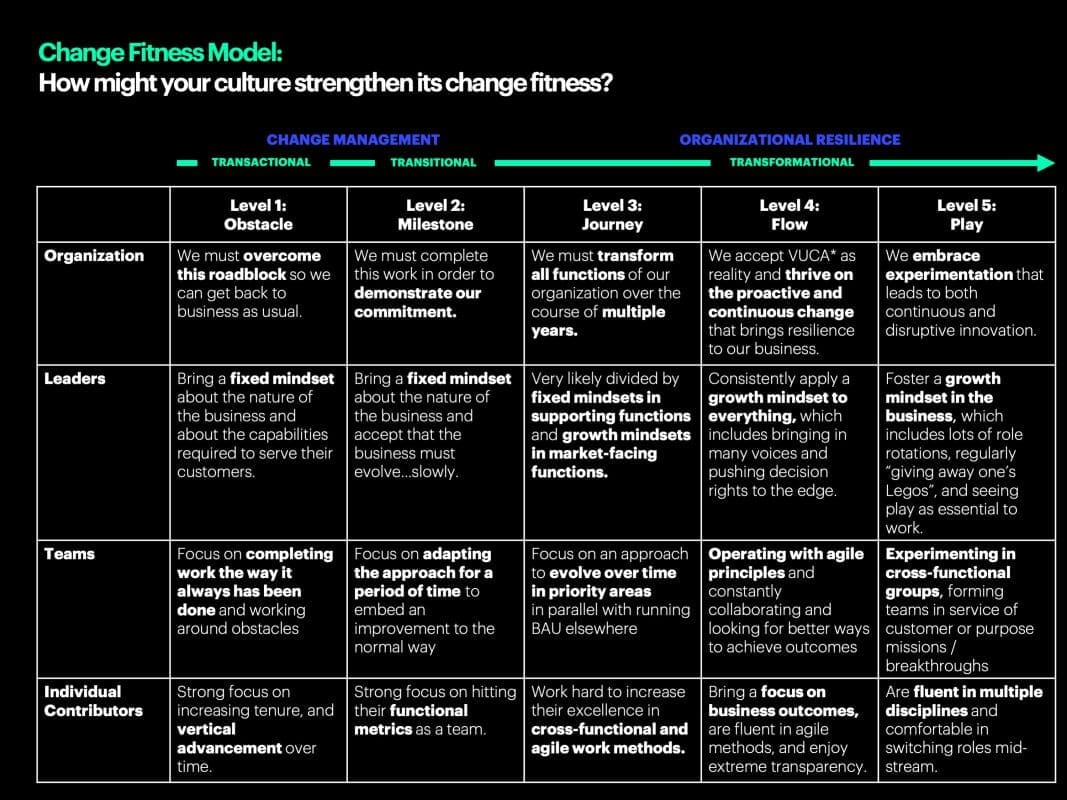
Over the last five years, our transformation practices have begun to crystallize into specific behaviors, methods, tools, skills and models. And those, in turn, have yielded the insight that our human metaphor for the organization extends to address the issue of embracing continuous change as a way of life. Prophet’s Change Fitness Model is a way of describing five connected and ascending levels of capability for individuals, teams, leaders and organizations to thrive throughout ongoing transformation.
Level 1 is where we view the world with a fixed mindset and change is viewed as an obstacle to be overcome.
Level 2 is where things begin to be framed slightly more positively and change is a milestone to be achieved and celebrated. However, our worldview still tends to favor a return to a steady state afterward.
It is only at Level 3 that we begin to enter the world of transformational change and the traditional tools necessarily begin to fray. Change is now a journey, often one spanning several years, with many cross-functional, cross-organizational and enterprise milestones to be achieved and value to be measured. Level 3 is where our mindset, individually and collectively, must truly shift to one of growth and abundance. Change is exciting because it leads transformation into something better: a better business model, operating model, and often culture.
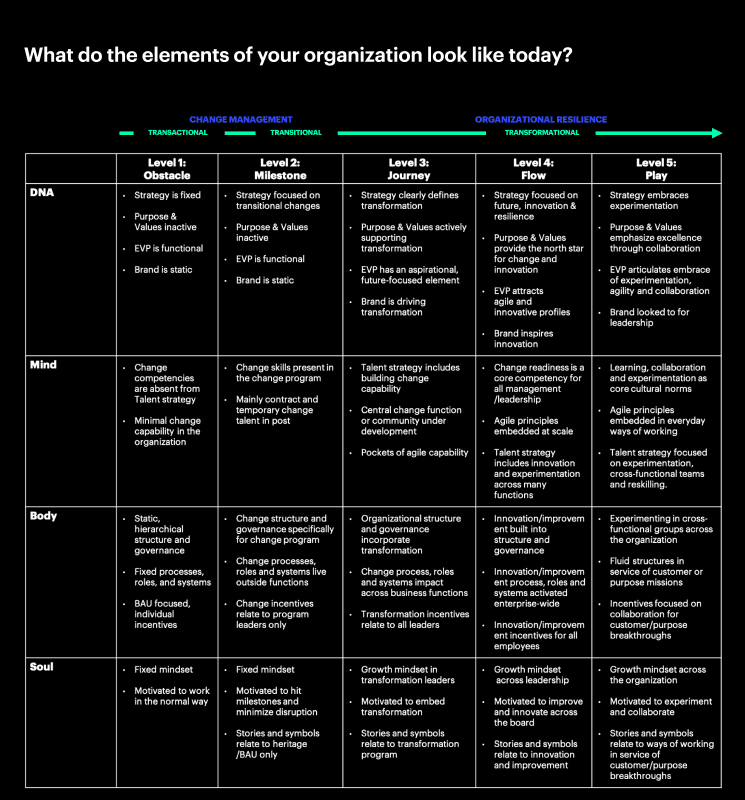
Level 3 is where Prophet often meets our most significant engagements. Client organizations recognize the need for changes to their DNA and as a result, all the organizational components of Body, Mind and Soul must evolve as well. Our desire with these clients is to leave them better than we found them – at Level 4. And therefore, we seek to design and manage the program such that the pace of change tilts, bringing as many of the colleagues into a state of flow as possible. This means moving just enough pieces at once so that everyone is working at the height of their competence, but not to push efforts so fast that people feel burned out.
Ultimately, we believe organizations that learn to thrive on change and embrace a growth mindset eventually find their way to Level 5 – a state of play where transformation is a sport. It’s an opportunity to find yet more ways to excel, individually and collectively.
Now that we are seeing the world through the lens of the Change Fitness Model, we are more able to quickly diagnose needs with our prospective clients. A handful of probing questions – easily inferable from the chart below – quickly reveal where the organization stands today and suggest the kinds of work that could be helpful to build change muscle and resilience for the transformations to come.
As you look at your organization today, consider the descriptions in each row. Which seems to most accurately describe you as a leader? Which best characterizes how your team stands currently? What about your organization as a whole?
As you look forward to the rest of 2021 and beyond, a few minutes of consideration will likely reveal some important opportunities where your organization should develop increased change fitness. What actions might serve you best?
If you want to learn more about how you might increase your organization’s change fitness and build long-term resilience, then contact our Organization & Culture practice today.
Three Ways Financial Services Companies Can Help Advisors Win in the Meme-Stock Age
Who cares if it’s trendy? Meeting digitally-driven new investors in their favorite channels can help brands win fans.
Some people – including the co-founder of Reddit – say that the tsunami of new investors snapping up shares of GameStop, Clover Health and AMC amounts to a “bottom-up revolution.”
Maybe. We certainly agree that the meme-stock movement, the viral stock surge of GameStop, AMC, and others in the first part of 2021, means new and old types of consumers are looking for financial advice in new places. The pandemic-induced shift to virtual interactions made consumers open to new channels for receiving advice. As we look beyond the pandemic, and advisors need to find ways to establish credibility and win trust.
These digitally-driven customers represent enormous growth possibilities if served in the right way. For companies and advisors, this requires agility in responding to market changes and commitment to cohesive omnichannel experiences, especially when it comes to onboarding clients.
Companies that don’t adapt fast enough or don’t support their financial advisors with the right tools are pushed out of consideration. A recent study of more than 250 financial planners finds that 77% of advisors have lost business because they did not have the right technology to interact with customers. In fact, these advisors reported losing an average of 20% of book value as a result.
Redefining Target Markets
First, it’s time to ditch the negative “Reddit bro” and “FinTok” stereotypes. Yes, there’s plenty of over-the-top gambling going on in social media and some genuinely terrible investing advice. However meme-stock investors aren’t just young kids investing pizza money. In fact, meme-stock investors represented a major slice of America. A Yahoo Finance-Harris Poll found that in January 2021 – the height of the GameStop saga – 28% of American adults had purchased shares of viral stock that month. Nearly half of those people invested more than $250 and almost 17% were more than 45 years old.
But even before that, we saw massive increases in the demand for digital financial advice. The pandemic served as a financial reset for many, and consumers began reaching out to advisors with greater urgency. One study found that 67% of people said the pandemic had been a wake-up call for them to examine their finances.
“A recent study of more than 250 financial planners finds that 77% of advisors have lost business because they did not have the right technology to interact with customers.”
Another study from Nationwide Financial, which surveyed more than 2,000 people, found that by the first week in April of 2020, 24% said the pandemic had caused them to contact a financial adviser for the first time. It also reported that 80% of respondents felt they had lost control of their ability to manage their investments and finances.
Fast forward eight months to the GameStop frenzy. “How to invest in stocks” surged in Google search rankings, proving how quickly people moved from feeling helpless to digital derring-do. These people, who are adults, want answers, with 73% of viral-stock investors saying they have researched the U.S. financial system and 20% consulting a financial advisor before buying.
“Since then, some advisors and firms proactively publish content with a clear point-of-view on how to navigate meme-stock fluctuations. They adjust their content strategy to anticipate the flood of customer questions and to educate and prevent hasty decisions.
The best of both fintech and legacy companies are stepping up their tech investments. They understand the elevated consumer demands for frequency and channel of advisor interactions. Facet Wealth, for instance, makes its sign-up process straightforward. Once a prospect becomes a client, the dashboard makes it easy for them to engage with their finances from one place and schedule an appointment with their advisor.
It’s smart since 53% of millennials and 29% of baby boomers say they would switch advisors if they can’t use satisfactory technology.
Three Ways Financial Services Brands Can Gain Relevance in the Meme Stock Era
Survey financial advisors to understand what support they need to proactively initiate conversations about topics like viral stock options and to explore different channels by which to interact with customers.
Create a market sensing function to respond to market changes. And compile a centralized point-of-view on hot topics, offering a range of responses to support advisors.
Incorporate a regular placeholder within the marketing content calendar for market commentary to proactively address market changes and reinforce brand credibility.
Firms that win in the market use digital-first thinking to create agile experiences and proactive communications. They’re stepping away from dated ideas about who invests and why. These innovators are working to establish trust and meet customers where they are right now. They’re striving to support remote customer-advisor relationships that meet and exceed technology table stakes. In doing so, they’re building trust and relevance in the era of digital-first finance.
Want to get your organization fit for the future working landscape?
The past year has shown the critical capacity organizations need to build for change. The COVID-19 crisis accelerated many organizations’ re-examination of their ways of working and cultural norms. It also introduced a profound new set of forces of organizational change, putting many organizations’ culture and resilience to the test.
To thrive today, companies need to evolve from traditional to transformational change management across all levels of the organization in order to support long-term growth and build resilience.
The latest research from our Organization & Culture practice looks beyond the self-evident insights of 2020 to propose a way forward for leaders driving transformation and how to make an organization fit for change.
This report provides deeper insights on:
The critical new forces of cultural change shifting the landscape and shaping transformation for years to come
A new change model that tracks an organization’s ability to transform across multiple measures
The three primary areas where leaders should invest to help their organizations become fit for the future working landscape
How to identify your organization’s fitness level and the kind of work needed to strengthen it for transformation
The connection between an organization’s change fitness level, its ability to take on transformation and positive financial outcomes
It’s the best of times to innovate. It’s the worst of times to stand still.
The COVID-19 pandemic has been a catalyst for innovation and accelerated change with many companies forced to adapt business models and develop, deliver and scale new products, services and processes rapidly in order to remain relevant and sustain competitive advantage. Innovation can’t stop now. The future success of any company depends on its ability to continually innovate.
In this report, our Experience & Innovation practice outlines what’s required for a company to become a serial innovator, one that can not only survive but also thrive in our disruptive world.
Read this report to learn:
Why innovation is imperative now
The seven traits of a truly innovative company – impacting how (and how well) an organization sets itself up to innovate
Where your company sits on our Innovation Grading Model
How to be an enlightened innovator for the times ahead
Prophet’s Pro-Bono Journey With the LGBTQ+ Civil Rights Movement – A 20-Year Journey
Stories–understanding how legal issues impacted the everyday lives of people–turned the tide.
In the spring of 2000, I was approached by a colleague and friend to consider doing some pro-bono work for a small nonprofit with a critical strategy project. I was caught off guard. Our company, relaunched as Prophet Brand in 1999, was in the middle of its first growth surge, powered by David Aaker’s global brand guru status and the Dot.com investment boom. As a young, fast-growing firm, we were having a hard time establishing our culture, growing our team, defining our methodologies and driving high-quality work for paying clients. I struggled to envision how we would be able to free up the time and resources to also do high-quality work for pro-bono clients. My mid-30’s CEO mindset sensed that this was a luxury we couldn’t afford. Luckily for me, this Prophet colleague – Cathy Halligan – didn’t give up. She was determined to help me see why doing this kind of work was consistent with our aspiration as a firm and my hopes as a leader.
The nonprofit organization had a passionate leadership team that enabled some of the only visible wins for its movement in the United States. But, it found itself at a crossroads. Its talented executive director, team and board needed to figure out how to capitalize on its strengths and build a story that would help power the organization and its resources to more transformational impact. As Cathy Halligan consistently argued, Prophet circa 2000 had exactly the right mix of expertise and perspective to help solve this problem. If we weren’t ready to generously apply our time and talents to helping change leaders answer their hardest brand and narrative questions, what were we here for?
Her persuasive words and spirit have stayed with me to this day. Cathy’s determined efforts led us to shape our first pro-bono project in the fall of 2000 with The Lambda Legal Defense and Education Fund. It was the first of what’s become a series of Prophet pro-bono efforts to support a range of US organizations committed to advancing LGBTQ+ civil rights in the United States and globally.
Starting Our Work With LGBTQ+ Civil Rights
It may be hard to remember the state of the LGBTQ+ civil rights movement at the turn of the century. Bill Clinton had signed the Defense of Marriage Act into law in 1996, stating that marriage could only be between one man and one woman. At the state level, many anti-LGBTQ+ laws and ballot measures were getting passed left, right and center. Also, the AIDS crisis was still roiling the broader LGBTQ+ community. Times felt dark.
The single bright spot of progress was in the courts, where courageous citizens and their lawyers were bringing legal challenges to some of the most oppressive anti-LGBT laws. Lambda Legal and some of its allies were the driving forces behind this strategy. They would identify the most egregious laws that allowed for discrimination in employment, housing, healthcare, education, etc., or that still criminalized consensual LGBTQ+ relationship behavior between consenting adults, find plaintiffs who would sue the government asserting that these laws were unconstitutional, and then provide the plaintiffs with all the legal support needed to execute the cases. Through this strategy, Lambda Legal helped win the first HIV/AIDS discrimination case in the 1980s, won a historical legal precedent holding schools accountable for harassment and violence against LGBTQ+ students in the 1990s and achieved broad progress on so many other legal battlefields.
But the organization was made up of lawyers using lawyer-speak in all their communications, was chronically under-funded and was not well-known or understood even within the LGBTQ+ community, let alone the broader public. Our job was to help them land on an aspirational purpose, brand strategy, narrative and roadmap that would help elevate its impact, enable transformative change, dramatically increase its donor base and elevate its reputation among the broader movement.
We unlocked a critical insight – most people didn’t understand how the outcomes of Lambda’s work would impact the everyday lives of LGBTQ+ people, families and communities. We needed to help them turn their legal strategies into human stories told through the faces and voices of those directly affected. We needed to help them develop a storyline that up-leveled the context of their work – to help people understand how making progress through the courts was an essential building block to advance the movement’s broader civil rights agenda. The selected strategy created a second major plank for the organization – a commitment to investing in dialogue-shaping education, as well as precedent-setting litigation in the pursuit of social justice. The way in which it was embraced and executed fundamentally changed the character and trajectory of Lambda Legal, elevating its influence, dramatically increasing its fundraising prowess and growing its capacity and resources to drive transformative change.
Adding on to the Movement
Later that decade, we found another organization in the LGBTQ+ movement – Equality California – a trailblazer with charismatic leadership and an excellent track record of advancing the most comprehensive set LGBTQ+ legal protections passed by elected officials and politicians anywhere in the United States. Prophet aligned itself to support Equality California when the organization and the movement were at an incredibly low point. Many were blaming the organization for losing the “No on Prop 8” anti-gay marriage California ballot initiative in the 2008 election, in effect ripping away hard-earned marriage rights and putting the legal status of 18,000 same-sex marriages from the previous 4 months in limbo.
Equality California had to learn to acknowledge the mistakes with grace and humility while finding a new way forward. We dug deep to unlock a new set of insights across an array of stakeholders and learned that there was an opportunity to reposition the organization as a champion for full equality for LGBTQ+ Californians, not just same-sex marriage. Getting legal rights was not enough if it didn’t lead to a pervasive change in the “lived” experiences of LGBTQ+ citizens across all dimensions of their lives. And that marriage, while important, was only one of the vital steps in this path to full “lived’ equality.
This kicked off what turned out to be a 10-year plus relationship with leadership at Equality California. Over the course of our partnership, we found many ways to support its leaders and its mission. For example, we helped provide detailed insights work to understand how to shift perceptions of potential allies and voters as LGBTQ+ civil rights were tested through ballot propositions. We also helped with donor growth strategies and volunteer mobilization campaigns.
In 2017 and 2018, we helped the next generation of leaders unlock a new purpose and story for Equality California after the marriage question had been settled. What should “full and lasting” equality look like? There were still dramatic disparities in the health and wellbeing of the community and continuous attacks on the gains that had been achieved. How could Equality California become a movement builder, intersectional and inclusive in nature, and fit for a new era of digital activism, grassroots energy and urgent necessity? We helped them answer these questions, and then retooled the brand along with its look and feel to reflect the new strategy. “Until the work is done” became the phrase that captured the spirit and the intention of this team.
Celebrating 20 Years of Giving Back
While these stories spotlight the bookends of 20 years’ worth of pro-bono energy and commitment to this movement, there have been many other organizations and themes that Prophet teams have touched along the way. We’ve rebranded a groundbreaking leader in its drive to create safe, respectful and healthy K-12 schools for LGBTQ+ students, helped to enrich stories for teams working to redefine LGBTQ+ images in the media and supported leaders tackling the tough issue of LGBTQ+ youth suicide rates and homelessness. No matter what the organization or the issues, committed Propheteers stepped up to the table with energy, expertise, humility and compassion to deconstruct thorny questions, unlock new insights and co-create positive strategies, programs, identities and narratives to move the work forward.
As we launch the next chapter of Prophet Impact, with three focus areas – equality, social mobility and sustainability – my hope is that we can build upon our journey within the LGBTQ+ movement, and the organizations and grassroots advocates who power it. Prophet has grown in scope and scale now, with a deeper set of capabilities to support bold organizations aspiring to drive transformative change. Our experience has taught us that it is only with sustained effort that we can hope to support these movements and organizations in our shared desire to drive enduring, meaningful change. And that we must be prepared to continue to invest, even in the face of demoralizing setbacks, fierce resistance and uneven progress.
I am grateful for Cathy Halligan’s persistence more than 20 years ago, and for all the energy that so many creative, strategic, committed teammates have put into this body of work over the years. So much effort and so much heart have been poured into our collaboration with these trailblazing organizations. Our talents elevate the impact of organizations and movements on the ground. We see firsthand the struggles and challenges these movements face in their efforts to drive systemic change. But rather than feel daunted by these realities, we bring even more determination and optimistic energy to the work at hand. We’re enriched and strengthened as professionals and humans through our shared work together – we get way more than we give.
“No matter what the organization or the issues, committed Propheteers stepped up to the table with energy, expertise, humility and compassion to deconstruct thorny questions, unlock new insights and co-create positive strategies, programs, identities and narratives to move the work forward.”
Happy Pride. Happy 20th anniversary, Prophet Impact. Here’s to a new generation of leaders and the next 20 years of effort focused on helping to build a healthier, more compassionate and more just world.
This start-up’s fast moves, quick changes and hot drops offer lessons for much bigger brands.
Hill House Home (HHH) and its internet-famous Nap Dress have an impressive news presence for just a six-person company founded in 2016. So, how did the founder Nell Diamond generate so much publicity? The company has followed the right strategy playbook to leverage organic content from a community of loyal customers to spark demand for the brand.
Context is Key
Some companies found accidental success during the pandemic, while others capitalized on the new opportunities. Hill House Home did both. Though the brand launched the Nap Dresses in 2019 and trademarked the name in January 2020, the cutesy name became a masterstroke of branding when the divisions between work and home were erased. Rather than relying on the good fortune of newfound popularity, the brand doubled down on the production of dresses and embraced its new reputation as an apparel, not linen company, and it worked. The five-year-old brand had 275% growth in 2020, with the Nap Dress category increasing 1120%. The lesson here is in order for brands to stay relentlessly relevant, they need to capitalize on the quickly changing world around us.
Unafraid to Refocus
Hill House Home started with bed linens as its primary product offering, but the founder always had a bigger vision for the company beyond bed sheets. When the Nap Dress quickly outpaced other categories, Diamond wasn’t afraid to lean into the organic PR customers enabled and spurred even more product demand. Although Diamond is quick to point out that all categories experienced triple-digit growth during the pandemic, the Nap Dress category quickly outpaced all others. It was so popular, likely due to its ruched design, that flatters many body types and professional yet comfortable look, perfect for working from home. HHH allowed the customer voice to guide which products sat at the forefront of the brand. Other DTC companies can learn from HHH’s example and avoid becoming too attached to their product vision to accelerate growth in products that show the most potential.
Drop It Like It’s Hot
The other half of the production equation that has worked well for HHH is selling products using the “drop” model — an industry practice that goes against the usual model of releasing products on a rigid calendar 4-6 times a year. The brand produces limited runs of its products and drops them at random times throughout the year. This creates buzz and excitement more reminiscent of a streetwear brand than a Victorian-style dress brand. Online, women talk about their Nap Dresses the same way sneakerheads do about the latest Air Jordans.
“The cutesy name became a masterstroke of branding when the divisions between work and home were erased.”
Diamond’s vision from the start was to create luxury products at a non-luxury price point, and her production timeline helps boost the brand’s luxury feel. Although the dresses are not made of luxury materials, simply pulling the strings of supply and demand creates an exclusive aura. Other DTC brands similarly can capitalize on the scarcity effect, making limited edition products that are automatically associated with exclusivity.
Content is King
Hill House Home knows that sharing beautiful marketing images and user-generated content naturally gets people talking. The brand maintains an active blog filled with stories from the founder and has more than 100k followers on Instagram. The company shares a mix of photos with of-the-moment influencers, UGC and non-product photos that come together so seamlessly that it becomes difficult to tell which photos were taken by the company and which by its fans. The best CEOs know that loyal customers are their best marketers, and that content and community can fuel each other, generating more and more excitement around the brand.
The brand vision is aspirational and authentic. HHH describes itself as a “lifestyle brand that brings beauty and joy to everyday rituals” which it delivers through high-quality accoutrements such as sheets and bathrobes. Although customers may not attend an outdoor picnic complete with china and tea sandwiches, as many photos suggest, a customer may realistically wear a Nap Dress on a walk outside with friends. All of this is a credit to Nell Diamond’s strong conviction in her own personal aesthetic. The product line and color offerings are tightly curated and adhere to the brand’s ultra-feminine image. It would have been easy to create a Nap Dress in every color and try to appeal to everybody, but Diamond stuck to one unified creative vision.
Hill House Home is a model for any DTC brand looking to create the right mix of content, commerce, and community. Here are the four key takeaways for other DTC brands:
Content: Recruit customers to market your product for you and allow them to feel part of the brand by championing their content
Commerce: Adapt when necessary and let your customer guide you instead of trying to guide your customer
Community: Create buzz around product launches through innovative production models and the scarcity effect,
Purpose: No brand can be relentlessly relevant without having a strong sense of their own brand vision and purpose
Prophet helps companies establish a DTC business mindset and approach for customer-centric, performance-based growth activities, fostering direct consumer relationships to achieve the benefits that unfold. Prophet also helps digitally native companies reach next-level growth in brand and consumer engagement, with a focus on profitability and long-term sustainability.
Let’s chat how your brand can reach and engage potential customers directly to maximize growth.
How Transformation Can Help Insurers Win With Rapidly Evolving Customers
Insurance brands must find new partners, focus on value-added services and transform their business model.
Insurance customers’ needs are rapidly changing, but the industry is not. With insurtech companies – like Hippo, Root and Lemonade – overwhelming the market, longstanding insurance leaders can’t shake organizational norms and industry standards, preventing them from connecting with digitally native consumers ahead of new disruptors.
We often hear our insurance clients ask us, “How can I best prepare for the future needs of our customers?”
Insurers are ready to mobilize their transformation efforts to become more customer-centric businesses, but they often implement new technologies or point solutions without a clearly defined digital strategy to guide their efforts. Without a holistic understanding of digital transformation (which goes well beyond technology implementation), insurance companies miss the mark with their customers. They struggle to find the true sweet spot between consumer privacy and personalization – while providing the right level of transparency and autonomy. Not to mention, customer expectations are changing each day making it extremely difficult for legacy insurers to keep up with their demands.
“Without a holistic understanding of digital transformation insurance companies miss the mark with their customers.”
Prophet’s new research report, The Insurance Customer of the Future, was written to highlight the most pertinent market trends set to impact the insurance industry in the next decade and explains how these trends are changing the relationship between customers and their insurance providers.
We centered the research around “Jamie,” an insurance customer living in 2030. By understanding and anticipating the generational trends and technological possibilities that will shape Jamie’s environment, insurers can make the right transformation moves to win Jamie’s – and her peers – business in the future.
But it won’t be easy to become the kind of insurance company Jamie wants to choose. While battling new entrants and advancements in technology, insurers need to keep their ever-evolving customers’ needs, values and expectations at the center of their transformation agenda.
Here’s how insurers need to transform their businesses over the next decade:
Go beyond personalization
Find partners to build holistic ecosystems
Transform business models to serve next-generation customers
Double down on capital-light, value-added services
Reimagine the mind, body and soul of the organization
Plain and simple: the insurance industry is ripe for disruption. Insurers will either be disrupted by insurtech or be the disruptors. By prioritizing these five core areas as a part of their transformation agendas, insurers will cater to their future customers and achieve the disruptive growth they crave. The report gives insurance leaders the research, insights and ‘action items’ needed to capture the future market and create a new standard for customer experience within the industry. Read the report today.
Will Your Organization Be Left Behind as Consumer Healthcare Transforms?
Offer more value, and be willing to meet your customers in the messy middle.
It’s no surprise that the pandemic has changed the way consumers interact with healthcare. We see it in the proliferation of virtual care across the care continuum, from acute to chronic, episodic and now primary and preventive care. We see it in the embrace of new digital devices and programs designed to monitor chronic conditions at home. And we see it in the uptake of digital pharmacy services that promise ever-faster delivery times and simple, easier, prescription transfers. These shifting consumer need states are forcing companies to action.
Those that will win with consumers in the post-pandemic age are the ones that will accelerate innovation as they reimagine their business models – integrating and re-configuring assets around emergent consumer use cases.
Here are three healthcare business design imperatives for making markets and capturing post-pandemic value through big, bold and transformative moves:
1) Trade the value chain for value exchange
The old news? Payers, providers, pharmaceuticals and MedTech companies once controlled discrete pieces of the value chain. Today, they are operating as collaborators and competitors alongside one another – with non-healthcare entrants (financial services and technology companies) also looking for a piece of the pie.
The new news? “Who does what” doesn’t matter to consumers, instead they value the promise of an integrated approach to health. Whether you build, buy or partner, leaning into the discomfort of superseding the value chain can lead to transformative, new offers. Teladoc Health is a great example of a company that bet big on the idea that virtual primary care is here to stay. It built the Primary360 platform as an entryway to take advantage of its unique portfolio of assets from acute and episodic care (Teladoc Health) to chronic care (Livongo), behavioral health (BetterHelp), and more.
Alternatively, a company that took the partnership route is Cigna. They joined forces with Oscar Health to create an integrated, easily navigable approach to health plans for small businesses. By bringing together Cigna’s provider network and Oscar’s technology platform, they’ve created a relevant solution for the small business population that meets their needs.
2) Meet consumers in the messy middle
If transcending historical value chains is one way to play, another is to exploit the current outages in the value chain and become the middleware that bridges a care gap. Emerging care gaps could include areas like post-acute care, kidney care, pre-and post-Cancer treatment, and health conditions at the intersection of health and wellness (e.g. sleep, behavioral health).
Take recently acquired startup PatientPing, which focuses on the post-acute care space. Through its technology platform, the company can coordinate care by “pinging” healthcare providers when their patients are treated at other facilities. For instance, a provider could be notified in real-time when a patient is transferred from a nursing home to another outpatient setting. Now, with its acquisition by Appriss Health, close to 1 million healthcare professionals across all 50 states can be connected across care settings.
“Those that will win with consumers in the post-pandemic age are the ones that will accelerate innovation as they reimagine their business models.”
In another direction, Alula Health is a startup tackling the “messy middle” of the physical, emotional and financial changes involved with a cancer diagnosis and treatment process. Alula’s platform focuses on patients and their caregivers. They provide organizational tools such as spreadsheets and calendars to ease treatment coordination and a curated list of cancer-specific shopping items (e.g. post-surgery bras and robes with extra room for prostheses or drain management, “Travel to Treatment” bundles with pill organizers, sickness bags, sanitizing wipes, and face masks).
A final example is Talkspace, a platform aimed to make behavioral therapy more accessible. In a world where the dominant method of therapy was administered through expensive 1:1 sessions, Talkspace broke the prevailing mode of thinking and dispensed therapy through bite-sized, text-based interactions – a new modality for meeting the needs of those struggling with mental health challenges discreetly and without confining therapy to a set date/time. In doing so, they normalized therapy for a whole new, addressable market and have since expanded to partner with employers to offer its service as part of workplace benefits.
3) If it doesn’t have their name written on it, it’s not for them
The third hack for making markets through transformation is to address the unmet needs of unique consumer populations. Traditional provider-driven healthcare focuses on triage to identify a treatment path for every patient. But flipping this approach on its head allows for a deeper level of focus, prioritizing time, resources and expenses to solve the needs of one population group more effectively than a general solution.
Segment-specific opportunities are everywhere and can include:
Those with a stigmatized condition
An underserved population with unique needs
An overly generalized population.
A good example of the first opportunity is Ro, self-styled as “the patient company”. Ro started by providing telemedicine and prescriptions for erectile dysfunction via its Roman brand, but gradually expanded to include other medical challenges like smoking cessation (via zero) and weight management (via Plenity). With the technology infrastructure, brand architecture and consumer base established, the company can pursue additional disease states with room for growth.
An example of the second segment-specific opportunity is Included Health, newly acquired by telemedicine provider Grand Rounds / Doctor on Demand. Included Health focuses on the needs of the LGBTQ+ community, who have all too often faced challenges finding culturally competent and affirming providers. The company works with employers to provide benefits to individuals that help them connect to physical care providers, mental care providers, community support and gender-affirming care.
The third-dimension type of play is to identify an overly generalized population – and the field of women’s health is a great example. While some companies have developed “female” healthcare brands, women have different needs by life stage. The spectrum of startups in today’s women’s health space demonstrates different focus areas such as reproductive/sexual health, pregnancy and postpartum, as well as menopause. Within each focus area, individual companies target specific challenges. For example within the category of reproductive/ sexual health, some companies focus on areas such as fertility (Modern Fertility, recently acquired by Ro), cycle tracking (Glow), birth control (Nurx) and more.
The pandemic has created new and exciting consumer use cases. Uncommon growth will only be captured through transformative moves that reconfigure assets and ecosystems. To capture this growth, companies can deploy one or more of the three design imperatives. Incrementalism is a direct path to low growth and missed opportunities, and capturing uncommon growth will require high-conviction leaders, cultural resilience and organizational agility. To help companies forge a path to uncommon growth, Prophet approaches each organization as though it were an individual – with a unique DNA, Body, Mind, and Soul.
The pandemic accelerated the integration between marketing and sales – and it’s never going back to the way it was. Leaders in healthcare and life sciences will need to embrace a marketing and sales strategy that is both digital and collaborative to reach business goals. The reality is that if organizations fail to transform their go-to-market approach they will be at risk of losing customers.
Transforming Healthcare: The State of Digital Marketing & Selling in Life Sciences identifies and quantifies the salient trends and key practices used by top companies today. Based on data from Altimeter’s research for The 2020 State of Digital Marketing and The 2020 State of Digital Selling, this industry-specific report provides insights for healthcare and life sciences leaders looking to strengthen their marketing and sales functions and jumpstart a new era of uncommon growth.
Read this report to gain deeper insights on:
The top priorities of marketing and sales teams in healthcare and life sciences today
The biggest obstacles organizations are facing in terms of digital collaboration and performance
Marketing and sales leaders’ candid observations of what their teams are doing well – and how they need to do better
Four key recommendations for marketing and sales teams seeking significant performance gains
19 Ways COVID-19 Is Shaping the Future of Innovation
It’s not all masks and sanitizers. The “coronocoaster” is spawning many valuable new ideas.
Necessity is the mother of innovation. And the ‘coronacoaster’ we’ve been riding has given birth to blue Skype thinking as businesses have stepped up and strapped in. As always, the winners have been the most innovative in responding to changing market dynamics and consumer needs – putting momentum behind ideas that create the most sales energy, scaling production when the time is right, demonstrating cultural resilience in sometimes plummeting conditions and showing agility through the loop-de-loops of competition.
As we step off the ‘coronacoaster’ and onto (what we hope is) a new Roaring 2020s joyride, it’s critical that businesses innovate in ways that leverage how echoes of the pandemic will remain endemic in the future. The post-demic perspectives we’ve provided aren’t necessarily prophecies, but they are informed by recent Prophet thinking (and doing). Some are old trends that have been potentiated by the virus. Others are new to the scene as a result of the virus.
So, pour yourself a stiff quarantini and let’s have a malaproper look at nineteen ways COVID-19 is shaping the future of innovation.
1. Birth of Distance
Space has always been a luxury (especially in service categories), but social distancing has made it a necessity. Expect new environmental innovations that create psychological space as well as physical distance. Expect more in the way of exclusive boxes at events, private dining rooms in restaurants, etc. and other innovations so there is less ‘stranger danger’ from others in one’s immanent domain.
2. Heal.thy
There’s nothing like a global disease outbreak to get people to think more about ‘thy’ own health. Expect to see more innovation that plays to real or perceived health and healing from angles ranging from ancient homeopathic wisdom to lab-based neutraceuticals. Even naughty categories like alcoholic beverages are tapping into this trend through watered-down alt liquids and lower proof points that feel healthier to consumers.
3. @Home
People have been increasing the amount of time they’ve been spending in their homes for some time now (Faith Popcorn coined the term ‘cocooning’ 40 years ago), but the pandemic has created a step-change in making more bodies homebodies. People want to continue to feel at home (especially in times of crisis), so expect to see more demand for home comfort innovations in the coming decade – creating a sense of ‘home sweet home’ instead of a feeling of house arrest.
4. Mask.aura
Masks were the fashion accessory of 2020 – and mascara was the beauty product of the year because eyes are visible above the mask. Think about other innovations that help consumers look (and feel) their best in times of potential lockdowns and coverups. What innovations can help consumers manage their self-presentation aura?
5. Ment.all
The stresses and strains of being locked up during lockdown are making all types of people more mindful of their mental health. We expect more neurons to fire in this direction as the decade progresses. Innovations that help people manage their day-to-day mental health and/or take their peak performance to a limitless level are a no-brainer. People are going mental for apps, like Happify, to train their brains for positivity.
6. Mod.u.larity
Companies and consumers alike need an innovative way to deal with public policy capriciousness. Modularity is part of an ever-adapting answer. Goods and services that serve us well should have the option of being switched on and off and/or sized up and down on-demand. Driving less today? Your insurance bill stays in first gear. More people in your business tomorrow? Your cleaning service rolls in harder and heavier.
7. Pan.skilling
The pandemic has required companies and consumers to upskill and reskill in a panoply of ways. The next generation of innovators will be pan-skilled in a way that flexes with agility. We expect new forms of learning innovation to help organizations and individuals to develop these pan-skills.
8. Part.icipation
Many companies have experienced mixed results with highly collaborative innovation approaches. We are consistently seeing more effective results by focusing collaborative participation on the most important parts of an innovation process instead of dragging everyone through the end-to-end journey. Think about it as a ‘minimum viable participation’ model to accompany ‘minimum viable product’ design thinking.
9. Phygital
Phygital fuses the best of the physical world with the best of the digital world. More advanced phygital experiences are increasingly being demanded as a result of our enhanced sophistication with the digital world under lockdown. The best phygital innovations deliver the 3Is — immediacy, immersion and interaction. The PS5 is becoming more phygital through the augmented haptics it delivers while a gamer is immersed in a digital world. The Nike flagship store in NYC is a phygital temple designed to navigate with your phone – If you like something you see on a mannequin, just scan it and someone runs it over it to you. When it comes to phygital innovation, just do it.
10. Pivotry
To ensure a steady stream of dollars in a fluxed-up decade, businesses need to pivot on a dime. Be prepared to rapidly innovate into spaces that are close (enough) to your core competencies and are reachable with a sensible stretch. The way dine-in pivoted to take-out, fast fashion pivoted to masks and ‘essential retailers’ started selling dubious essentials that consumers couldn’t get (offline) elsewhere.
“It’s critical that businesses innovate in ways that leverage how echoes of the pandemic will remain endemic in the future.”
11. Pop-Ups
Prime urban real estate is increasingly un or under-occupied. Nature abhors a vacuum and landlords abhor an empty property. We expect more and more innovative business models (and office space for businesses) to be strutting down pop-up catwalks designed with quickie contracts for ephemeral experiences and short-term shops. Here today, there tomorrow.
12. Purposeful
Many people woke up during the pandemic and continue to respond well to products and services that demonstrate a full commitment to a purpose – from beauty brands that are more than skin deep to socialpreneurs transforming the meaning of BOGOF to ‘buy one, GIVE one free’. Consider how your innovations can cause a stir with consumers via genuine links with a positive cause.
13. Screen Standout
With more shopping moving from the real world to the virtual world and word of mouth becoming the word of thumb, screen stand out is becoming more important than shelf standout. Innovations need to be designed with colors, shapes and materials that look fab on the small screen. Hero beauty shots should eliminate the shopper marketing clutter seen on many packs these days (it isn’t legible on small screens anyway) leaving only ‘extraordinary elements’ and ‘incisive information’ on screen-optimized designs.
14. Sir.valence
Big Brother is increasingly accepted if he helps ensure everyone is complying for the collective good. Surveillance and compliance innovation is expected to be built into a host of people processing systems that provide ‘certain.fication certificates’ of a clean bill of health. This will mean a smoother flow of human capital around the world (or around the neighborhood). But Taylorist employers will be counting keystrokes as WFH becomes less of a WTF.
15. Social.learning
People are social animals and social networking marched on with a tech-tonic shift during the pandemic. To be successful in the future, all innovations need to learn how to take full advantage of social platforms. Ensure your innovations are leveraging the latest in social seduction and consummation technology to always be within thumbs reach of desire.
16. Surthrivalism
Survivalists must be feeling a bit smug about their readiness for the pandemic. Expect more innovation to help people go beyond surviving to thriving in case of further untoward world events. Our 21st Century Archie Bunkers may not all be building bunkers, but many will take smaller steps to honor the Boy Scout motto of ‘Be Prepared’.
17. Suss.tainability
Many inquisitive minds have spent their lockdown sussing out Netflix ecomentaries like Cowspiracy and have become even savvier about the importance of living sustainable lifestyles. Innovation in the coming decade needs a sustainability angle – from how it makes a material difference with the materials it uses (or doesn’t use) to the 411 on its value chain that doesn’t raise a 911 alarm.
18. Touch.less
People have become conditioned to taking a hands-off approach to their interactions with the outside world. This is because every touch means an opportunity to pick something up (or pass something on). Innovation should consider how to minimize the literal ‘touch-points’ in the user experience (especially for products that are shared or taken outside the home).
19. Tr.eats
The self-treat strategy to mood management has worked wonders during the pandemic. Many people have harnessed the new age wisdom of ‘do something nice for yourself every day’ and many of these mood (re)setting treats have been eats. New innovations that inexpensively help people give themselves a treat every day are expected to continue to go down a treat for the foreseeable future.
Interested in increasing your innovation capacity?
Prophet’s Experience & Innovation practice can help you to underpin a superior approach to innovation to help you realize your ambitions, get in touch here.
From “phygital” to “surthrivalism,” the pandemic continues to unleash powerful–and business-changing–new perspectives. Develop a strategy to find those with the most potential for your brands.