BLOG

How Effective Go-To-Market Strategies Unleash Brand-Demand Love

The third post in a series about integrating brand and demand marketing capabilities to win in a complex and dynamic landscape.

We think it’s time for brand and demand to fall in love. After all, they’ve long been attracted to each other’s strengths and can shore up the other’s shortcomings. When brand and demand build a strong, sustainable and mutually satisfying relationship of equals it lays a foundation for increased brand relevance and ultimately leads to uncommon growth.

Like the best marriages and strongest teams, a commitment defines what is possible. Bringing complementary skills together leads to greater mutual success. In talking to senior marketing executives, we heard passionate interest in unifying marketing at every level and taking an integrated, agile and data-driven approach.

If one were to equate a relationship’s declaration of commitment to a declaration of commitment between brand and demand marketing organizations, one may reference a marketing go-to-market (GTM) strategy. An effective GTM strategy provides strategic guidance for achieving an organization’s performance goals across key channels and disciplines. Despite the importance of this guidance, marketing organizations continue to face challenges in developing an integrated GTM strategy across their brand and demand teams, leading to misaligned activation plans which ultimately impact the efficacy of campaign efforts.

The Prophet-developed framework described below highlights the key components of effective go-to-market strategies that powerfully combine the best of brand and demand. They are important because achieving the appropriate brand-demand balance is a constantly moving target, meaning GTM strategies must be designed for flexibility and ongoing adjustment.

Key aspects of the CMO agenda – from audience strategy to creative and content – are central inputs to designing an effective brand and demand capability. Indeed, they are the vows by which brand and demand teams can build solid and successful relationships.

Marketing GTM Strategy Framework

There are six key areas to address as part of an integrated go-to-market strategy, each with its own set of requirements and implications for execution.

Brand StrategyBrand Position, Architecture, Key Messages, Voice and Expression

The brand strategy forms the core of the brand identity and should manifest itself clearly and consistently across brand and demand campaign initiatives.

Audience Value PropositionsHow to Win with Your Audiences

Audience value propositions describe the reasons audiences should have an interest in your brand, product or service.

Customer Data and InsightsWhat You Need to Know About Your Audiences

The successful utilization of customer information provides insights into their behavior and opportunities to convert across channels. Both brand and demand campaigns generate key customer insights which can be used to improve all campaigns (for example high-performing digital placements on the sports-oriented websites may provide a rationale for purchasing TV ads on sports networks and programming). Establish a pipeline for sharing customer data and insights between teams.

Pricing and DistributionHow and Where Audiences Will Find Brand, Product or Service

Understanding how customers can acquire your product or service, including the cost associated with that acquisition, is a key consideration. While demand channels can provide a direct path to conversion, the impact of brand channels shouldn’t be ignored.

Creative, Content and ChannelContent and Experiences Will Attract and Convert Audiences

Creative and content contain the messaging and imagery that will connect audiences to your brand, product or service. While creative formats vary across brand and demand channels, a holistic analysis of creative performance provides opportunities for greater insights and improved content creation.

Media & Channel CommunicationsHow, Where and When You Will Find and Engage Audiences

The touchpoints by which a customer can be reached and converted are important facets of any GTM strategy. An integrated model requires a mutual understanding of media campaign strategy and channel selection.

When developing a go-to-market strategy, it’s crucial to understand the implications for both brand and demand marketing teams. While each team is responsible for the successful deployment of campaign efforts against their respective channels, their measure of success should align against the overarching goals of the organizations as set forth by the GTM strategy. Organizations should avoid us vs. them mentality when crafting their organization and recommendations but instead account for the holistic impact of their recommendations against an aligned, cohesive goal for the organization at large.

Again, there is no set formula for effective brand-demand integration. Even if there was, it would fluctuate based on multiple market variables. That’s why these strategic principles are so powerful ­– they keep marketers pointed toward the “north stars” of business strategy and organizational purpose while enabling the necessary recalibration of campaigns, budget allocations and other levers that produce strong outcomes.

In our next post, we’ll look more closely at the financial and pocketbook implications of brand-demand love. Specifically, we’ll examine how:

  • To define shared goals
  • Set an investment agenda
  • Define smarter metrics for allocating budgets and tracking performance
  • Highlight how brand and demand can stop fighting about money

The new research report, “Brand and Demand: A Love Story” is here! Learn how today’s Brand and Demand Generation leaders are bringing their functions together to drive greater impact.
Download today!


FINAL THOUGHTS

Understanding where brand and demand might have shared foundational components, from brand strategy to creative and content distribution, can create shared value across marketing objectives and enable greater agility between brand and demand goals. This sort of synergistic and complementary relationship is what we mean when we talk about brand-demand love.

Get in touch today if you’d like to learn how to develop effective go-to-market strategies to unleash your company’s “Brand-Demand Love”.

WEBCAST

Webinar Replay: The 2022 Prophet Brand Relevance Index

Our research uncovers a new pattern of relevance, with brands appealing directly to the head and the heart

51 min

Prophet’s brand experts join executives from Sony and Teladoc Health to share the results of and discuss the most relevant brands in the seventh annual Prophet Brand Relevance Index® (BRI).

In this year’s Index, we asked more than 13,500 U.S. consumers about what brands are most relevant to their lives. Watch the webinar for insights on more than 293 brands across 27 categories.

Key Takeaways

  • A new pattern of relevance emerged. Brands are finding new and unforgettable ways to deliver experiences in the new normal by connecting to us as humans – appealing directly to the head and the heart.
  • Brand relevance = growth. The top 50 brands saw 133% more growth than the S&P 500.
  • How are top-ranked brands are winning with consumers? See which trends – from tapping into authentic expression to enabling self-care – consumers say they can’t imagine living without.

Panelists

The Prophet BRI serves as a roadmap for building relevance with consumers, the type of relevance that leads to business growth. Contact our team to learn how to apply the insights from the 2022 Index to your organization.

BLOG

Get Ahead in the Great Reprioritization

The best employer brands appeal to the heart and the head, with a clear purpose and distinct values.

For years, the workforce has accepted the dichotomy known as “work/life balance”: A fiction that these were two separate domains, compartmentalized from one another. Over the past two years, this illusion has been shattered. The pandemic collapsed domains of work, family, school, relaxation and wellness into a single reality. Knowledge workers were no longer able to easily compartmentalize their feelings about their work environments when there was no longer a physical separation for them to draw an imaginary line.  

Naturally, something had to give. For front-line “essential” workers, it was jobs that didn’t pay enough to compensate for the risk they assumed. For knowledge workers, it was employers who were inflexible; who were misaligned with their personal beliefs or values; or whose purpose no longer felt meaningful enough. Subsequently, large portions of the workforce recognized the illusion of work/life balance for what it was. And they recognized the truth hiding behind it: It’s ALL life. 

With that newfound clarity, a collective re-prioritization has been shifting the relationship and expectations people have with their jobs and their life. This has been variously named the Great Resignation, the Great Retirement and, perhaps most accurately in our view, the Great Reprioritization. Because in the end, that’s what is happening. The workforce is re-examining their priorities in relation to work and to employers. Now more than ever, there is a deep need to integrate personal values into the professional aspects of one’s life. But what is it that employees want?  

“We find that relentlessly relevant brands appeal to consumers simultaneously in the head and the heart—these brands, their products and experiences are pragmatic and innovative, personal and inspired.”

Prophet’s 2022 Brand Relevance Index® (BRI) and annual Organization & Culture research series, Catalysts, reveal a compelling story at the intersection of consumer brands and employee experiences. We find that relentlessly relevant brands appeal to consumers simultaneously in the head and the heart—these brands, their products and experiences are pragmatic and innovative, personal and inspired.  

We also find that the best employer brands are those that appeal to the heart and the head. These are organizations that have a clear purpose and values, and the ways of working, operating model, and training help employees accomplish their personal purposes. And it is the organizations appealing to employees’ hearts and heads that are coming out ahead in the face of the Great Reprioritization.  

The Head, Heart and Human-Centered Transformation Model™   

At Prophet, we describe the organization as a macrocosm of the individual. Its DNA includes its brand purpose and values; its Mind is comprised of its talent; its Body is the operating model that creates value; and its Soul arises out of the mindsets, behaviors, stories and symbols that generate belief in its DNA. Whether you wish to forge a heart or a head brand, you must think holistically about how best to align your firm’s DNA, Body, Mind and Soul to achieve the desired outcome. The greater the misalignments, the more room for a competitor to win and you to lose your customers…and your talent. 

Take USAA, for example, a Top 10 brand in this year’s BRI. USAA has relative strengths in the heart and head—namely in trust and dependability, meeting an important need and upholding beliefs and values that align with those of its consumers. In looking through the lens of Prophet’s Human-Centered Transformation Model™ we see USAA appeals to the heart and head by aligning the core elements of the organization.  

DNA 

For 99 years, USAA has been singularly focused on helping military families build financial security. Many employees seek out working for USAA to fulfill their desire to serve those who have served. Across sources such as Glassdoor, Indeed and Niche, employees remark how the company mission permeates operations and that employees are well taken care of “to encourage them to do the same for members.” As a result, 82% of employees at USAA say it is a great place to work compared to 57% of employees at a typical U.S.-based company according to Great Place to Work. 

Mind   

USAA has been a leader in digital member experience and was able to leverage such capabilities to keep members and employees safe throughout the pandemic. While doing so it also improved the efficacy of training. One example of this is USAA’s piloting the use of augmented reality-enabled glasses with field adjusters. This technology allows adjusters’ managers to see the damage without physically being present, thus eliminating dozens of hours of travel time for adjusters and enabling more efficient, practical training for new employees.  

More widely known might be the extensive and immersive training USAA employees go through which covers not only the fundamentals of their position but also helps employees understand the military culture. Prior to the pandemic, employees embarked on a boot camp-like training that simulates challenges military personnel experience regularly—such as eating meals-ready-to-eat (MREs) for lunch. The training is intended to give employees a better understanding of members’ perspectives and help them deliver more empathetic and effective service on the job. 

Body  

USAA has famously realigned the customer-facing components of the organization intuitively along the journey of its members. This effectively reduced the complexity and distraction of the full product portfolio to ensure that members are exposed to the products and bundles most relevant to their immediate needs.  

Internally, USAA is committed to leveraging technology to free up capacity for employees so they’re able to focus on service, not paperwork. For instance, USAA has deployed machine learning to digitize paper medical records and create materials for life insurance underwriting. The previous manual approach could take up to five days, whereas machine learning has reduced the time to just one day and has improved accuracy and capacity.  

Soul  

USAA’s commitment to immersing employees in the member experience is also embedded in the mindsets, behaviors, stories and rituals of the organization. One particular ritual is referred to as a “Mission Moment.” At the start of a meeting, an employee will share a story about a member. This story can be anything from their background, service, or interaction with USAA in moments that mattered along their journey. This seemingly simple story frames the rest of the meeting in a more member-centric mindset.  


FINAL THOUGHTS

More than ever, organizations need to understand what matters to consumers and employees in order to create experiences, products/services and jobs that appeal to and satisfy the head and the heart of their respective audiences. And doing so authentically will require a holistic approach across the core components of an organization’s ecosystem. So, what are you waiting for? 

Are you interested in better aligning the core elements of your organization to be more authentic for both your consumers and employees? Our brand and culture experts can help, reach out today and hear how we are helping clients just like you. 

BLOG

2022’s Relevance Report: What Brands Can Learn From Apple, Peloton, Spotify and Bose

This year’s index uncovers important shifts, including a need for self-care, DIY swagger and a little escapism.

Prophet just released the 2022 Brand Relevance Index® (BRI), and boy, has it changed the way we look at the constellation of brands that dominate our culture. Of course, relevance is always a moving target. But this year’s BRI–our seventh–proves how quickly brands can gain and lose favor. As we sifted through the latest findings, a new pattern of relevance emerged. The best brands are increasingly finding success in our new normal by the way they connect with us as humans.

Some go straight for the heart, resonating with us emotionally. Others appeal to the head, drawing us in with practical benefits. And an elite few do both. These relentlessly relevant all-stars take the top three spaces in our Index this year, led by Apple, coming in #1 for the seventh straight time. Peloton ranks #2, followed by Spotify at #3. While Peloton and Spotify have been in the news recently for a number of reasons, it’s clear that loyal consumers continue to stand by their favorite brands. Bose and Android come next, with Instant Pot, PlayStation, Fitbit, TED and USAA rounding out the top 10.

Certainly, many brands gained influence in our lives because of pandemic-related changes, as U.S. consumers continue to find new ways of working and learning. An astonishing 23 of the top 25, for instance, are brands primarily used in the home (Don’t worry, there are also encouraging signs that we’re headed out of hibernation, with travel and hospitality brands perking up nicely).

Our research is based on the same foundations we’ve used since we started dissecting relevance in 2015. We asked more than 13,500 U.S. consumers about four key drivers and attributes of relevance. But this year, we filtered these responses through two additional lenses. We asked, “How are brands appealing to the head?” and “How are brands speaking to the heart?” Through this approach, we uncovered important lessons for brands looking to become more indispensable to their audiences.

Brands that appeal primarily to our heads are the ultimate problems solvers. These rely on ruthless pragmatism and pervasive innovation, two core drivers of relevance. And they have become more relevant as the pandemic wears on, with consumers looking to become more self-reliant.

“The best brands are increasingly finding success in our new normal by the way they connect with us as humans.”

These brands are competent and dependable. Led by companies like Bose (#4), Instant Pot (#6) and KitchenAid (#18), they reassure us that they’ll keep life running smoothly, no matter what.

Next, we have the brands that speak to the heart. These are driven by customer obsession and distinctive inspiration. It’s the kind of passion that turns consumers into passionate evangelists. That can only happen by making sure each brand experience makes consumers feel good about themselves, whether drenching them in sweat, like Peloton, or filling them with smiles, like Pixar (#17).

Our relentlessly relevant all-stars do it all, pulling our heartstrings even as they shine in every aspect of execution. Think of how brands like Apple, Spotify, and Android connect us to our work and the world. These all-star brands help us fulfill our goals to find happiness and strength.

How Brands Can Increase Relevance

No matter where they landed on this year’s Index, we think any brand can get closer to their customers, following the trends we’ve uncovered. Some clear steps toward building more relevance:

Build tech that’s more human – Apple, Peloton, Spotify and Android prove that when tech is personalized and helps us connect human-to-human, it resonates. Whether we are communicating directly through messages and social media, joining a new community or discovering new voices, these brands give us the power to express ourselves through technology.

Enable self-care – In an anxious age, Calm, #12, the app for sleep and meditation, scored highest of all 293 brands we studied on the “Connects with me emotionally” ranking. Despite its production problems and falling revenues, Peloton continues to earn adoration because it makes people happy. And Fitbit provides a gentle push towards better health.

Back promises with performance – More time at home means people are closer to machinery all the time, with reliability becoming more important. (If it takes months to get our hands on a new appliance, who wants to fool around with something second-best?). Besides Instant Pot and KitchenAid, Dyson (#19), Whirlpool (#45) and Keurig (#34) also made impressive showings precisely because consumers see them as better than their competitors.

Encourage autonomy – Nothing feels as good as DIY confidence, whether air-frying a chicken or filing taxes. Financial brands did well as a result, including Afterpay (#11), a financing service for online transactions, TurboTax (#46) and Zelle (#39). Highly digital and customizable, these offerings put more control in the hands of the user with ease and reliability.

Make magic – People are still eager for brands they can access from home, even as the pandemic drags into its third year. They want to escape, and content creators made up a considerable portion of our top performers this year. Marvel (#14) and Pixar (#17) outpaced even Netflix (#29), coming in first and third respectively for the attribute “Makes me Happy.” Gaming platforms such as PlayStation (#7), Nintendo (#23), and Xbox (#35) also took on outsized importance in daily life.

Emphasize authenticity – Social and technology platforms that encouraged people to strut their stuff also did well. From Etsy (#24) and Pinterest (#41) to YouTube (#70) and TikTok (#144), watching people “Create” online–whether they’re dancing, knitting or interviewing Noodles the Pug–does more than entertain. These platforms democratize the way people can create, sharing joy and inspiration with others.


FINAL THOUGHTS

Whatever tomorrow brings, we can be sure that brands will play a huge role in our lives. To achieve uncommon growth, brands will have to provide a must-have service while delivering experiences that make us feel alive. What are the most relevant brands in your lives right now?

Want to learn more about how the most relevant brands are tapping into the head and heart of consumers? The Prophet BRI serves as a roadmap for building relevance with consumers. Contact our team to learn how to apply the insights from the 2022 Index to your organization.

BLOG

2022 Prophet Brand Relevance Index®

Prophet asked more than 13,500 consumers in the U.S. about the brands that matter most in their lives today. We measure their relationship to 293 brands in 27 categories, looking closely at 16 attributes. A new pattern of relevance emerged in this research: Brands are finding success in our new normal by connecting with us as humans—by appealing to the head and the heart.

“Brands are finding success in our new normal by connecting with us as humans—by appealing to the head and the heart.”

Download the Index.


BLOG

How Brand-Demand Love Wins Across the Marketing Lifecycle

The second post of a series about integrating brand and demand marketing capabilities to win in a complex and dynamic landscape, based on our conversations with CMOs across industries.

As we highlighted in the first post in our Brand-Demand Love series, we think it’s time for a more integrated and complementary relationship between brand and demand-gen marketing. Why? Because the current separation isn’t aligned to the dynamic purchase behaviors of consumers across an increasingly complex landscape. As Karla Davis, VP of Marketing at Ulta Beauty, told us:

“What is brand, and what is demand? That’s a little gray now.”

Karla Davis, VP of Marketing at Ulta Beauty

When accomplished senior marketers question the validity and usefulness of the traditional brand-demand paradigm – and many do – then surely, it’s time for a new model. After all, the effective coordination of brand and demand-gen activation strategies represents an integrated and agile marketing capability – the gold standard amongst marketing pros.

Feeling the Brand-Demand Love Across the Marketing Lifecycle

Brand and demand-gen activation cannot be viewed as separate or competing functions, but rather as interdependent and mutually reinforcing capabilities that comprise the core of the overall customer experience.

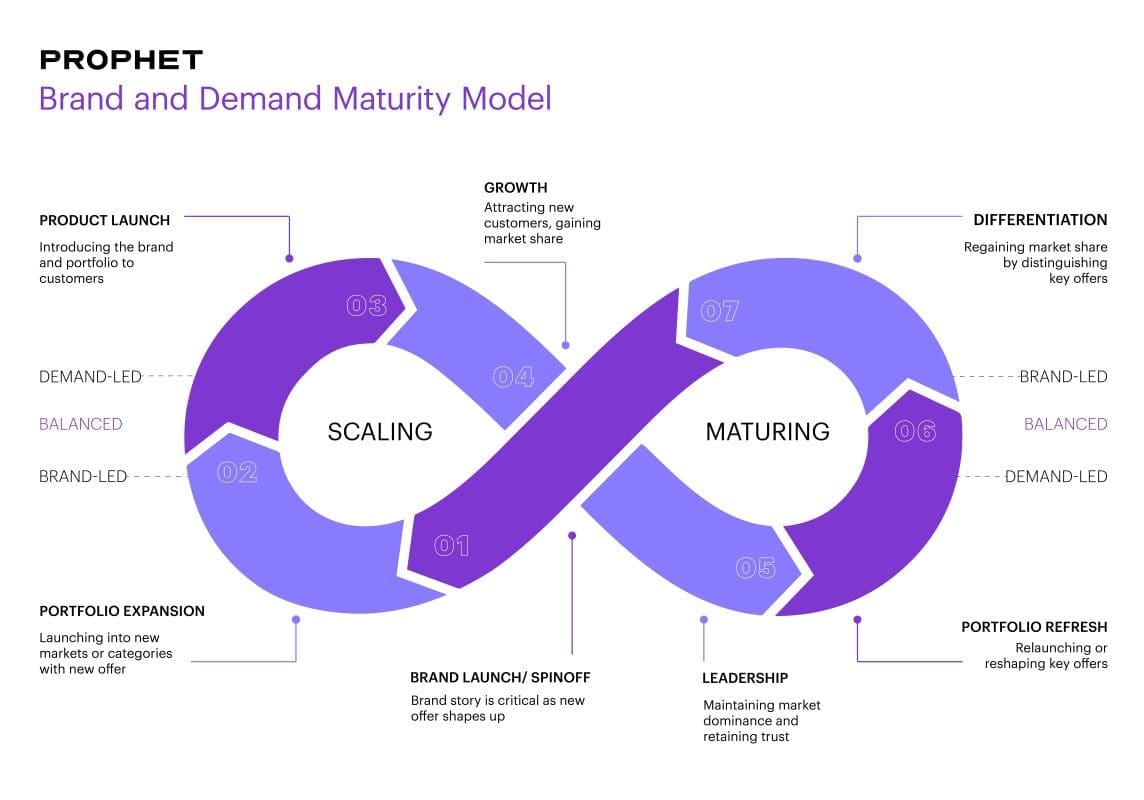
Each set of tactics has a significant role in attracting buyers and strengthening relationships at every step of the customer journey and across the entire lifecycle. But, taking the perspective of marketers, it’s easy to see why the brand-demand balance is fluid. When considering marketing activation investments, companies might adjust their orientation as:

  • Brand-led
  • Demand-led
  • Balanced

As business objectives evolve and companies navigate distinct phases of maturity, the optimal marketing approach will vary. For instance, a brand needing to differentiate from a competitive pack may need to be brand-led to generate awareness and consideration, while a business undergoing a portfolio launch, expansion or refresh may have more balanced brand-demand priorities.

For businesses focused on customer acquisition or market share gains, demand-led models will serve their immediate priorities in tandem with brand campaigns. Many direct-to-consumer brands, unique in their offerings, initially focused on acquisition only to shift towards brand marketing as their category became crowded. Mature organizations that find themselves at a point of market saturation and businesses without fully defined offers will both rely on brand-led marketing efforts to develop, sustain and enhance customer relationships.

Learning from Airbnb

Airbnb’s decision to cease all demand generation activities coming out of the pandemic suggests just how much the brand-demand pendulum can swing. When the pandemic shut down all travel, the company eliminated its marketing activation spend, which totaled $1.62 billion in 2019. As lockdown restrictions eased, Airbnb saw most of its traffic return to pre-pandemic levels, prior to re-investing in marketing activation campaigns.

“I don’t anticipate doing a lot of incentives because we have a huge amount of demand for the service already,” Airbnb CEO Brian Chesky told CNBC. “We are never going to spend the amount of money on [demand] marketing as a percentage of revenue as we did before the pandemic [because] our brand’s incredibly strong.”

Not every brand is Airbnb, of course, and it’s far more common for brand marketing spending to get in the crosshairs of budget cutters. The brand-demand mix is fluid for large and small marketing organizations. Other companies will find they need a different balance at different moments within their growth curves and maturity cycles.

External factors also play a role in defining the right balance at the right time. Social issues, including diversity and inclusion and climate change, are leading some companies to deploy brand spending to align with important causes.  Ashley Laporte, director at the communications firm RALLY explained her company’s approach as “Less about cause marketing, and more about helping companies take part in driving systemic change.” Taking positions that consumers support may lead to some increase in demand, but it will be hard to attribute sales directly to, say, thought leadership regarding a company’s commitment to net-zero admissions.

Another CMO in the manufacturing industry said she wanted “credit from business leaders, the board and institutional investors” for effectively positioning the brand relative to these issues, especially since it made the business more attractive to rising generations of workers.  An industry analyst told us, “Brands are being tortured with the cultural and societal unrest that’s out there,” and not just because investments related to these tricky issues are extraordinarily hard to measure.

What’s Love Got to Do With It?

Mastering the brand-demand mix means being flexible and committing to making necessary adjustments over time, like those that take place across the course of loving relationships. One partner’s needs may take precedence during a certain phase of life, but afterward, things rebalance as conditions change. It’s never exactly 50-50 (or 60-40 as in the famous Binet & Field model for budget allocation, which we’ll explore in more detail in a future post). Such a rigid formula may cause opportunities to be missed and doesn’t match the real world, where marketers must continuously adjust based on changing market conditions and business needs.

The new research report, “Brand and Demand: A Love Story” is here! Learn how today’s Brand and Demand Generation leaders are bringing their functions together to drive greater impact.
Download today!


FINAL THOUGHTS

We suggest speaking the “language of love” to business leaders and other stakeholders who struggle to see beyond the numbers in evaluating the merits of brand investments. The key is to connect business objectives to the power and resonance of brand. Marketers that can bring empathy and emotional intelligence to these conversations will be more likely to find supportive partners – and isn’t that what we’re all looking for?

In our next post, we look more closely at proven principles for shaping effective go-to-market strategies – the “vows of the brand-demand marriage.”

Get in touch today if you’d like to learn how to bring brand and demand together to win across the full marketing lifecycle.

BLOG

Into the Metaverse: How Should Brands Engage Today?

It’s not quite here. But brands need to know whether they intend to tiptoe, dabble or dive right into Web 3.0.

Many of us have been living in a world that feels a bit like Microsoft’s metaverse for the past two years. From Outlook and Teams to LinkedIn and Xbox, Microsoft has built a growing network of digital experiences that keep many of us in its ecosystem throughout much of daily life.

While the experiences don’t yet connect to form the fully immersive digital world deemed a “metaverse” it’s clear they are well-positioned to become a key player. Recently, this ecosystem got a monumental reinforcement in the form of the biggest acquisition in the company’s history: A near $70B acquisition of Activision Blizzard, one of the largest video game developers and publishers in the world. Through this move, the embattled Activision Blizzard will receive a lifeline from Microsoft in exchange for the developer’s hits, including “Call of Duty,” “World of Warcraft” and “Candy Crush.”

Microsoft is not the first tech firm to make a significant move toward the metaverse, with digital players increasingly positioning for this future. From Facebook rebranding their parent company to Meta, to Snap acquiring a host of augmented reality companies, many digital companies see the metaverse as the next frontier.

These companies are recognizing the significant shift in how consumers are engaging with digital platforms and are placing huge value on the impact these platforms can have with Gen Z and beyond. But with the metaverse arms race accelerating and the benefits of digital engagements clear, how can brands win in these new worlds as they continue to develop?

Brands Building Digital DNA

As the metaverse continues to unfold, brands shouldn’t wait to start engaging. Early adopters will earn an advantage by diving in with the platforms today, building native credibility in a market skeptical of brands, while gaining a competitive edge on brands that are slower to adopt this next frontier.

Brands that wait until the platform reaches consumer saturation will not drive incremental benefit beyond that of an additional ad channel – the opportunity in the metaverse is much more significant. There is no better way to prepare your brand for the future than to jump in now and refine your digital strategy and presence as you go.

To help with this transition, Prophet has identified three key brand strategy questions to consider:

How Can Your Brand Meet a Need in Consumers’ Digital Lives?

Brands entering these virtual worlds shed their physical limitations and have an opportunity to rethink the value they provide to their consumers. The companies that win in this space are the ones that create experiences to meet a need within this digital ecosystem while reinforcing the brand equity strengths carried through from the physical world.

Nike was able to answer this question in preparation for the introduction of NIKELAND on Roblox, clearly identifying that they would be able to support consumers in digitally expressing themselves, both in lifestyle and clothing.

How Might Your Brand Come to Life Within a New Digital Environment?

The metaverse creates immersive opportunities for brands to build relationships in real-time, beyond the bounds of the sequential conversations that dominate social media. In the metaverse, brands must be wholly authentic and dynamically engaging – and the ones able to strategically translate their voice, imagery and experiences into this context will earn new levels of consumer favor.

While AI-based conversational technology is yet to be widely utilized by brands, we can look to advanced virtual assistants like Amazon’s Alexa or Samsung’s Bixby for inspiration on how brands will soon be capable of continuous, real-time conversations with consumers. These dynamic and infinite touchpoints will demand continuous on-strategy voice and tone to build brands within these new platforms.

Ultimately, How is Your Brand Going to Commercialize the Metaverse?

Commercialization in these digital spaces goes beyond anything possible today. It’s more than just selling products – digital engagements provide an unparalleled opportunity for collaborations and completely immersive branded experiences on platforms where creators have the most power.

As augmented reality blurs the lines between reality and technology, brands will have unprecedented context for consumers’ daily lives and will need to commercialize themselves in ways that feel authentic and value-added. When brands overstep their bounds or present themselves in overly commercialized or sales-focused contexts, consumers will perceive the integrations as creepy and reject the offerings entirely.

“The companies that win in this space are the ones that create experiences to meet a need within this digital ecosystem while reinforcing the brand equity strengths carried through from the physical world.”


FINAL THOUGHTS

Metaverse-defining moves like Microsoft’s acquisition of Activision Blizzard will only accelerate as both big tech incumbents and forward-thinking startups converge in this next evolution of our internet.

Prophet’s Technology, Media and Telecom team has partnered with metaverse pioneers, and we’d love to help you think through these key questions as you consider your brand’s strategy within these new worlds. Whether you’re a traditionally analog brand looking to connect with Gen Z or a digitally native brand accelerating growth through new channels, let’s chat about how you can become a leader in this next phase of digital consumption.

BLOG

Coming Soon: Winners in our 2022 Prophet Brand Relevance Index®

Get ready for a shakeup. Consumer post-pandemic perceptions are redefining relevance.

Mark your calendars, brand watchers. We are getting ready to release our seventh edition of the Prophet Brand Relevance Index®, and it’s full of surprises. Without giving too much away, we can tell you that we have 96 new brands in the study this year, many of which landed in our top 50 brands. And as we’ve seen in previous years, relevance continues to be a key driver of growth – with the top brands outpacing the average growth rate in the S&P 500.

The new crop of winners shows that while relevance has always been a moving target, two years of seismic shifts in consumer behavior have solidified the way people adopt and abandon brands. And these changes go far beyond the obvious. Of course, digital matters more than ever. And we can see brands that have made intelligent moves to meet these cultural moments are those making the biggest gains.

For the second year in a row, that’s meant honoring how much time people are spending at home. It’s not just where the heart is—it is where the head is, where the body is, where everything is. And so, it is no surprise that every single brand in our top twenty-five represents an aspect of our home life. And a number of brands in the top 50 show that as the pandemic evolves and confidence builds, people are itching to come out of hibernation.

But more importantly, our brand thought leaders discovered that new patterns of relevance are emerging. The team includes:

“We’ve found that the four components underpinning our relevance research are as meaningful as ever,” says Mulvihill. “Brands still derive their relevance from customer obsession, ruthless pragmatism, pervasive innovation and distinctive inspiration. Yet as we continue to refine the science of relevance and interpret post-pandemic changes, these components express themselves in new ways.” Based on responses from 13,500+ U.S. consumers, we looked at 293 brands in 27 categories. We’ve discovered that brands are finding success in our new normal by connecting with us through three distinct avenues.

Brands that solve life’s frustrating problems are leading the first path to relevance. These ruthlessly pragmatic, pervasively innovative brands stand out by fueling the current need for self-reliance and DIY confidence. As we recalibrate our routines through this increasingly digital life, we choose only the best support staff. We want appliances, products and services that are smart enough to enable a new reality spent mostly at home.

“Brands that solve life’s frustrating problems are leading the first path to relevance.”

Others win us over almost by magic, increasing relevance by speaking more to people’s hearts than their heads. Customer obsessed and distinctively inspired, these are the names that turn customers into fans, loyalists and collectors. Devotion and demand like this are born from experiences that make people feel good about themselves, whether by providing easy access to escape or luxury that makes us feel alive and special.

Then there are those relentlessly relevant all-stars that somehow do both, hitting us simultaneously in the head and the heart. It’s because they are easily personalized, making us feel like they actually know us. They connect us to our families, work and the world. They help us discover communities of others who share the same passions. They fill our intimate spaces with stories and sounds from the outside. They help us fulfill our goals to find happiness and strength. These are the brands brightening the world, every single day.


FINAL THOUGHTS

“In this year’s Index we not only wanted to understand what brands are most relevant but how these brands connect with people in different ways to become indispensables,” says Brandt Jones. “By looking at the data this way we were able to uncover fascinating truths about why we make the choices we make, not only because of the pandemic’s at-home reality but because of the role different brands fill in our lives.

Want to learn more about how the most relevant brands are tapping into our heads and hearts to win over consumers? Sign up now to be the first to receive a copy of the 2022 Prophet Brand Relevance Index®.

BLOG

Brand and Demand Marketing: A Love Story

Marketing has always been shaped by shifts in consumer behavior, expectations and technology advancements, as well as its contribution to the enterprise. As the scope and speed of such changes expand and accelerate, it is more difficult for brands to know which types of campaigns and media work best, and the growth to which marketing can contribute.  

They must make hard tradeoffs in deciding where to invest finite resources, how to differentiate amongst competitors and how ambitious they need to be as a growth engine. Are the tradeoffs—and competition between forces—helpful or harmful? 

Today’s marketing industry feels different, according to our recent candid conversations with a dozen senior marketing leaders across industries. Customers are harder to reach and engage, even though we have vastly more data and insights about them and stronger personalization tools. Budgets are tighter and internal stakeholders more demanding. Tried-and-true best practices no longer apply. There’s a sense that rules are being rewritten in real-time. The once useful “marketing funnel” concept seems less relevant given that consumer behavior changes constantly and paths to purchase are increasingly non-linear.  

As a result, many marketing organizations experience significant tension between brand marketing and demand generation – a tension we believe undercuts growth and harms performance. Brand marketing typically describes long-term efforts to drive awareness of and preference for a company, product or service, while demand marketing seeks to get audiences to take action immediately (e.g., click on an offer, sign up for a newsletter).  

“This topic is one of the things that we’ve [been] trying to understand – where in the funnel do we need to spend our dollars in order to really drive business results and drive growth.”

– TD Bank, CMO

As the CMO of a challenger consumer goods brand told us, “Brand is about growing awareness and affinity over time,” while the primary objective for demand, or performance marketing, is “driving short-term conversion.”  

The “either-or” bifurcation of marketing into these categories presents huge challenges as marketers seek to optimize budget allocation, track performance and structure their teams and operations to drive uncommon growth. The worst part, the split between brand and demand generation isn’t aligned with consumers’ consumption patterns in today’s world.  

As a senior industry analyst told us, “Consumers have zero separation between the brand being communicated and their experience. In finding the right investment for brand and demand, it’s both, not versus.”  

Stop the fighting and find the love.

This article, the first in a series, is based on our recent market research with senior marketing executives and focused on the specific internal and external challenges CMOs face today related to brand and demand. These marketers also highlighted the levers they have at their disposal to create effective and integrated brand and demand strategies.  

Every marketing executive we talked to confirmed the importance of finding the right balance between brand and demand. We also heard repeatedly what a difficult balance it is to strike; everyone agrees that brand and demand efforts must be coordinated and synchronized. However, how to do this is much less clear. Despite the interdependence of brand and demand marketing, many tricky questions remain: 

  • How much impact does brand marketing have on conversion?
  • How does customer acquisition efforts influence brand perception?
  • What’s the optimal level of investment across brand and demand?
  • How can brand and demand show up most effectively across channels?

“This topic comes up all the time, in the B2B context, the brand piece is a hard sell because our team doesn’t understand why it’s important.”

– Trane Technologies, SVP of Marketing

In our brand and demand blog series, we explore this important conversation with a modern lens, examining how marketers can embrace the brand-demand love. Specifically, we’ll cover:  

  • The seasons of love: Understand why brand and demand are meant to be together and how they can overcome obstacles to love across the marketing lifecycle – we’re playing a long game 
  • Writing the vows: Set a strong strategic foundation, because every brand-demand marriage needs a rock-solid foundation of what it stands for and how it will approach the market – when to say “I do” and when “I don’t” 
  • Shared finances: Create shared goals and an investment agenda, define smarter metrics for allocating the shared pocketbook, or budget, and track the performance of those shared investments – brand and demand should not fight about money 
  • Setting up the household: Determine how to organize teams and build the right capabilities – brand and demand need a comfortable nest 

The new research report, “Brand and Demand: A Love Story” is here! Learn how today’s Brand and Demand Generation leaders are bringing their functions together to drive greater impact.
Download today!


FINAL THOUGHTS

We think it’s time for brand and demand to stop thinking of themselves as competing interests fighting for the same precious resources. Rather, they must be complementary companions with a shared agenda and intertwined goals. We believe it’s time for brand and demand to fall in love because together, they are the ultimate power couple to build relevance and unlock uncommon growth.   

Get in touch today if you’d like to learn how to bring brand and demand together to unleash the full power of your business.

BLOG

Brand Breakthroughs: What to Expect in 2022

As brand spending makes a comeback, we think the branding discipline is in for a big, big year.

Get ready, brand strategists – 2022 is going to be your year. The last 18 months have been packed with plot twists, creating new opportunities for better brand activations and experiences. And it’s not just the progression of the pandemic, supply-chain challenges, rising inflation or ever-more-digital consumers that’s caused this shift.

It’s that authenticity matters more as people struggle to absorb all those changes. They’re switching buying behaviors and brands at an unprecedented level. One recent study finds that 75% of consumers have shopped in a new way, with 36% trying a new brand.

To keep customers and attract new ones, companies need to prove they support the greater good in a way that’s unique to their brand. That’s terrible news for brands not actively building and delivering against an authentic purpose that consumers can believe and relate to. But this approach offers wide-open growth avenues for those that can find better ways to connect with customers. We expect the savviest brands to lean hard into these five trends in 2022:

Brand Spending Makes a Comeback

Companies are increasingly aware that they can’t earn customer loyalty without a clear brand identity. There’s just too much noise in the market, and too many options for consumers to choose from.

Clear communication about what a company stands for requires investing in a well-defined brand identity and awareness. How can companies expect to make connections if their target audience is unclear about what they are? We expect to see a greater focus on brand with more dollars shifting –often from the demanding budget – into brand building. Additional resources will allow marketers to ensure brand efforts are clear, inspirational and delivered with energy.

We even think brand and demand may stop fighting and find love, as the two resolve tensions and work together in harmony. CMOs will develop integrated models where brand –the long-term efforts to drive awareness –and demand – which seeks to get audiences to act immediately – are synchronized with shared agendas and intertwined goals.

Got Purpose? Prove it, and Make Sure it Benefits the Planet

For years, we’ve known that consumers are increasingly choosing brands with a higher-order purpose – they want to buy from companies that make a difference in the world. This year, they’ll expect brands to put their money where their mouth is. They’ll want action, like Lush leaving social media because it’s become toxic for their customers, or Nike, investing tens of millions in countering systemic racism.

Sustainability and environmental concerns are especially important. Too often, companies isolate ESG and DEI policies, but they need to become central to brand purpose – a golden thread that winds through every aspect of the organization. ESG and DEI aren’t just about mitigating risks. These efforts add value to everything the company does.

“To keep customers and attract new ones, companies need to prove they support the greater good in a way that’s unique to their brand.”

Whether companies like it or not, protecting the planet is the No. 1 concern for both Gen Z and millennial audiences. Led by firebrands like 18-year-old environmentalist Greta Thunberg and 21-year-old gun-control activist David Hogg many see themselves as warriors acting to protect the planet. These young consumers can spot green or virtue-washing efforts from miles away and will punish companies that get it wrong.

All Digital? Nope. Never

Once upon a time, the business world envied those digitally native direct-to-consumer brands and the way they dinged the dinosaurs who shopped in brick-and-mortar stores. But with the defeat of Casper in the public markets, it’s clear omnichannel rules, and those D2C darlings have stampeded toward the mall. Warby Parker, Glossier, Allbirds and Wayfair are all proving that ­humans like to look, touch and feel what they’re buying.

Led by companies like Apple, Lululemon, Nike and Samsung, this trend toward experiential retail is already strong and will continue to grow. Levi Strauss & Co., for example, is opening 100 new stores this year, and Lego intends to open 174 new locations.

While people know they don’t need actual stores to transact, they do need them for experiences – especially as consumers long for post-pandemic connections. People have spent the last 18 months re-evaluating many priorities. They’ve learned that they love digital for cutting down on the drudgery in their lives, like grocery shopping and banking, so they can focus on the experiences that mean the most to them.

They do, however, want to experience products before purchasing, especially in certain categories, and we expect to see more brands open physical spaces.

The Decline of the Mega Brand

After decades of consolidation, conglomerates are starting to see the benefits of breaking up. With a CEO openly mocking the myth of synergy, GE is leading the way, followed by Johnson & Johnson and Toshiba Corp. More will follow as companies increasingly challenge the belief that one brand can work in many markets, and that bigger is always better.

Companies are asking themselves the hard questions: Can we continue to use a single brand, expecting it to be equally meaningful among different verticals, markets and customers? Is that one brand universally credible? And if not, when is time to switch that strategy?

Facebook’s recent decision to become Meta, illustrates another facet of this trend: More brands may increase a company’s agility, allowing it to pivot in more precise (and perhaps even more affordable) ways.

Midlife Crises Spark Unicorn Reinvention

Remember all those companies we admired back when BlackBerry dominated the market? Twitter (founded in 2006), Airbnb (2008), Pinterest (2009) and Instagram (2010) are all middle-aged now. No longer the cool kids, they need a refresher course in disruption. As they revisit purpose, they need to better understand empowered consumers and find new growth channels. How and where can they innovate as they face younger rivals?

To keep up, they’ll need creative Web 3.0 pivots. We’re already used to watching elderly unicorns struggle. Google used its transition to Alphabet to age gracefully, but once-huge tech brands, such as Jawbone, GoPro and Groupon, have languished from lost relevance. We expect plenty of big news and at least a few missteps as these almost-old digital natives reinvent themselves.


FINAL THOUGHTS

With all the disruption of the last few years, if we’ve learned anything, it’s that brands can’t sit on their laurels. They need to be actively thinking about their next move. To stay relevant with consumers and drive new growth opportunities, brands must be thinking about the future and be prepared to reinvent themselves to meet the moment.

Get in touch to learn more about we help our clients achieve uncommon growth through brand-driven transformation.

BLOG

Brand Equity vs. Brand Value: What’s the Difference?

Each offers a different way to increase loyalty, but require different metrics.

  • Brand equity refers to the importance of a brand in the customer’s eyes, while brand value is the financial significance the brand carries. Both brand equity and brand value are educated estimates of how much a brand is worth.

What’s the Difference Between Brand Equity & Brand Value?

Brand equity and brand value are similar, but not the same. Oftentimes, there is confusion around how each differs so let’s look at exactly what each means:

Brand Equity

Brand equity is a set of assets or liabilities in the form of brand visibility, brand associations and customer loyalty that add or subtract from the value of a current or potential product or service driven by the brand. It is a key construct in the management of not only marketing but also business strategy.

In the late 1980s, brand equity helped create and support the explosive idea that brands are assets that drive business performance over time. That idea altered perceptions of what marketing does, who does it, and what role it plays in business strategy.

Brand equity also altered the perception of brand value by demonstrating that a brand is not only a tactical aid to generate short-term sales, but also strategic support to a business strategy that will add long-term value to the organization.

Brand Value

Brand value, on the other hand, is the financial worth of the brand. To determine brand value, businesses need to estimate how much the brand is worth in the market – in other words, how much would someone purchasing the brand pay?

It is important to note that a positive brand value does not automatically equal positive brand equity.

How Should Brand Equity & Brand Value Be Measured?

While measuring brand value is fairly straightforward, the process for brand equity is not quite so simple. Brand equity is a set of assets or liabilities in the form of brand visibility, brand associations and customer loyalty that add or subtract from the value of a current or potential product or service driven by the brand. Here we’ll dive into each.

Brand Visibility

This means that the brand has awareness and credibility with respect to a particular customer need—it is relevant. If a customer is searching for a buying option and the brand does not come to mind, or if there is some reason that the brand is perceived to be unable to deliver adequately, the brand will not be relevant and not be considered.

Brand Associations

Brand associations involve anything that created a positive or negative relationship with or feelings toward the brand. It can be based on functional benefits but also a brand personality, organizational values, self-expressive benefits, emotional benefits or social benefits.

Customer Loyalty

Customer loyalty provides a flow of business for current and potential products from customers that believe in the value of the brand’s offerings and will not spend time evaluating options with lower prices. The inclusion of loyalty in the conceptualization of brand equity allows marketers to justify giving loyalty priority in the brand-building budget.

Driving Brand Value in the Short Term

The value of a brand represents its impact on the short-run and long-run flow of profits that it can generate. With respect to short-term profitability, the problem is that programs that are very good at driving short-run products – like price promotions – can damage brands.

Looking at the ways a brand can help drive short-term financial performance can help mitigate this tendency:

Brand Loyalty

  • Reduced Marketing Costs
  • Trade Leverage
  • Attracting New Customers via Awareness & Reassurance
  • Time to Respond to Competitive Threats

Brand Visibility

  • Anchor to Which Other Associations Can Be Attached
  • Familiarity Which Leads to Liking
  • Visibility That Helps Gain Consideration
  • Signal of Substance/Commitment

Brand Associations

  • Helps Communicate Information
  • Differentiate/Position
  • Reason-to-Buy
  • Create Positive Attitude/Feelings
  • Basis for Extensions

Improving Brand Value in the Long-Run

One of the ongoing challenges of brand equity proponents is to demonstrate that there is long-term value in creating brand equity. The basic problems are that brand is only one driver of profits, completive actions intervene, and strategic decisions cannot wait for years.

There are, however, some perspectives that can be employed to understand and measure the long-term value of brand equity:

Brand Value Approach #1: Estimate the Brand’s Role in Business

One approach is to estimate the brand’s role in a business. The value of a business in a product market such as the Ford Fiesta in the UK market is estimated based on discounting future earnings. The tangible and intangible assets are identified and the relative role of the brand is subjectively estimated by a group of knowledgeable people, taking into account the business model and any information about the brand in terms of its relative visibility, associations and customer loyalty.

The value of the brand is then aggregated over products and markets countries to determine a value for the brand.  It can range from 10 percent for B2B brands to over 60 percent for brands like Jack Daniel’s or Coca-Cola.

Brand Value Approach #2: Observe Investments in Brand Equity

A second approach is to observe that, on average, investments in brand equity increase stock return, the ultimate measure of a long-term return on assets. Evidence comes from a series of studies I conducted with Professor Robert Jacobson of the University of Washington, using time series data which included information on accounting-based return-on-investment (ROI) and models that sorted out the direction of causation.

The consistent finding was that the impact of increasing brand equity on stock return was nearly as great as that of an ROI change, about 70 percent as much. In contrast, advertising, also tested, had no impact on stock return except that which was captured by brand equity.

Brand Value Approach #3: Reflect on Other Valuable Brands

A third approach is to look at case studies of brands that have created enormous value. Consider, for example, the power of the Apple personality and innovation reputation, BMW’s self-expressive benefits connected to the “ultimate driving machine,” and the ability of the Whole Foods Market brand to define an entire subcategory.

Or, the fact that from 1989 to 1997 two cars were made in the same plant using the same design and materials and marketing under two brand names, Toyota Corolla and Chevrolet (GEO) Prism. The Corolla brand was priced 10% higher, had less depreciation over time, and had sales many times more than the Prizm. And consumers and experts both gave it higher ratings. The same car! Only the brand was different.

Brand Value Approach #4: Consider the Conceptual Model

It’s important to consider the conceptual model surrounding a business strategy. What is the business strategy? What is the strategic role of the brand in supporting that strategy? How critical is it? Is price competition the alternative to creating and leveraging brand equity? What impact will that have on profit streams going forward? Management guru Tom Peters said it well:

“In an increasingly crowded marketplace, fools will compete on price. Winners will find a way to create lasting value in the customer’s mind.”


FINAL THOUGHTS

Brand equity continues to be a driver of much of marketing, indeed business strategy. For it to work, it needs to be understood conceptually and operationally. And it is important that it be tied to brand value in credible ways.

Discover how Prophet helps companies establish a brand strategy that drives business growth.

BLOG

How Verbal Branding Can Amplify Your Transformation

Story-telling, innovation and personalization all help differentiate, deliver and win in the market.

With rising customer expectations, companies across industries are investing in innovative experiences, digital marketing capabilities, and organizational change to attract and retain talent. But with fast-moving timelines and competing demands, they can’t always invest in storytelling, a key component in influencing and driving change.

Verbal branding—or the strategic deployment of language through tools like voice, messaging, content strategy and copy—plays a key role in optimizing the return on these investments, ensuring companies make thoughtful choices about their communications in these high-impact moments.

In this article, we offer three imperatives for organizations to consider when using their verbal branding to differentiate, deliver their promise, and win in the market.

Meet Customers’ Expectations for Personalized, Connected Communications

More and more, customers expect a consistent experience across channels – from mentioning a brand on Twitter to calling customer service. They expect their interactions to be seamless, with one channel easily picking up a conversation started in another (for example, starting in a chatbot and following up by phone—these two interactions use different systems but are ideally connected by a centralized customer data platform to create a unified customer picture). In short, customers want brands to recognize them as the same person across different channels and interactions.

While these channels and interactions have different formats, functions and requirements, they need to feel creatively and strategically cohesive. The implication for brands is ensuring that all these channels—whether automated or human-enabled—are on-voice and on-message.

But cohesive doesn’t necessarily mean uniform. The best service interactions modulate based on user sentiment. They can sense excitement, frustration, confusion, and adapt as needed. This can be achieved through both human and digital capability.

For example, it can be as simple as empowering call center reps with cues on how to identify customer archetypes based on emotion and providing discrete service journeys and scripts for them. This is particularly important for industries that customers approach with sensitivity or trepidation, such as financial services or healthcare.

“Verbal branding plays a key role in optimizing the return on these investments, ensuring companies make thoughtful choices about their communications in these high-impact moments.”

At the same time, brands using natural language processing tools, such as in-chatbot experiences, can similarly “train” their Natural Language Processing (NLP) tool to not only identify the customer’s desired “job to be done,” but to detect underlying emotion and adapt responses accordingly. For example, a chatbot that can sense a customer’s frustration about a delayed order, offer sympathy and quickly route them to live chat support, can help repair the customer’s brand perception in a tenuous moment.

Invest in Innovation—and its Expression

While many companies prioritize investing in new products and experiences, sometimes they don’t consider the importance of the words used to guide their audiences through them.

Rather than viewing product and expression as separate steps in the process, they should be developed in tandem as complementary assets, working together to shape how customers interact with and perceive the brand. Effective verbal expression (in this case, UX writing) bridges the gap between the layout and usability of the product.

Regardless of how brilliantly developed the product is, without clear and engaging written cues, the audience (customers or employees) may struggle to use or navigate it. More broadly, however, approaching innovation solely through a product lens misses an opportunity to embody the brand’s verbal identity. Effective copy can help a brand make a human connection with users that’s often not possible through design alone.

Brands should develop on-voice UX writing that has clear user goals in mind and reflects the likely emotional mindset of customers at various stages of their journey. Using this approach, copy can help drive self-progression or clarify complex topics in an engaging, on-brand manner—without disrupting the experience.

Brands that harness the strategic prowess of UX writing will excel at forming closer bonds with customers over brands who merely prioritize function in their innovations.

Use Storytelling to Galvanize Employees Around a Shared Vision, Meet Mandates and Drive Retention

The “Big Quit” is upon us. In an increasingly competitive talent market following a year that has upended what work looks like, employee expectations are rapidly changing. To meet this upheaval, impactful verbal expression can play a vital role in shaping experiences that respond to employee needs and catapult desired organizational change.

From crafting a meaningful shared vision to galvanizing employee sentiment, retaining key talent and attracting prospective candidates, transformational organization change requires a comprehensive accompanying voice and messaging strategy.

For example, how might we excite employees about new innovations? Inspire employees to care about new internal initiatives? Bring new hires into the corporate culture and values? Present a compelling case for change?

Like customers, employees are not a monolith. Different customer segments have different needs and respond to different ways of messaging. Companies with robust customer segmentation strategies can take the same approach with their employees, creating targeted messaging to meet specific employee audience group needs.

Taking a strategic messaging approach allows brands to connect external brand ambition to internal employee communication and experience, ultimately aligning the organization behind shared ambition, values, and purpose.


FINAL THOUGHTS

Words shape how we see and experience the world. Now more than ever, verbal branding can play a crucial role in driving and amplifying transformational change. To capitalize on this opportunity, brands should prioritize verbal expression when shaping service and support channels, developing new product experiences and engaging employees along the way.

Your network connection is offline.

caret-downcloseexternal-iconfacebook-logohamburgerinstagramlinkedinpauseplaythreads-icontwitterwechat-qrcodesina-weibowechatxing