BLOG

Beyond NEO Luxury: How Premium Brands Can Prepare for Radical Change 

What does a custom GPT reveal about the future? 

Every luxury brand needs a proactive approach to growth, whether that means adapting to shifting consumer attitudes, leveraging technology, or identifying new markets. One thing is certain: foresight and imagination are essential to staying ahead. 

Prophet’s Jörg Meurer has advised luxury brands for almost two decades. In this interview, we explore the concept of NEO Luxury and ask: What’s next? 

Prophet has been talking about the concept of NEO Luxury for more than five years. What does it mean? 

Brands at the premium end of the market are used to navigating major changes, most recently the rapid adoption of AI. They must constantly stay on the front foot when it comes to engaging with existing and future consumers, understanding their markets and turning innovation into profit.  

Until now, the luxury industry’s timeline can be categorized into three phases: First, classic luxury, which focused on exclusivity, ownership and craftsmanship, with tightly controlled distribution and elite audiences. Second, new luxury, which was a shift toward experiences, personalization and emotional connection, thus making luxury more accessible and lifestyle-oriented for consumers. Third, NEO luxury, a forward-thinking model for brands, integrating sustainability, technology, and purpose-driven values to redefine exclusivity and deliver ethical, experiential luxury.  

In 2019, we released a study examining the move toward NEO Luxury in collaboration with Dr. Julia Riedmeier, an international luxury brand strategist, renowned luxury expert, and the founder of Code \ Luxe. Fast forward to 2026: the big question for luxury and premium brands is what comes after NEO Luxury? 

How can brand leaders begin to anticipate what comes after NEO Luxury? 

It’s a bit more complex than simply asking ChatGPT. But, we did call upon AI to develop our initial predictions and remove some of the guesswork. 

Brands can find answers by combining structured foresight with creative hypothesis-building. So how does this work in practice? We created a custom GPT model to generate a couple of plausible scenarios for the future of luxury. We wanted each to be grounded in emerging signals but to also consider bold possibilities. These scenarios were not to be taken at face value; instead, we applied a curated, critical lens to evaluate their underlying assumptions, cultural implications, and potential business impact.  

This approach allows brand leaders to move beyond reactive thinking and into proactive innovation. By stress-testing these hypotheses and identifying accelerators, such as technology adoption, new collaboration models or shifts in consumer values, brands can chart a course toward the most promising directions, often before the market realizes they exist. 

What were the three potential futures for uxury imagined by the GPT model? 

Conscious Culture Luxury 

By 2028, luxury may be less about ownership and more about cultural and emotional intelligence. Status will come from understanding, not accumulating. Brands become “curators of meaning,” offering spaces for reflection and cultural exchange. Technology plays a quiet role, helping us slow down and connect rather than overwhelm. Think cultural travel, hybrid craft and psychological well-being shaping the experience. 

Neo Human Luxury 

With technology advancing at such speed, luxury may focus on the dignity of being human. Technology becomes a tool for empathy and well-being, not distraction. Expect bio-luxury (health tech and longevity) to be paired with radical transparency and “quiet AI” that understands rather than sells. Ownership fades as experiences and self-cultivation take center stage. Imagine studios dedicated to mental craftsmanship and mindfulness. 

Luxury Quantum 

Imagine a future where luxury isn’t confined to physical objects or digital screens but exists in a seamless blend of both. In this scenario, experiences become “phygital rituals,” combining real-world touchpoints with immersive virtual layers. NFTs evolve beyond collectibles into emotional artifacts, carrying meaning and memory, for example art pieces. The virtual world is enhanced by sensory technology, adding smell, sound, and touch for truly multisensory engagement. AI companions act as personal curators, shaping lifestyles and guiding choices. For brands, this means moving from selling products to designing entire alternative realities, spaces where identity, creativity and consciousness come together.  

Coming back to the present, what should premium brands be thinking about right now? 

Six years after we began to define NEO Luxury, the scenarios above are just the beginning of future thinking on this topic. The idea of “Luxury Quantum” may seem very futuristic, maybe even far-fetched, but we need to be open to a number of possible scenarios.  

In the near-term, luxury brands must balance heritage with innovation, embrace ethical transparency, and integrate technology thoughtfully. When creating experiences, they should prioritize cultural relevance, human well-being, and immersive engagement to stay competitive in today’s ever-changing market. 


FINAL THOUGHTS

It’s a fascinating time for brands to be in this space, and the winners will be those who understand how to deepen customer trust and take an imaginative approach to creating long-term value.

BLOG

Five Ways GenAI Helps Turn Marketing into a Growth Driver 

How leading marketers use GenAI to sharpen decisions, strengthen brand impact, and directly drive revenue growth. 

Seventy percent of CEOs report measuring marketing performance based on revenue growth. Yet for many organizations, marketing is still treated as a cost center, not trusted as a primary growth engine. 

The tension has never been more acute. Marketing leaders are navigating tighter budgets, longer sales cycles, fragmented customer journeys, and rising expectations for personalization all while proving impact with fewer resources. At the same time, GenAI is moving from experimentation to enterprise reality. But the tendency to see GenAI as a solution for reducing marketing costs misses the real opportunity to apply it in ways that credibly drive growth. 

What we’re seeing in the market is clear: GenAI is not just accelerating how marketing work gets done, it is changing who marketers are marketing to, how decisions get made, and how growth is earned and defended. The emergence of the “AI-powered consumer” in which machines increasingly surface options while humans make meaning, demands a different approach. 

For constrained teams, the opportunity isn’t to “do more marketing.” It’s to use GenAI as leverage: to reduce risk, sharpen focus, and connect marketing activity more directly to revenue outcomes. 

Based on our work helping organizations increase their AI-enabled marketing maturity, five use cases consistently separate teams that create growth credibility from those that simply create more output. 

1. Dynamic Audience Understanding: Maintaining Decision-Ready Audience Insight in a Constantly Shifting Market 

Traditional segmentation was designed for a slower world — annual refreshes, static personas, and assumptions that held long enough to matter. That model can break down in B2B environments with long buying cycles and in mid-market organizations where missed signals are expensive. 

GenAI enables a shift from static segmentation to living audience intelligence. By continuously analyzing behavioral, transactional, and engagement data, structured and unstructured, AI can surface early demand signals before they appear in CRM or pipeline reports. It allows teams to re-cluster audiences dynamically as motivations shift, markets evolve, or new use cases emerge. 

The real advantage here is not precision for its own sake. It’s being less wrong, earlier. 

For B2B marketers, this means understanding which accounts are warming before sales see it, which buyer assumptions are eroding, and where emerging needs are forming at the edges of the market. For mid-market teams with limited research budgets, GenAI acts as a translator, extracting insight from imperfect data rather than waiting for pristine inputs that never arrive.  

Increasingly, marketing teams are augmenting their first-party data and traditional research with cultural and behavioral intelligence platforms such as Quilt.AI and HiveScience.AI, which ingest millions of digital conversations across professional communities, industry forums, social platforms, and expert networks. These tools surface how buyers frame problems, evaluate trade-offs, and influence one another long before intent appears in CRM or marketing automation systems. Rather than relying only on survey responses or owned-channel behavior, marketers gain visibility into the narratives shaping demand inside peer groups, communities of practice, and category conversations. As influence, trust, and purchasing decisions increasingly form in these distributed B2B ecosystems, this layer of intelligence helps brands design strategies, campaigns, and creative that align with how buying groups actually think, talk, and decide — keeping marketing grounded in real market momentum, not internal assumptions.  

Some organizations are taking this further by simulating customer reactions to new product ideas, value propositions, or messaging using AI-powered behavioral modeling. Others deploy those digital twins of key personas to create a shared, evolving understanding of customers across marketing, sales, and products. 

In all cases, the outcome is the same: fewer wasted bets, sharper prioritization, and more confidence in where growth actually lives. 

2. Consistent Brand Experience: Turning Brand into a Force Multiplier 

Brand governance is often misunderstood as bureaucracy – layers of approval that slow teams down. Inconsistency is far more expensive. It creates friction in sales, dilutes the effectiveness of performance marketing, and forces constant rework across decentralized teams. 

GenAI allows marketing leaders to codify brand strategy into scalable systems designed for decentralized teams. These tools can monitor brand expression across channels before assets go live, evolve storytelling across the funnel, and enable sales teams and partners to deliver on-brand experiences without constant oversight. For mid-market and B2B organizations, this reframes brand investment as efficiency, not overhead. 

When brand guardrails are built directly into workflows, teams move faster, not slower. Content is clearer. Sales conversations are more coherent. Every dollar spent downstream works harder. Marketing teams are leveraging custom GPTs and enterprise tools such as Writer.ai and Jasper.ai to enable teams and partners to leverage the brand voice and tone and create content that is consistent across the funnel while also being customized for the target audience. 

Additionally, the need for consistency is becoming more urgent as the funnel itself collapses. The journey from discovery to decision is increasingly converged and mediated by AI models, from search overviews to conversational assistants. In many cases, customers now form impressions, shortlist options, and even make decisions without ever visiting a brand’s owned channels. 

As a result, brands are losing direct control over how they show up at the moments that matter most. AI-generated summaries, featured answers, and zero-click experiences increasingly define the brand narrative, often compressing complex positioning into a few lines of synthesized output. The impact is already visible: historic drops in direct and organic traffic, declining click-through rates when AI overviews appear, and growing difficulty explaining performance shifts to executive stakeholders using traditional metrics. 

In this environment, brand consistency can no longer be managed solely through owned experiences or channel-specific guidelines. It must extend into AI-mediated discovery itself.  

That shift requires moving beyond a traditional SEO mindset optimized around keywords, rankings, and clicks to an Answer Engine Optimization (AEO) strategy designed for how AI systems interpret, select, and represent brands. As AI-mediated discovery accelerates and zero-click experiences reduce direct traffic, AEO becomes a critical growth lever, not just to protect brand consistency, but to mitigate lead erosion and revenue risk as traditional demand signals quietly disappear. 

The most effective leaders use GenAI not to control creativity, but to multiply it, enabling even the most bootstrapped teams to extract the most value from the brand across all of the moments that matter. 

3. Content at Scale: Orchestrating Insight and Creativity for Growth 

Content is where most GenAI adoption starts and where it often stalls. Producing more assets faster is easy. Producing the right content that actually moves buyers is harder. 

In an AI-saturated content environment, “more” is not a competitive advantage, difference is. When every team can generate competent copy on demand, the brand that wins is the one that creates distinctive, emotionally resonant work grounded in a sharper understanding of the buyer than competitors have. GenAI doesn’t reduce the importance of creativity; it increases the return on it. 

The real power of GenAI lies in connecting insight, strategy, and creation. By training models on customer personas, performance data, and channel context, teams can identify which topics, formats, and messages are most likely to drive value, then rapidly generate on-brand assets aligned to the funnel stage and buyer need. 

The biggest failure mode we see is not low adoption, it’s reliance on AI that produces AI-average work. GenAI is excellent at generating what is already common: category clichés, familiar narratives, and safe phrasing that passes a brand check but fails to earn attention or preference. That kind of efficiency can quietly stifle growth: it fills the funnel with content while draining the brand’s distinctiveness. 

Creativity is the counterweight. Distinctive creative work builds memory, creates meaning, and earns attention in compressed, AI-mediated journeys where buyers may encounter your brand through summaries, snippets, and secondhand interpretation. As discovery becomes more “zero-click,” the job of creative is not just to communicate, it is to stick. 

GenAI enables faster iteration, disciplined experimentation, and continuous optimization so teams can spend more time on the few ideas that will actually differentiate the brand. Content becomes a portfolio of bets, not a factory of outputs. 

Importantly, the highest-value creative inputs are still human: strategic judgment, cultural sensitivity, and the ability to introduce productive tension and say something specific enough that it excludes as well as includes. GenAI can help teams explore directions faster, but it cannot replace the brand’s point of view. The goal is not to automate creativity; it is to protect it from being flattened while scaling execution. 

When done well, creative capacity expands without diluting quality and marketing earns greater credibility by tying content directly to commercial outcomes. 

4. Always-On Insights: Ending the Quarterly Hindsight Problem 

Most marketing insights arrive too late to matter. Quarterly brand trackers, post-campaign analyses, and lagging performance reports explain what happened, but rarely when there was still time to act. 

GenAI changes this by enabling always-on intelligence systems that continuously monitor market signals, customer sentiment, competitive movement, and performance data across the funnel. Rather than waiting for formal research or reporting cycles, marketing leaders gain early visibility into shifts in perception, emerging objections, and changing expectations. While those shifts are still manageable. 

This matters deeply in B2B categories, where trust erosion often precedes pipeline decline and where sales friction shows up long before revenue does. AI-powered insight systems can model brand perception trajectories, forecast how marketing actions are likely to influence consideration or trust, and surface risks before they materialize in missed targets or stalled deals. 

But the most important shift is operational and commercial. Always-on insights make marketing performance easier to explain and defend. By unifying data across brand, demand, and sales systems, GenAI helps teams identify which KPIs connect marketing activity to revenue. It enables automated optimization loops, real-time budget reallocation, and scenario modeling that shows what is likely to happen next, not just what has already occurred. 

For leaders struggling with the cost-center perception, this is transformational. Instead of reporting past performance, marketing can recommend next actions and clearly articulate the trade-offs. Generative models allow teams to simulate future outcomes, test investment scenarios, and speak the language of finance: risk, return, and probability. Marketing evolves from an execution function into a decision partner in growth. 

The critical shift is to embed insights directly into decisions through content briefs, campaign prioritization, sales enablement, and spend allocation. For constrained teams, GenAI reduces learning costs and narrows the gap between signal and action. In an environment defined by uncertainty, speed and clarity of understanding become a durable competitive advantage. 

5. Future Back Planning: Designing Growth Around the Customer of the Future 

For many organizations, “whitespace” is still defined reactively: where competitors are weak today, where products don’t yet exist, or where demand appears underserved in current data. But in an environment shaped by GenAI, shifting buying behaviors, and accelerating category convergence, that approach is no longer sufficient. 

The most valuable whitespace opportunities sit ahead of demand, not behind it. They emerge at the intersection of how customers are evolving, how markets are fragmenting, and where competitors are structurally constrained by legacy assumptions. 

GenAI enables marketing and growth leaders to take a fundamentally different approach: identifying whitespace through a future-back view of the customer. 

Rather than asking only who our customers are today, teams can begin to answer deeper, forward-looking questions: who their customers are likely to become, what they will care about as AI reshapes work and decision-making, how their journeys will evolve, and how expectations around value, experience, and trust will shift over time. By decoding emerging market signals, early adopter behaviors, and disruptive forces, GenAI allows organizations to feed these inputs into predictive foresight models that simulate plausible futures. 

This capability is especially powerful in B2B categories, where buying decisions are increasingly shaped inside communities, peer networks, and ecosystems long before formal intent signals appear. GenAI can synthesize millions of conversations, behaviors, and signals to reveal not just unmet needs, but unarticulated tensions: where customers are struggling to reconcile old solutions with new realities, or where existing offerings no longer map cleanly to evolving jobs-to-be-done. 

From there, whitespace becomes clearer and more actionable. Teams can identify: 

  • Gaps between customer expectations and current category norms 
  • Opportunities competitors are unlikely to pursue because of their business models, capabilities, or positioning 
  • Emerging needs created by AI adoption itself — new workflows, risks, and sources of value 

This is not an abstract strategy exercise. GenAI allows organizations to simulate future customers across different scenarios, stress-test ideas before they go to market, and engage in “research” with modeled future audiences to understand motivations, trade-offs, and barriers. The output is not just insight, but clarity on what new products, services, experiences, or business models are most likely to resonate. 

The final unlock is cross-functional. When whitespace is grounded in a shared view of the future customer, marketing can help translate insight into implications for growth strategy, offering design, experience innovation, and capability building. Instead of chasing incremental differentiation, organizations align around where to place their bets and why. 

In uncertain markets, growth doesn’t come from filling gaps competitors leave behind. It comes from seeing where customers are headed next and building into that space before it becomes obvious. 


FINAL THOUGHTS

GenAI will not turn marketing into a growth engine by itself. But it gives teams, especially those that are resource-constrained, something they have historically lacked: leverage. 

The winners will not be those who adopt the most tools, but those who apply GenAI where it reduces risk, sharpens focus, and strengthens the connection between marketing activity and business outcomes. 

For mid-market and B2B leaders under pressure to prove impact, that shift — from output to outcome — is what ultimately changes how marketing is valued. 

And in today’s environment, that may be the most important growth opportunity of all. 

BLOG

Accelerating Speed to Growth With AI

Expanding on our Uncommon Growth research, we examined how top performers are leveraging AI to accelerate growth.  

Nearly every leader has AI at the top of their agenda, with resources deployed to understand how to utilize it for efficiency gains. We’ve all heard the promises: AI has the potential to deliver massive business efficiencies from automating administrative tasks to managing customer service channels, to drafting copy for SEO, ads and product pages. But beyond efficiencies, AI can deepen customer engagement, surface strategic insights and shorten the time it takes to bring new products to market.  

We call this speed to impact — a critical component of achieving uncommon growth. Growth that is sustained and outsized versus category peers. 

In a world where AI has the potential to impact everything, leaders face the choice of where to invest to maximize value creation. As the adage goes, “we can do anything, but we can’t do everything.” Successful AI strategies require a sharpened strategic focus, with investments deployed toward growth use-cases. 

Prophet’s Uncommon Growth research shows that companies achieving growth share three core traits: Customer Obsession, Pervasive Innovation and Strong Cultures. Investing behind these pillars is key to achieving business success. Deploying AI across the pillars, done right, has the potential to supercharge growth.  

We explored how AI is accelerating impact across these three pillars in 179 companies that achieved uncommon growth. 

Customer Obsession 

Companies achieving uncommon growth are relentlessly focused on understanding and engaging their customers — often outspending peers in sales and marketing. GenAI has introduced new channels of engagement, from influencing how consumers research products to driving deeper personalization and connection.  

In Prophet’s study, The Rise of the AI-Powered Consumer, 45% of consumers reported using Gen AI in the past six months to inform purchase decisions. Highly considered purchases, like technology, automotive and beauty, are seeing the most disruption. To remain competitive means optimizing your brand, marketing and media strategy for LLM awareness and sentiment.  

The Harvard Business Review’s “Forget What You Know About Search: Optimize Your Brand for LLMs” suggests marketers should: 

  • Highlight expertise
  • Speak to use cases and consumer needs
  • Tailor content to the processing style of dominant LLMs for their target audience 
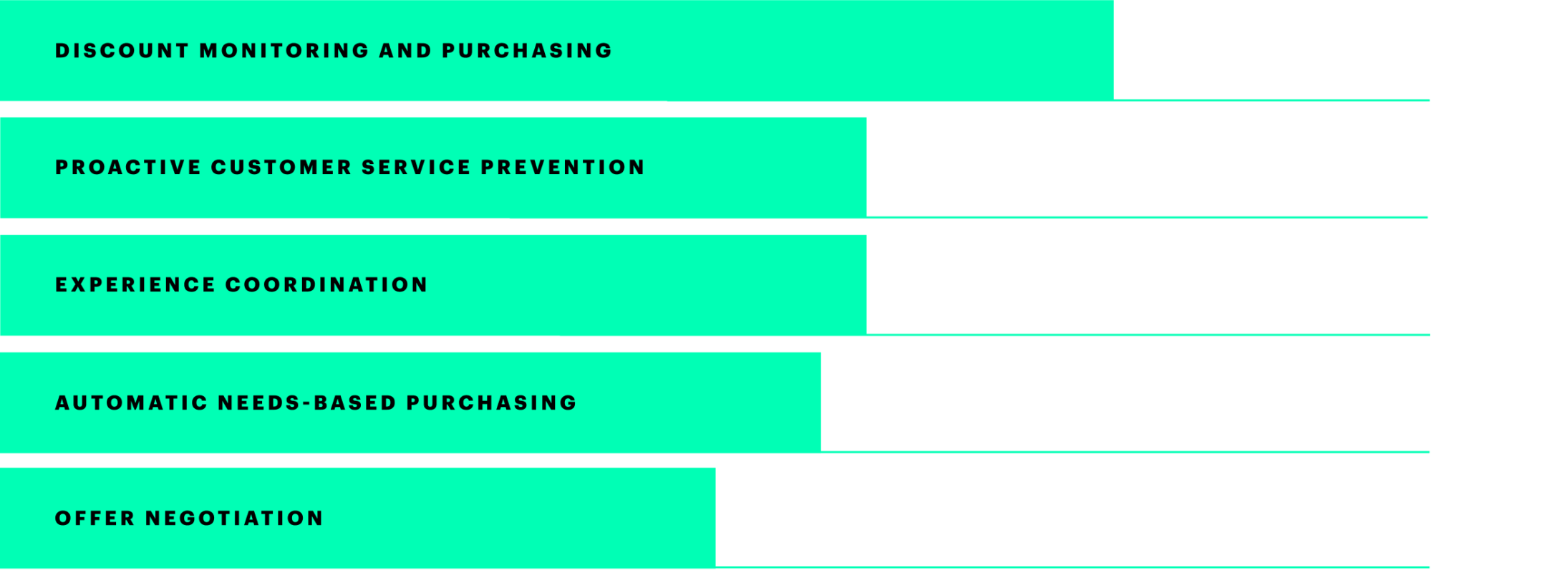
  1. Retailers and marketplaces are taking this one step further, collapsing the “choose-use journey” within GPTs. Etsy recently announced a partnership with OpenAI, enabling in-chat purchases, with Walmart just following suit. More will undoubtfully follow. 

AI allows brands to get even closer to their customers, driving engagement and winning with personalization, leading to increased purchase likelihood and CLTV.  

Example: Crocs 

Crocs has long proven that personalization fuels growth. The success of Jibbitz, the individual charms for crocs, has lifted average order values, driven repeat purchases and built deeper brand affinity. With 75% of customers purchasing Jibbitz and $271M in 2024 sales (18% of total revenue). With the launch of the ABLO AI co-design tool, Crocs is doubling down on personalization, enabling customers to design their own Jibbitz through AI-prompts and image uploads. AI prompt indicators point to greater personalization and conversion, showing how AI can deepen brand affinity and accelerate growth at scale. 

“We have Jibbitz for everyone — from teachers to gamers to healthcare workers — and we are now giving our fans the option to design one-of-a-kind charms using ABLO’s AI technology, taking customization to the next level.”

Crocs Brand President Anne Mehlman, Fast Company

Example: L’Oreal 

L’Oréal has long positioned itself as a beauty tech pioneer. Through acquisitions like ModiFace, L‘Oreal offers virtual try-ons and diagnostics that reduce hesitation in digital shopping. Its new venture Noli uses over one million skin data points to generate hyper-personalized product recommendations. Internally, its CreAItech content lab produces up to 50,000 images and 500 videos per month, allowing marketers to rapidly adapt creative assets across markets and cultures without sacrificing brand essence. AI is enabling L’Oreal to expand personalization and inclusivity at scale by strengthening emotional connection while accelerating growth.  

In January 2024, L’Oréal was the first-ever beauty company to deliver the keynote speech at the world’s most important tech event – the Consumer Electronics Show in Las Vegas. It was a highly visible stage to showcase our pioneering and leadership role in Beauty Tech and our next-generation innovations for more sustainable, personalized and inclusive beauty. These innovations included… Beauty Genius – a Gen AI-powered personal beauty assistant and HAPTA – the world’s first AI-powered makeup applicator for people with limited hand, wrist and arm mobility.

L’Oréal 2024 Annual Report

Pervasive Innovation 

Market leaders view innovation as an always-on, critical business muscle. They consistency over-invest in R&D, maintaining that discipline even in turbulent economic times. AI is accelerating the innovation process — from aggregating and synthesizing customer insights, identifying opportunities faster, to rapid concepting and prototyping and offering consumer validation through digital twins. With AI developing higher-quality innovation concepts, businesses can focus on critical routes to market activities, like securing the right distribution and getting through regulatory processes. 

Example: Moderna 

Legacy biopharma R&D is notoriously slow and capital intensive, but Moderna is proving that AI can reset the pace of innovation. Through its partnership with OpenAI, Moderna has deployed ChatGPT Enterprise across functions – from R&D to manufacturing — creating thousands of custom GPTs to trial handle trial data review, anomaly detection and documentation. These tools remove bottlenecks in data-heavy processes and allow scientists to focus on higher-order interpretation, resulting in a richer innovation pipeline. The result is compression of discovery-to-development cycles and Moderna plans to bring 15 new mRNA products to market in the next five years — from RSV vaccines to individualized cancer therapies. 

Culture as a Catalyst 

Culture is critical to achieving uncommon growth. Purpose-driven, intentionally designed cultures to enable enterprise-wide adoption of innovation, AI included. When AI adoption is fragmented across silos, momentum stalls. Prophet’s research, “Human-Centered AI: Culture as the Catalyst for AI-enabled Growth,” identified several imperatives for enterprise-scale AI adoption:

  • A shared AI vision aligned company purpose, values and strategy 
  • CEO and CHRO alignment on the AI vision 
  • Clear expectations for AI fluency and the role of humans  
  • Systems and training that enable AI adoption at scale  

Example: JPMorgan & Chase 

JPMorgan approaches AI adoption as both technological and cultural transformation. In under a year, it deployed its LLM Suite to more than 200,000 employees -embedding AI in daily workflows and building organizational fluency at scale. Tools like EEVEE and Smart Monitor (two of over 400 use cases at the firm) free teams from low-value manual work, redirecting energy toward higher-order problem-solving. The result is a workforce that sees AI not as a threat but as a partner: one that’s projected to fuel $1.5B in AI impact by 2030. JPMorgan’s bet is clear: AI will augment every role and drive growth — cultivating a culture where AI is trusted and widely used will compound in value, turning efficiency gains into a sustained competitive advantage. 

“We are setting very clear goals of success and KPIs for each one of these rollouts. We also have very good experimentation, so we can actually measure the incremental benefits by giving the tool to some agents and setting up test and control groups. We compare these results with clear metrics of success, and it helps us learn what’s working and what’s not working and what we need to do to drive adoption.”  

Katie Hainsey, Managing Director and Head of AI/ML and Data & Analytics for Digital, Marketing and Operations at JP Morgan

Example: Moderna 

Moderna recognized early that the barrier to AI adoption wasn’t just technology, but shared expectations of fluency. In 2021, it partnered with Carnegie Mellow to launch its AI Academy to drive AI fluency across the workforce, preparing employees long before generative AI went mainstream. That groundwork paid off when ChatGPT Enterprise rolled out in 2023: adoption was immediate, with nearly half of weekly active users creating their own GPTs and averaging over 100 interactions per week. By aligning purpose, values and training, Moderna turned potential resistance into active engagement, making AI a natural part of how work gets done.  


FINAL THOUGHTS

Category leaders are already leveraging AI as a top-line growth-accelerator, and not just as a bottom-line optimizer. We expect the revenue growth disparity will only deepen as AI maturity amongst leading companies continues. So, if you’re not using AI to grow your top-line, now is the time to start experimenting. 

BLOG

How AI Synthetic Personas Create a Whole New Level of Customer Centricity

Deeper, faster, more intelligent insights at your fingertips. 

For companies, achieving uncommon growth is a challenging goal. One important element is having a fact-based and data-backed strategy about who your customers are and how to target them. In reality, many blue-chip and large organizations are still not investing sufficient time and resources into addressing these questions. This is where smart segmentation can make a tangible difference. 

In marketing, customer segmentation has long been a tried-and-tested strategy to help leaders define what we call the “where-to-play”: Which customer segments to focus on as design target (a core set of consumers whose needs perfectly match their brand promise, products, services, and offerings etc. ) and as commercial targets (a broader group of potential customers with similar needs and therefore addressable). 

Once companies define “where-to-play”, the “how-to-win” question arises: How to best address the target segments in terms of product offering, marketing and sales? 

And this is exactly the spot where AI is now taking customer centricity to the next level by offering a deeper, faster, more intelligent analysis, interpretation and understanding of customer habits and preferences. This gives companies greater visibility and confidence about how they design their go-to-market approach.   

In recent work with a number of organizations, we have been pioneering a more innovative “how-to-win” approach to segmentation, by developing and testing so-called synthetic AI personas. We believe these AI-based personas have the potential, if properly managed, to give organizations next-level customer insights at their fingertips.

Transforming Audience Insights

Simply put, an AI is trained on all the qualitative and quantitative audience data from a segmentation project. The result is a digital twin that functions like a GPT, responding to text or voice input. You can “talk” to your target audience, a persona generated by AI, and ask it questions. It answers, depending on the model setup, in real time or after a short delay.   

The outcome? Clear, nuanced answers to questions about product and service offerings, price sensitivity, communication preferences, or decision-making behavior. Even more impressive, we’re seeing results that go beyond the typical scope of market research and the data set that was originally fed into the system.  

Of course, having clear guardrails and rules are critical to success. For example:  

  • Instructions on expected response quality (e.g., “Include data points with every recommendation, always reference motivation drivers of the target group”)
  • No-go zones (e.g., “Avoid any kind of generic recommendations or mass-market tactics in marketing efforts”)
  • Quality checks (e.g., “Formulate all recommendations in a customer-ready format so they can be implemented immediately”)

Another essential factor is training the AI. In one of our recent projects, it was necessary to put in place a three-step human-machine process: first, removing obvious errors and so-called hallucinations. Then, a twofold review phase where an initial set of recommendations was deliberately compared with the deep industry expertise of our consultants.  

The results have superseded our expectations. Nothing less than “audience insights at the push of a button.” In effect, marketers can now have access to a 24/7 customer persona they can consult on brand, product, pricing, sales or marketing communication topics.  

Below are three recent examples that show how this works in real-world settings. 

Example One: Travel company 

For a leading European travel group, we defined target customer segments for its hotel brands using a unique segmentation approach that combines lifestyle and travel behavior and needs. This resulted in the creation of Travel Lifestyle Clusters.  

For these segments, we developed AI personas and used them to help the client design targeted product strategies and communications across the entire experience journey—from brand to marketing and sales. The twist: once trained (which requires deep technical and industry know-how), these personas can draw implications beyond the  initial data input.  

For example: When asked, “What would an ideal welcome sequence at a luxury boutique hotel look like for you?” the persona provides detailed product, service and communication suggestions. Or, if market research reveals that a target group enjoys “beach and garden games” during hotel stays, we could ask it to specify which games fit their lifestyle. The AI persona would deliver tailored suggestions in seconds, including full staging, materials, music, etc.  

Example Two: Education foundation 

For a large foundation active in education, we developed AI personas for teachers as part of a school development project. Unlike the travel case, there was no primary market research available. Instead, personas were conceptually defined and built as “AI avatars.” Psychological models on motivation, change readiness, and change capabilities were used as input, along with a wide range of secondary statistical data. The final boost came from interviews with real teachers, conducted to reflect different pedagogical archetypes and integrated into the AI model.  

To deepen the impact, we gave the AI avatars names and faces, making them feel very real. As with the travel example, the results marked a milestone in working with audience insights. “Which of the following slogans would you prefer for a marketing campaign surrounding new tools and offerings to aid school development?”—the AI provides clear, precise, and logical answers that hold up in A/B testing with real interviews.

Example Three: Fast Food Brand 

For a fast food brand, we helped teams translate segmentation insights into decisions aligned with brand principles and growth goals. The breakthrough? We transformed the target segment into an AI-powered assistant—one that behaves like the segment and speaks the brand’s language. It was trained on human insights (attitudes, behaviors, cultural signals), brand DNA knowledge (positioning, tone, promise), and market context (category dynamics, local norms).    

This assistant is a flexible and replicable system that can generate and filter ideas, such as menu concepts, partnerships, channel formats and more, so they’re shaped by what will truly resonate with the audience while staying on-brand.  

Crucially, this should be regarded as an inspiration tool, not a decision-maker: human judgment still assesses feasibility, risk appetite and commercial readiness. That balance between speed from AI and judgment from experts can lead to faster alignment, clearer briefs and a stronger pipeline of testable ideas. 


We would like to thank Erik Muenster, Zadkiel Yeo and Prophet’s AI team for their contributions.


FINAL THOUGHTS

Within just the last 12 months, AI has elevated decades of marketing practice by building upon a strong foundation of customer data and insights.  

Knowledge is becoming more immediate, direct, and usable in real time. If properly set up and trained, data and insights form a nucleus from which AI can generate recommendations and actions that go beyond what the original data might suggest. Creativity may not be AI’s strength, but logical, linear extrapolation certainly is — and that leads to a significant boost in speed and quality. This can enable firms to derive even more value from their proprietary data, providing an important competitive advantage.

The power of AI in creating more flexible and intelligent customer personas is undeniable. Against this backdrop, marketing leaders must act decisively to put themselves ahead of competitors who are not yet using AI to their benefit.  

BLOG

The New Rules of Search: Why AEO Is the Next Frontier in the Age of AI 

SEO isn’t dead—It’s evolving but now is the time for companies to build a new AEO strategy. 

Search is no longer just about clicks—it’s about conversations. With the rise of AI-powered tools such as ChatGPT, Gemini, Perplexity and Bing Copilot, users are discovering information in radically new ways. These platforms summarize, synthesize and recommend content—often without users ever clicking a link. 

AI overviews are fundamentally changing user behavior, fragmenting discovery and forcing brands to rethink their web strategy. AI-generated summaries are increasingly occupying prime real estate on search engine results pages (SERPs), leaving fewer opportunities for traditional click-throughs. In fact, 74% of users now turn to AI tools instead of Google for information and 70% of B2B buyers say they’re less likely to trust a vendor if its AI-generated answers are inaccurate. 

Despite bold claims that “SEO is dead,” the truth is more nuanced. SEO is evolving. It remains foundational to how AI models understand and surface content. But to stay visible in this new landscape, brands must go beyond traditional tactics. Enter Answer Engine Optimization (AEO).  

AEO is a future-ready strategy that blends structured content, knowledge graph alignment and AI discoverability tactics to help brands appear in AI-generated responses. It’s not just about ranking anymore—it’s about being recognized, cited and trusted by AI. 

Why SEO Isn’t Dead—It’s Evolving 

Large Language Models (LLMs) are trained on the open web. That means your SEO-optimized content—structured, authoritative and well-linked—is still the raw material for AI-generated answers. 

Over the years, SEO has evolved from keyword stuffing to structured data, schema.org markup and semantic search. Now, AI is accelerating that evolution. Brands must ensure their content is not only crawlable but also interpretable by AI systems. 

In short: SEO is no longer just about ranking. It’s about being recognized and recommended by AI. 

The watch-out for brands today isn’t that SEO is dead—it’s that outdated or inaccurate content will quietly kill your credibility in AI-driven search.

From Search to Summarization: The Rise of AEO 

AEO is the next evolution of digital visibility. It’s a strategic approach to ensure your brand shows up accurately and prominently in AI-generated answers across platforms like Google’s AI Overviews, ChatGPT and Perplexity. 

A strong AEO solution requires: 

  • Brand Embedding: Measuring how close your content is to high-value topics in AI models. 
  • Entity Mapping & Schema Optimization: Ensuring your website’s content has structured data and brand’s information is correct in sources like Wikidata. 
  • Content Optimization: Creating AI-friendly content that’s concise, structured and semantically rich. 
  • Monitoring & Feedback: Tracking your brand’s presence in AI responses and correcting misinformation. Keeping that data at your fingertips through custom dashboards to showcase your brand’s visibility within LLMs and SOV against competitors.  

In a world where decisions are made without a click, AEO helps your brand stay visible, credible and competitive. 

The Rise of Multimodal Discovery 

Discovery isn’t just text-based anymore. Users now rely on: 

  • Voice search (“What’s the best HR software for small teams?”) 
  • Visual search (Google Lens, Pinterest) 
  • Conversational interfaces (AI chatbots and assistants) 

This shift means brands must optimize across formats—text, images, video and structured data. Multimodal discoverability is the new baseline. 

What Brands Need to Do Now 

Audit Your Digital Footprint

LLMs are trained on what’s already online. Outdated, inaccurate, or off-brand content can hurt your discoverability and credibility. 

Action: Audit old blogs, press releases, backlinks and landing pages. Identify and fix content that no longer reflects your brand or is factually incorrect. 

Refresh and Structure Content

Use structured data (like schema.org) and emerging formats (like LLM.txt) to help AI understand your content. 

Action: Refactor key pages with clear headings, concise answers and semantic markup. Write for both humans and machines.  

Strengthen Domain Authority

AI models prioritize content from trusted sources. Being quoted, linked, or cited by high-authority domains boosts your visibility. 

Action: Revisit your PR, editorial and influencer strategies. Build authority signals across the web. 

Understand Your Brand’s Embedding

AI models organize knowledge in vector space. Understanding your brand’s “semantic distance” from key topics reveals content gaps and opportunities. 

Action: Use tools to visualize your brand’s position in AI models and identify where to create or consolidate content. 

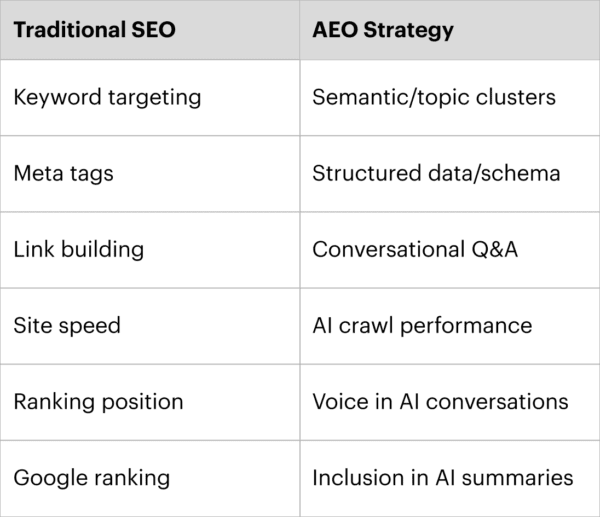
SEO vs. AEO: A Strategic Comparison 

AEO doesn’t replace SEO—it builds on it. But it requires a shift in mindset: from optimizing for clicks to optimizing for answers


FINAL THOUGHTS

We’re entering a new “wild west” of digital discovery—similar to the early 2010s of SEO, but moving even faster. AI is reshaping how people find, trust and act on information. 

Brands that modernize now—by embracing AEO and rethinking their content strategies—will have a significant competitive edge. Get in touch with our team to learn more about how we’re helping companies navigate the new AI-driven environment. 

BLOG

Rethinking Marketing Maturity in the Age of GenAI

How CMOs can leap forward—not just level up.

Every CMO we talk to these days knows two things:  

  1. Generative AI will change how marketing works  
  2. They don’t have time to wait and see how  

What they’re asking now isn’t why, but how.  

  • How do we start—without getting stuck?  
  • How do we scale—without fragmenting the customer experience?  
  • How do we prove ROI—without drowning in pilots?  

To answer these questions, Prophet has reimagined what a marketing maturity model should look like in the GenAI era.  

 Let’s Start With a Step Back   

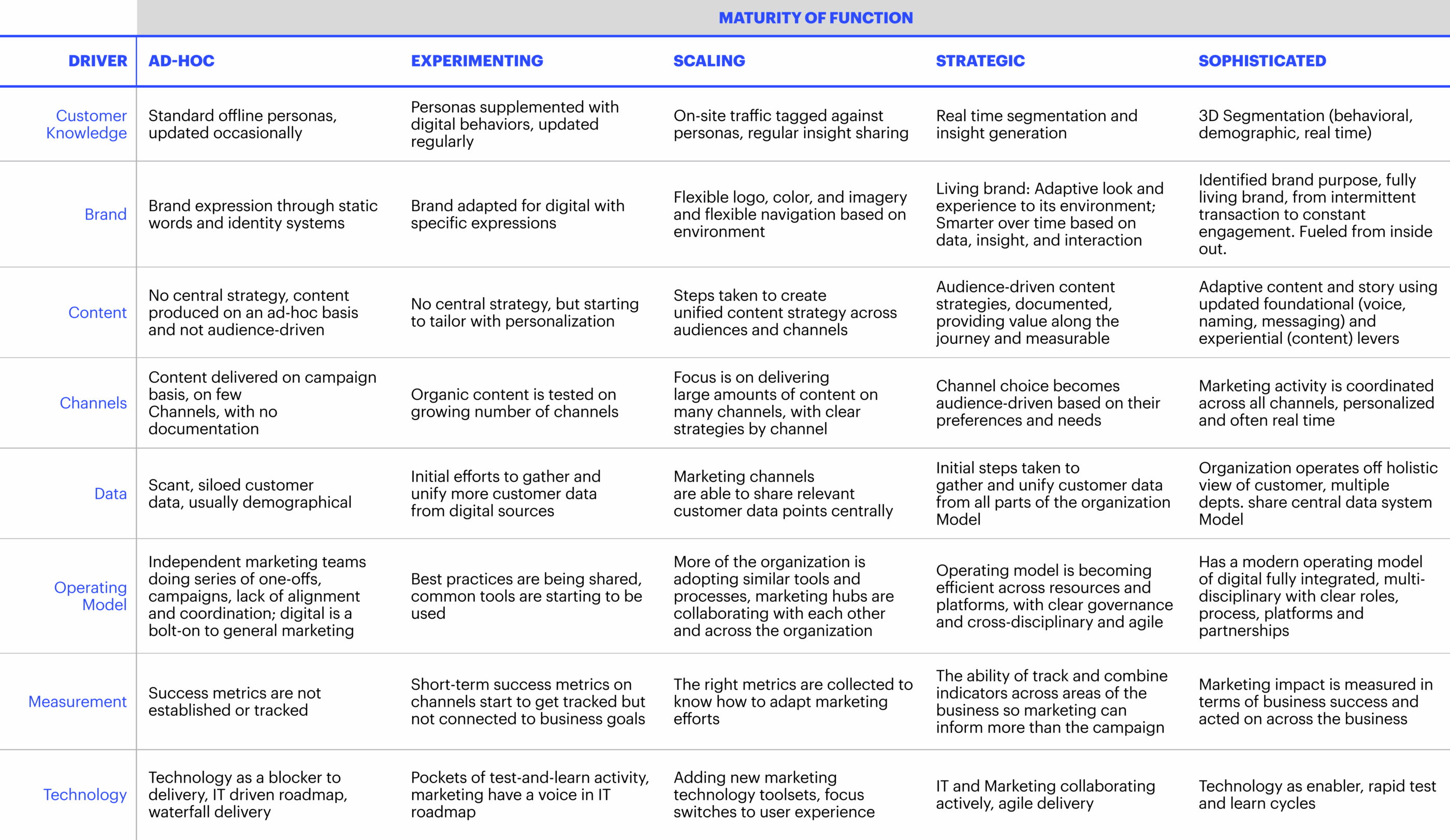
In 2018, Prophet debuted our Marketing Maturity Model to help our clients understand where their companies have the opportunity to transform their approach to marketing and unlock growth. It evaluated marketing capability across key dimensions: content, customer data, channels, operating model, measurement and technology.  

Our 2018 Marketing Maturity Model  

For the most part, with some iterative updates, it has stood the test of time, and we still use it to help guide our clients.   

However, the pressure on CMOs has never been higher. Expectations around marketing-led growth continue to rise, while teams wrestle with talent gaps, disconnected data and flat or shrinking budgets. At the same time, customer expectations demand personalized, real-time experiences and traditional marketing processes can’t keep pace.   

The Opportunity for GenAI in Marketing  

GenAI—and increasingly, agentic AI systems—are reshaping how marketing operates. It’s not just about faster content or smarter segmentation. It’s about fundamentally changing how marketing teams plan, execute and optimize across the entire value chain:  

  • From content creation to campaign orchestration
  • From persona-based targeting to predictive segmentation  
  • From manual reporting to real-time optimization  

And GenAI can supercharge marketing performance:  

  • IDC Estimates that GenAI will increase Marketing productivity more than 40% by 2029.
  • The Financial Times, reporting against an analysis of 167 companies deploying level-3 LLM based agents saw revenue increases of 9-21% for sales and marketing functions.

Early adopters are rapidly out-pacing competitors by embedding GenAI. They are meeting customers’ demands for hyper-personalization and Autonomous AI agents are giving teams more agility than traditional marketing processes allow. And companies that have already started are seeing the benefits of exponentiality whereby the agents learn and become more effective and efficient with time.   

Content Creation and Creative Augmentation  

Generative AI tools act as creative partners, drastically cutting down the time to produce marketing materials and opening possibilities for mass customization. A human-in-the-loop approach ensures brand voice and factual accuracy remain on point. Generative AI supports the creative process so marketing teams can focus on high-level messaging and strategy, confident that the AI can supply a steady stream of drafts or designs to choose from.  

  • Expanded Creative Capacity: GenAI rapidly generates copy, imagery and video—multiplying creative output with fewer resources.  
  • Personalized Creative at Scale: AI enables customization of content variants tailored to segments or individuals without extra lift from teams.  
  • Faster Iteration & Testing: Content variations (headlines, formats, CTAs) are automatically generated, A/B tested and optimized in real time.  
  • Brand Governance Built-In: AI systems can be trained or prompted to comply with brand tone, voice and regulatory requirements.  
  • Creative Co-Pilot to Creator: As capabilities evolve, GenAI will shift from augmenting human creatives to autonomously producing and deploying asset-ready materials across channels.  

Dynamic Segmentation: A New Era of Customer Understanding  

Understanding your customers at a granular level is foundational to effective marketing. GenAI supercharges customer segmentation by analyzing data at a depth and scale that humans  cannot match. Marketers move from static segmentation to a responsive, intelligent system that adapts in real time to market and customer changes.  

  • Granular Precision: GenAI analyzes behavioral, transactional and engagement data at scale to uncover micro-segments and hidden patterns traditional methods miss.  
  • Real-Time Adaptability: AI-driven segmentation evolves continuously based on live data across channels—adjusting targeting as preferences, signals, or behaviors shift, allowing marketing to shift on the fly.
  • AI-Generated Personas: Models can synthesize lookalike audiences and new personas, improving targeting precision and reducing waste in campaigns.  
  • Predictive Insight: GenAI strengthens segmentation with forward-looking intelligence—anticipating churn, lifetime value and conversion probability. It can predict which customers are most likely to make repeat purchases, which are at risk of churn, or which prospects are likely to convert, often with greater accuracy than traditional models, thanks to the AI’s ability to detect subtle patterns.  

Hyper-Personalization of Customer Experiences  

The holy grail of marketing is “the right offer, at the right time, via the right channel, to the right person.” Generative AI is bringing this ideal of hyper-personalization at scale closer to reality. By combining granular customer data with creative generation capabilities, GenAI can help craft experiences and messages tailored to segments of one.  

  • Dynamic Personalization: Combines real-time data and AI-generated content to create truly individualized experiences.  
  • Beyond Messaging: AI personalizes offers, journeys, pricing and digital environments—not just copy.  
  • B2C & B2B Impact: Tailors experiences across the customer lifecycle, from retail to complex B2B buying groups.  
  • Efficiency Gains: Automates content, outreach and optimization—freeing teams for strategic creative work.  
  • Business Outcomes: Increases conversion, customer satisfaction and loyalty by making customers feel understood.  

Autonomous Campaigns and Marketing Operations  

Perhaps the most transformative impact of GenAI will come from automation of marketing operations and the emergence of autonomous marketing agents. In today’s marketing, executing a campaign involves many manual and repetitive tasks. Agentic AI has the potential to choreograph many of these tasks automatically, effectively acting as an extra pair of (digital) hands – or an entire “digital marketing team” – that works 24/7 with perfect consistency  

  • From Tasks to Autonomy: Agentic AI automates campaign execution and internal workflows—acting as a 24/7 digital marketing team.  
  • Faster, Smarter Execution: AI agents optimize performance in real time—audience targeting, budget shifts, creative testing, etc.  
  • Seamless Funnel Engagement: Agents handle early-stage lead qualification, handoffs and conversational marketing.  
  • Cross-Functional Automation: Supports operations like content planning, compliance review and data integration.  
  • The Future of “Marketing Autopilot”: Phased evolution from AI-assisted tools → autonomous agents → fully automated marketing teams.  

Introducing the Prophet GenAI Marketing Maturity Model  

Many marketing leaders  are concerned – are we too far behind already? Noting “Our current marketing wasn’t up to a sophisticated level of maturity before GenAI started to take over, so how can we possibly catch up?”  

Traditional maturity models describe a journey from “ad hoc” to “optimized,” implying you must climb rung by rung. But GenAI has changed the rules. You no longer have to move in sequence—you can jump.  

  • Go from inconsistent content to scalable, brand-safe personalization in a quarter.  
  • Skip the years-long Martech roadmap and deploy agentic systems that act as 24/7marketing teams.  

The trick is not just adopting GenAI tools—it’s embedding them into the operating model.  

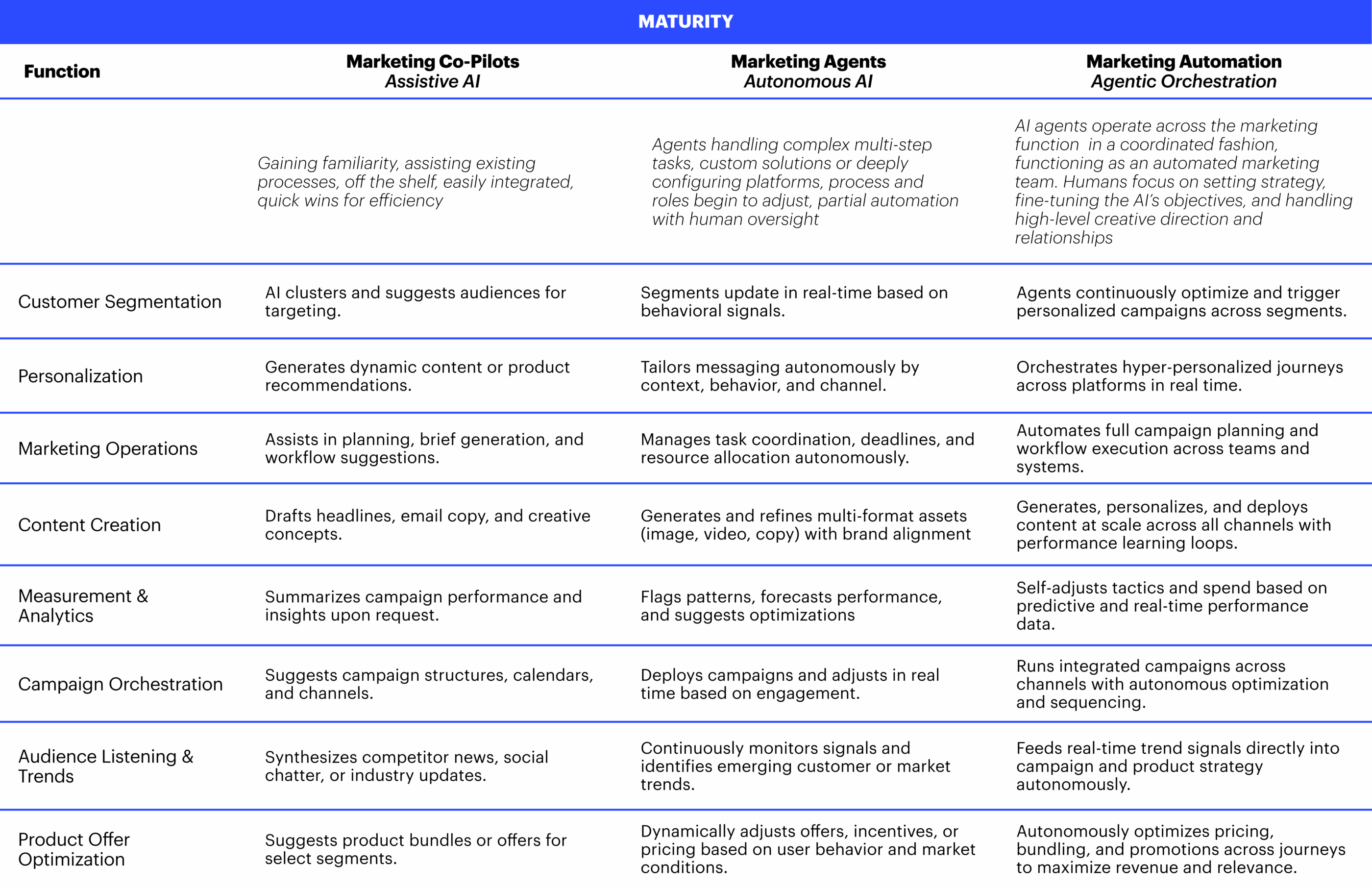
Our updated model maps GenAI capabilities across eight marketing functions—from customer segmentation to campaign orchestration—across three stages of maturity:  

Where are you Today—and What can you do Tomorrow?  

Whether you’re piloting your first GenAI tool or scaling autonomous agents, your path forward depends more on organizational readiness than AI capability. Here’s how to move:  

Start Small, Scale Fast  

  • Pilot in areas with low risk and high visibility (content ops, lead scoring, message testing).  
  • Use these early wins to build internal confidence and proof points.  

Design for Integration  

  • Establish a GenAI Center of Excellence or a cross-functional squad. 
  • Align with IT, legal and data to ensure brand governance, ethics and compliance.  

Map to Growth Metrics  

  • Don’t just track clicks—link GenAI to business outcomes: ROMI, CLTV, speed to value.  
  • Create a dashboard that shows GenAI’s contribution to revenue and retention.  

Shift Mindsets & Roles  

  • Upskill marketers to become orchestrators, not just executors.  
  • Redesign workflows to let AI handle the repeatable—and people handle the exceptional.  

FINAL THOUGHTS

Talk to Prophet about how you can embed AI in your marketing and in your marketing operating model for the uncommon growth that great strategy, creativity, innovation and culture can together provide.  

Human-Centered AI: Culture as the Catalyst
for AI-enabled Growth

Four Key Levers of
Human-Centered AI

DNA: Aligning AI with Purpose and Values.
Organizational DNA defines purpose and anchors strategy. When AI is aligned with core values, it gains direction, momentum—and staying power. 

Mind: Scale Skills for What’s Next.
AI demands new capabilities across the workforce. Equip employees with the skills and mindsets needed to adapt, grow and lead through change. 

Body: Redesign How Work Gets Done.
AI is reshaping roles, systems and workflows. To scale transformation, organizations must rethink how work happens and make agility the norm. 

Soul: Deepen Human Connection.
By removing routine tasks, AI allows employees to focus on meaning, creativity and connection. The result: stronger engagement and purpose-driven work.

The Future is Human-Centered AI

It’s time to move beyond fragmented experimentation and toward intentional transformation. 

AI isn’t just about automation—it’s about reimagining how people work, connect and grow. 

When embedded across the DNA, Mind, Body and Soul of an organization, AI becomes more than a tool. It becomes a catalyst for purpose-driven growth, empowered talent and lasting cultural change. 

The Future is Human-Centered AI

It’s time to move beyond fragmented experimentation and toward intentional transformation. 

AI isn’t just about automation—it’s about reimagining how people work, connect and grow. 

When embedded across the DNA, Mind, Body and Soul of an organization, AI becomes more than a tool. It becomes a catalyst for purpose-driven growth, empowered talent and lasting cultural change. 

Download Report
Human-Centered AI: Culture as the Catalyst for AI-enabled Growth

*Fill in all required fields

Thank you for your interest in Prophet’s research!

BLOG

Scaling AI Adoption from the Inside Out

This is how we’ve been building an AI-ready organization at Prophet.

At Prophet, we’ve been exploring AI’s potential for some time—experimenting, building and learning across teams. But our biggest leap forward didn’t come from a new tool or top-down policy. It came from a collective shift in focus. 

Earlier this year, we hit pause across all 15 global offices to host our AI Learning Jam—a firmwide sprint designed to upskill, energize and unlock new ideas. We brought in outside experts, spotlighted internal pioneers already integrating AI into their work, and carved out time for hands-on experimentation. Teams tackled real client challenges using AI—and the momentum was immediate. 

Feedback from the event was among the strongest we’ve seen for a firmwide initiative. But more powerful than any metric was what it set in motion. 

We followed it with our first AI Demo Day, inviting submissions in three categories: 

  • How we’re using AI to enhance current work 
  • How we’re guiding clients on AI strategy 
  • How we’re building AI products and solutions 

Twenty demos. Ten teams were selected to present to our executive leadership. The range of use cases was eye-opening—from custom GPTs that accelerate insights and storytelling, to AI-powered tools that generate consulting outputs, to strategic frameworks helping clients define their AI vision. We carefully considered the potential for each demo and recognized the top contributors. We are now scaling these solutions firmwide. 

One team reported a 90% time savings on market mapping tasks—freeing them to focus on strategic thinking and creativity. Another team doubled their content output using a custom GPT trained on a specific tone of voice. 

Our focus on AI solutions isn’t a one-off initiative. It’s a cultural shift—and we’re seeing it in the data. The number of custom GPTs built internally has grown exponentially. 

We’re also applying our own Human-Centered Transformation Model to this journey: 

  • MIND — Enable: The AI Learning Jam built foundational knowledge and shared capabilities across the firm. 
  • SOUL — Motivate: AI Demo Day showcased what’s possible and celebrated early wins. 
  • BODY — Direct: We’ve embedded AI into competencies and workflows, launched a Center of Excellence and built infrastructure to support scale. 

FINAL THOUGHTS

We’re early—but we’re all in. Because when transformation starts with people and is guided by purpose, it scales faster and sticks deeper. 

And we know many organizations are asking the same questions: Where do we start? How do we move beyond pilots? What should we build, automate—or advise on? 

If you’re looking to scale AI adoption, build internal momentum, or embed AI into the customer experience—we welcome that conversation. Get in touch. 

BLOG

Why Branding Matters More in the Age of AI 

As GenAI transforms customer experiences, brand authenticity and transparency are more critical than ever. Learn how companies can use AI to deepen brand loyalty and drive growth in Asia’s fast-evolving markets. 

Does branding still matter in the AI era? The answer is not just yes—it’s becoming more critical than ever. 

AI is radically transforming how people shop, communicate and make decisions. In Asia, consumers are embracing these powerful technologies faster than anywhere else in the world. They’re using AI assistants, experiencing AI-powered recommendations and creating content with generative tools daily.  

Something surprising emerged from Prophet’s research, The Rise of the AI-Powered Consumer, comparing GenAI trends in Asia and around the world: As technology advances, human connection becomes more valuable. We surveyed consumers across five countries and discovered that people in China and Singapore aren’t just AI enthusiasts—they’re also the most insistent on authentic brand relationships. They want the efficiency AI brings and the transparency, trust and genuine human touch that brands can uniquely deliver. 

This creates both a challenge and an opportunity for brands in Asia. Here are three key trends brand leaders should keep in mind, along with examples of companies already building powerful, practical connections in the wake of AI disruption. 

Consumers Want Authenticity 

Consumers are adopting GenAI at a fast pace, especially in Asia. Prophet’s study found that 60% of Chinese consumers and 56% in Singapore are using GenAI, well ahead of consumers in Western markets. Moreover, 84% of consumers in China and 75% in Singapore say they are excited about brands that integrate AI.

With brands being more dynamic than ever, they must evolve into intuitive storytellers, balancing machine insights with human judgment. If brands are not careful, GenAI content and experiences can appear too polished or too perfect. That may feel generic and inhuman, undermining trust and connection. 

At the same time, concerns persist. Globally, 43% of consumers find some aspect of AI worrisome, but in Singapore, that rises to 57%—the highest among surveyed countries. People also expect companies to be honest, with 82% saying companies should always disclose the ways they use AI. 

As consumers become more aware of AI’s role in marketing, brands must continue to lead with authenticity to maintain credibility and long-term loyalty. Brands that leverage AI for personalization can enhance their identity and relevance, but they must also be cautious of over-reliance on technology, not losing the humanity that makes for meaningful and enduring relationships with consumers. 

(Image Source: Campaign Asia)

One powerful example of authentic AI use comes from Telekom Malaysia. To celebrate Hari Kebangsaan (Malaysia’s Independence Day) in 2024, it launched “Sejuta Suara, Satu Ritma, Jiwa Merdeka,” using AI-driven lip-syncing and voice cloning to let Malaysians sing in their preferred language. Rather than showcasing AI for its own sake, the campaign celebrated Malaysia’s rich linguistic diversity and highlighted the brand’s promise to open doors to a promising tomorrow. 

The result: AI amplified cultural identity rather than diminishing it, showing how technology can strengthen authentic connections. 

Other brands are also using AI in service of authenticity. Zalora, a fashion ecommerce site, developed an intuitive, multilingual chatbot deeply integrated with customer service data. It helps users track orders, manage returns and resolve issues quickly—and it does this in ways that look and feel distinctly “on brand.” This demonstrates how AI can enhance the customer experience while maintaining the authentic brand voice that shoppers trust. 

Brands can enhance authenticity by: 

  • Ensuring overall brand strategy is built based on core human insights and not technology alone
  • Creating AI tools that solve real customer problems rather than showcasing technology 
  • Maintaining consistent brand voice and values across touchpoints using custom-built AI assistants 
  • Combining human oversight with AI to ensure outputs stay true to brand tone, audience needs, and real-world relevance 

Consumers Crave Human Connection 

In China, 89% of consumers believe GenAI improves people’s lives by automating tasks and boosting efficiency; in Singapore, it’s 84%. (These enhancements are proving so valuable to consumers that 83% of Southeast Asian shoppers say they would pay more for them.) 

But even with their enthusiasm, consumers remain wary of losing human interaction. In Singapore, 75% of consumers worry that AI might replace human contact—the highest level of concern among surveyed markets. Almost half of Chinese consumers also share this fear. 

Many companies begin their AI journeys by solving customer pain points. When AI simplifies transactions, consumers welcome it. But in the meantime, the role of brand remains crucial by ensuring that technology complements—not replaces—human connection.

AirAsia’s “Ask Bo” concierge app is a strong example. While it automates travel tasks like booking and gate changes, recent updates allow customers to seamlessly transfer to a human agent when needed—combining AI efficiency with human reassurance. This hybrid approach acknowledges that while AI can handle routine tasks, human intervention remains essential for complex situations—preserving the human touch that builds trust. 

Shiseido Haneda Boutique (Image Source: Shiseido) 

Shiseido offers another best practice. Partnering with Revieve, a beauty tech developer, it uses AI for skin analysis but complements it with in-store beauty consultants who personalize recommendations. The result is an experience that feels deeply human, even when AI powers the initial interaction. By combining technological analysis with human expertise, Shiseido creates a premium experience that neither AI nor humans could deliver alone, deepening the customer relationship. 

Brands can maintain human connection by: 

  • Clearly signaling human oversight within AI systems 
  • Giving customers access to live human support when needed 
  • Designing AI experiences that complement rather than replace human expertise 
  • Creating opportunities for emotional connection even within automated processes 

Loyalty Still Matters 

Even as AI changes consumer expectations, and transforms the customer experience, loyalty remains at the heart of brand value AI enables brands to deliver personalized, relevant interactions that serve to strengthen bonds with customers.  

This is especially true in Asia, where consumers are particularly optimistic about AI’s potential. In China, 76% believe GenAI will improve their financial well-being by offering smart insights, as do 65% of Singapore’s consumers, creating an opportunity for brands to deepen trust by delivering tangible, AI-enabled value. Asian consumers also show greater trust in AI’s ability to spot opportunities they might otherwise miss. About 72% of Chinese and 76% of Singaporean consumers believe AI can help them make better decisions—higher than any other region surveyed. 

DBS Bank, headquartered in Singapore, exemplifies loyalty-building AI. It has embedded more than 800 AI models across 350 use cases, offering customers personalized financial advice. Its AI-powered virtual assistant supports call center employees, reducing call handling times by up to 20%—making human help faster and more satisfying for customers. By making human help faster and more effective, DBS strengthens its reputation for exceptional service—turning AI into a loyalty-building advantage. 

Anthony Tan, Grab Group CEO and Co-Founder at GrabX 2025 (Image Source: GizGuide)

Grab, the Southeast Asian super app, is also investing heavily, introducing AI Merchant Assistant and AI Driver Companion tools in collaboration with OpenAI and Anthropic. The two AI-powered solutions are personal, intelligent assistants designed to help Grab’s merchants and drivers optimize their businesses and maximize productivity. By making daily tasks easier for its partners, Grab builds loyalty by showing its AI innovations have heart, not just efficiency. These tools demonstrate Grab’s commitment to supporting its ecosystem of partners, building a community of loyal merchants and drivers who in turn provide better service to end customers. 

Brands can build loyalty by: 

  • Personalizing experiences in ethical, human-centered ways 
  • Designing AI solutions that save customers time and help achieve their goals 
  • Using AI to empower employees to deliver better service 
  • Creating feedback loops that continuously improve AI tools based on customer input 

Prophet’s global research study is applied and brought to life in client engagements. We help organizations unlock uncommon growth by understanding and taking advantage of digital disruption. There are several ways to work with us: 

  • AI-powered growth consulting: Creating future-back business and brand positioning strategies that help you act on GenAI consumer and business trends to drive tangible results 
  • AI-enabled products and experiences: Envisioning and bringing to life new products, services and experiences that are enabled and accelerated by GenAI 
  • AI-driven marketing organization for the age of GenAI: Understanding your marketing vision, activating relevant AI use cases and deploying new capabilities 

FINAL THOUGHTS

AI is reshaping the customer journey, but it cannot replace the human elements that are central to strong brands. Consumers in Asia are embracing AI faster than anywhere else—and yet they still demand authenticity, trust and connection. Brands that use AI to enhance—not replace—these human values will be the ones that earn lasting loyalty and drive growth in the new AI economy.

BLOG

The State of GenAI Adoption in Europe  

Essential insights for business leaders aiming to unlock consumer-centric growth and stay ahead of the curve in 2025.   

GenAI marks a turning point in digital transformation – one that is fundamentally different from any technology shift we’ve seen before. As a technology that augments intelligence and creativity, its capacity to revolutionize industries is infinite. Senior leaders across Europe are eager to tap into GenAI’s potential to drive large-scale efficiencies and expand capabilities. But what does this mean for consumers? Are businesses truly considering the impact of GenAI on consumer needs and behaviors?  

As European businesses race to implement GenAI, they must center their strategies around consumers, ensuring that innovation serves not only business goals but also the evolving demands of the consumer. Placing consumers at the heart of GenAI adoption is key to achieving sustainable, uncommon growth.  

Many senior leaders are excited about GenAI’s potential to drive large-scale efficiencies. Boards are focused on GenAI risks, but recognise that investments have major potential upside. Our research confirms that for businesses to win in this next wave of digital transformation, it is all about consumers.

Data from our latest research report, The Rise of the AI-Powered Consumer, highlights that around a third of German (30%) and nearly 40% of UK consumers have embraced GenAI tools in the last six months. However, Europe lags behind other regions – Asian markets like China and Singapore report much higher adoption rates, with 60% and 56% respectively. The slower adoption can be attributed to growing skepticism and privacy concerns.

One notable trend in the European markets we surveyed is the younger demographic leading the charge. Millennials (ages 28-42) have shown the highest adoption rates, with 53% actively engaging with GenAI tools. In comparison, GenZ (ages 16-28) lags behind by 3 percentage points. Their lower enthusiasm stems from concerns over the relevance and accuracy of GenAI’s output. With millennials holding the most purchasing power today, businesses need to act now to meet their needs, or risk falling behind.  

Putting Consumers at the Heart of AI Innovation 

For GenAI to drive meaningful innovation, companies need to understand how European consumers are interacting with the technology. Our research shows that more than half of European consumers surveyed (and global consumers) use GenAI for both professional and personal purposes, with personal usage rates hitting 90%.  

The leading use case of GenAI is entertainment – creating memes, songs and other content to share with family and friends. This trend offers brands an opportunity to engage with consumers in playful, creative ways. Take Zalando, the German e-commerce giant, for example: they’ve introduced the Algorithmic Fashion Companion (AFC), a GenAI-powered tool that provides personalized fashion recommendations, resulting in a 40% increase in average basket size.  

European consumers also expect more from brands adopting GenAI. In the UK and Germany, over 70% of consumers want to use AI during the pre-purchase phase, showcasing the growing demand for AI-powered product and service exploration. Moreover, 73% of respondents view brands using GenAI as innovative, while 77% say GenAI sparks new product discoveries. It’s clear that consumers want AI to do more than just entertain – they want it to help them make informed choices.  

AI and Ethical Responsibility 

In Europe, there is a heightened demand for accountability and transparency when it comes to GenAI. Nearly 66% of German consumers express concerns about the ethical use of GenAI, a sentiment echoed across other European markets. Moreover, 82% of global consumers expect brands to disclose when they are using AI in their services.  

The reason for this concern is clear – privacy and data security remain top priorities for European consumers. Two-thirds of consumers cite these as primary barriers to greater GenAI adoption. This is especially pronounced in Germany, where privacy laws and concerns about data misuse are particularly strict. Consumers expect businesses to take the lead in creating ethical frameworks and transparent policies for AI usage, with 80% of global respondents agreeing that it is the responsibility of companies to develop clear guidelines for GenAI.  

As businesses in Europe look to unlock the full potential of GenAI, they must balance enthusiasm with caution. There is certainly a growing appetite for innovation, but the key to success lies in ensuring that these technologies enhance the consumer experience in ethical and responsible ways. This means taking seriously the need for transparency, privacy protection and clear ethical guidelines. 


FINAL THOUGHTS

For European brands to thrive, they must center their GenAI strategies around consumer needs, build trust and foster long-term loyalty. By doing so, they can position themselves for uncommon growth.  

The Rise of the AI-Powered Consumer

The TL;DR on Our Findings

We surveyed more than 2,400 consumers across the globe to understand how they perceive and use GenAI, here’s what we found:


Download the report to discover how consumers are leveraging GenAI today and how your business can harness these insights to create transformative growth opportunities.


Download Report
The Rise of the AI-Powered Consumer

*Fill in all required fields

Thank you for your interest in Prophet’s research!

Your network connection is offline.

caret-downcloseexternal-iconfacebook-logohamburgerinstagramlinkedinpauseplaythreads-icontwitterwechat-qrcodesina-weibowechatxing