How clear value stories can position health tech companies to earn greater trust and premium valuation.
Healthcare technology companies face a paradox: the market has never been more bullish on the sector — recent research showed that AI-enabled companies now capture 55% of all health tech funding and command a 19% premium on deal size — yet public health tech companies still trade at a meaningful discount to cloud peers, despite roughly 2x the revenue growth and free cash flow margin.
Strong businesses still lose value when the story is unclear: The gap isn’t just a business problem; it’s a narrative problem. Most health-tech companies have a brand platform in one deck, a product story in another, an investor narrative from the CFO’s team, and a sales pitch from field marketing. Individually, each is internally logical, but collectively incoherent and hard for teams to articulate. Too often, companies speak in higher-order benefits without ever making clear what they actually do, where they play, or why they should win an organization’s business.
We recently sat in a room where a health-tech company pitched its full suite of services. After they finished, our client simply asked at the vendor: “So what is it that you actually do?”
A Story of Value connects the story across audiences: What closes this gap for clients is a Story of Value: a coherent narrative spine that captures who the company is, the tension it resolves, how it creates value, and why that story justifies premium valuation. When the narrative is properly modulated for priority audience groups, it retains its core value while ensuring resonance for each audience.
Five Moves That Make a Value Story Credible
Health-tech companies that get this right will:
Define a clear frame of reference first. Before reaching for elevated positioning, companies need to answer a basic question: what do they actually do? Name the competitive set, the outcomes, and where they play. In our work with a major healthcare financial services company, the challenge was moving beyond its best-known role in facilitating payments transactions toward a broader frame: bridging gaps in the healthcare financial system, improving the financial experience of healthcare, and aligning the interests of payers, providers, and members. That shift created a stronger platform for growth.
Name where AI creates defensible economic value. Being AI-enabled may now be table stakes; it cannot be the whole story. The real question is where AI creates advantage that compounds over time and is difficult to copy. In our work with a major virtual care platform, we saw how quickly AI language can flatten into sameness: personalization, insights, integration. What created credibility was not broader AI rhetoric, but specificity — which data, improving which workflow, producing which measurable result.
Ensure the human touch is inextricably linked to AI. In healthcare, meticulous care around data is paramount, especially when it comes to AI use. In helping shape the story for that same virtual care platform, one important choice was to frame AI as an enabler of people, not a replacement for them, with clinician oversight built into the moments that matter most. The important move was not just having that governance mindset internally but making visible to the market where automation stops and expert judgment begins.
Thread a single narrative across every audience. Investors, buyers, clinicians, and patients should all recognize themselves in the same core story, with the emphasis adjusted for each audience. We saw this in our previously mentioned work for a healthcare financial services company: by anchoring the company in bridging gaps across the healthcare financial system, the story could resonate across payers, providers, and members without splintering into disconnected messages. One framework, many expressions.
Build a system of proof — and earn your claims over time. Sophisticated healthcare buyers are not rewarding ambition alone; they are asking for evidence. Large employers and health systems want proof before integrating new tools and systems, especially when AI claims are involved. In our work with a patient financial engagement platform, the strongest story was not AI for AI’s sake, but AI tied to operating outcomes: higher collections, lower cost-to-collect, faster cash flow, and fewer billing calls through intelligent support. That kind of results-backed proof makes innovation more credible because it connects technology directly to measurable value.
In the age of AI, the margin for narrative incoherence is zero. The companies that answer the market’s implicit question, “why this company?”, with one credible, evidence-grounded Story of Value will earn the multiples, the deals, and the trust, outpacing competitors without a clear articulation of what they do and why it matters.
Healthcare leaders are operating in an environment where innovation alone is not enough. To earn trust — and the premium that comes with it — companies need a narrative that is as disciplined as their strategy: clear in its frame of reference, specific in how value is created and grounded in evidence. The strongest stories do more than describe a business; they help the market understand why they should care.
Interested in pressure-testing your current story? Let’s discuss how a Story of Value can strengthen your organization’s positioning, market confidence and growth.
In Health Tech, AI Doesn’t Win Deals – Outcomes Do
In health tech, advantage comes from explaining the impact of advanced intelligence.
Every healthcare service and technology company now claims to be AI-powered. What once signaled innovation now reads as category shorthand. According to a recent McKinsey survey, 85 percent of healthcare leaders are now exploring or have adopted generative AI capabilities—making “AI-powered” closer to table stakes than a point of distinction. Meanwhile, buyer skepticism is rising in parallel: a national survey from Ohio State University and SSRS found that public openness to AI in care dropped from 52 percent to 42 percent in just two years. The presence of AI alone no longer earns attention. Buyers want to know what it actually does, where it matters, and why they should believe it will work in the environments in which they operate.
The market is saturated with undifferentiated AI claims. That shift has created a new messaging challenge. In many health-tech companies, AI is described at one of two unhelpful extremes: either as a broad aspiration that could apply to almost anyone, or as a technical capability that only product teams can decode. The result is a value gap. Companies may be making real investments in data, models, and intelligent workflows, but their market story still fails to answer the most important buyer question: why should this matter to me?
The Three Places Companies Tend to Tell Their AI Story
From our work across healthcare, data and technology businesses, we see a consistent pattern. AI messaging tends to land in three places, but only one of them creates real differentiation.
First, there is AI in the product: copilots, smart features, clinical suggestions, intelligent routing. These capabilities are increasingly expected, but rarely distinctive. Nearly every competitor either has them or claims to. Framed this way, AI becomes a feature label, not a market advantage.
Second, there is AI in the business: internal efficiency, lower cost-to-serve, faster processing, better staffing. This can be an important part of the investor story. But it is usually the wrong lead message for customers. Buyers care about whether those gains translate into better service, better economics, or better outcomes for them.
Third, there is AI as a driver of customer value. This is where differentiation begins. The message shifts from what the technology is to what it changes: which workflow improves, which decision gets smarter, which friction point is removed. In this mode, AI is not the headline. The headline is the benefit it generates.
The hardest claims to copy are not capability claims. They are claims rooted in proprietary data, embedded workflows, measurable results, and a trust model that holds up in practice.
A Simple Test for Whether Your Message is Working
We saw this clearly in a recent messaging engagement with a major virtual care platform. Like many companies in the category, it faced a familiar risk: its AI language sounded too broad to be credible and too similar to what others were already saying. Terms such as personalization, insights and integration were directionally right, but too generic to carry the story. What sharpened the narrative was greater specificity — which data made the system smarter, which moments in the care journey improved, how the technology helped care teams act sooner and engage the right people. Just as important, the company needed to show where clinician oversight remained essential and where governance was built into the system. In healthcare, trust is not supporting detail. It is part of the value proposition.
This points to a simple pressure test: if you remove the phrase “AI” from your message and it no longer says anything meaningful, you are describing the technology, not the advantage. If the story remains compelling without the term — because it communicates workflow impact, outcomes, proof, and trust — then the message is doing real strategic work.
In Healthcare, Credibility is the Differentiator
The companies standing out today follow the same discipline. They name the user and the workflow. They quantify the effect. They make clear why their data or delivery model gives them an edge. And they treat governance and responsible use as visible parts of the story, not footnotes for legal review. In healthcare, where the standard for credibility is structurally higher, vague AI rhetoric does more than blur differentiation. It can actively weaken trust.
In health tech, AI may be necessary, but it is no longer enough. The companies that stand out will not be the ones that talk about intelligence most loudly. They will be the ones who explain most clearly how intelligence creates better care experiences, stronger engagement, greater efficiency, and more credible outcomes.
If your organization is investing in AI but struggling to turn that into a story customers trust, it may be time to pressure-test the narrative. We work with healthcare services and technology companies to clarify where AI creates real value, how that value should be expressed across audiences, and what proof is needed to make the story credible in market. If that challenge feels familiar, let’s start a conversation.
AI Is Transforming Marketing in Healthcare–Is Your Team Ready?
How leading healthcare and technology brands are piloting AI to transform their marketing—and what it takes to do it right.
AI isn’t just another tool in the marketer’s toolkit. It’s fundamentally changing how brands understand audiences, create content, and drive growth. Across our recent working sessions with healthcare and health-tech organizations, one truth surfaced consistently: the brands that win with AI won’t be the ones that move fastest, but the ones that move most thoughtfully.
Today, most marketing leaders are already experimenting. Generative AI is in active use across content, analytics, and enablement, and investment is accelerating as CMOs see early ROI. But speed without strategy creates noise, not growth—especially in healthcare, where trust, accuracy, and consistency matter as much as efficiency.
The real shift isn’t just technological. It’s organizational. Marketers are evolving from storytellers to systems architects, responsible for building infrastructures that balance real-time responsiveness with long-term brand equity. AI can accelerate that evolution—but only if human judgment remains firmly in the loop.
The Shared Reality: What Healthcare Marketers Are Wrestling With
We hosted work sessions with four healthcare organizations’ marketing teams. Despite playing different roles in the healthcare ecosystem across organizations, a common set of tensions is emerging as AI moves from experimentation to scale.
Human insight versus machine output.
AI can generate content, insights, and recommendations at a speed no team can match. But machines optimize for patterns, not meaning. Ensuring that AI-generated outputs resonate emotionally, reflect lived patient experiences, and align with brand purpose remains a core challenge.
Brand consistency at speed.
As content volume explodes across channels, teams are struggling to maintain a consistent voice, tone, and visual identity—particularly in decentralized environments. The risk isn’t just inefficiency; it’s brand dilution that erodes trust over time.
Data security and privacy.
Healthcare marketers sit on highly sensitive data. Feeding proprietary or patient-related information into public models without guardrails introduces unacceptable risk. Governance, enterprise-grade tools, and thoughtful data design are prerequisites—not downstream fixes.
Internal resistance and uncertainty.
Fear is real: concerns about job displacement, confusion about where to start, and fatigue from too many tools slow adoption. Successful AI transformation depends as much on change management as it does on technology.
Why These Challenges Matter More Than Ever
Digging deeper, these tensions reveal structural issues that AI is exposing—and can help solve if addressed deliberately.
Being data-rich but insight-poor.
Many marketing teams have access to enormous volumes of data but lack intuitive ways to query, connect, and act on it. AI creates the possibility of natural-language interfaces and real-time insight generation—but only if data is clean, connected, and governed.
Scaling content without diluting credibility.
Healthcare brands are under pressure to publish more, faster, across more channels. The opportunity is scale; the risk is losing clinical rigor, thought leadership, or emotional authenticity. AI raises the floor—but only if brand standards are embedded into workflows.
Decentralization versus coherence.
Large systems often operate across hundreds—or thousands—of digital properties and contributors. AI can be a force for standardization, reuse, and quality control, but without shared frameworks, it simply accelerates fragmentation.
Knowing where to start.
Nearly every organization asks the same question: Which use cases actually matter? Leaders are increasingly prioritizing opportunities based on desirability, viability, and feasibility—then piloting quickly with small, focused teams before scaling.
The most forward-looking teams aren’t asking how AI can replace work. They’re asking how it can elevate it.
AI is not replacing the marketer. It’s redefining what great marketing looks like.
Think of AI as a multiplier. Strong strategy becomes faster. Strong creative becomes more personal. Weak foundations simply fail faster. The healthcare brands that invest now—in the right use cases, the right guardrails, and the right human–AI collaboration models—will be the ones setting the standard over the next three years.
The question isn’t whether AI belongs in your marketing strategy.
It’s whether your marketing strategy is ready for AI.
Ready to explore what human-centered AI can do for your marketing team? Connect with us to discuss a kickstart workshop to help your team identify the pilots that will be most valuable to helping you reach your brand and business goals.
The Retail Store as a Platform: Designing for Commerce, Curation, Connection, and Culture
The most forward-thinking retailers are engineering immersive, multi-faceted platforms that curate commerce, foster human connection, and cultivate culture.
For decades, the narrative surrounding physical retail has been one of disruption and decline, a story pitting brick-and-mortar against the digital juggernaut of e-commerce. But this binary view is obsolete.
The future of retail isn’t about the store versus the website; it’s about the store acting like a website—or more precisely, like a platform.
The most forward-thinking retailers are no longer just designing places to transact; they are engineering immersive, multi-faceted platforms that curate commerce, foster human connection, and cultivate culture.
Why a Platform?
To understand this shift, we must first dissect what a platform business truly is. Unlike traditional linear businesses that create value in a straight line (make a product, sell it to a customer), platform businesses create value by facilitating interactions and transactions between distinct, interdependent groups. Think of Uber (connecting drivers and riders), Airbnb (connecting hosts and guests), or the Apple App Store (connecting developers and users).
Their core asset is not inventory, but the ecosystem and the data that flows through it.
They thrive on network effects: the more participants on one side, the more valuable the platform becomes to the other.
So, how does a physical retail store transform into this kind of dynamic platform?
It ceases to be a mere point-of-sale and becomes a curated, multi-faceted ecosystem where the retailer acts as the orchestrator, not just the owner.
Currently, only a handful of retailers operate stores with this mindset; some fashion brand houses and others like South Korea’s Gentle Monster, Nike’s House of Innovation, and Starbucks Reserve Roastery locations come close. So, how can other retailers turn physical stores into dynamic platforms?
Gentle Monster, Shanghai flagship; art and technology meet fashion and beauty (Source: Gentle Monster) Gentle Monster, Shanghai flagship; art and technology meet fashion and beauty (Source: Gentle Monster)
A full customization wing lives in The Arena, delivering on Nike’s pioneering DIY spirit. (Source: Nike)The latest selection is continually rotated throughout the store. (Source: Nike)With Shop The Look, customers can scan the code at the foot of a mannequin and shop the entire outfit, which can then be purchased immediately through Instant Checkout. (Source: Nike)The Nike Speed Shop uses local data to stock its shelves, and re-stock them based on what the community wants. (Source: Nike)
Starbucks Reserve, Tokyo Roastery (Source: Starbucks)
The Store as a Platform for Curated Commerce
In a traditional model, commerce is straightforward: the retailer stocks what it predicts will sell. The platform store, however, reimagines the floor as a dynamic marketplace.
This means inviting third-party brands, both digital natives and local artisans, to “plug in” to the physical space. These brands become the “producers” on the platform.
For example, a Target or a Nordstrom isn’t just selling its own inventory; it’s hosting a rotating cast of pop-ups and exclusive collaborations. The physical store can become a living, breathing showroom for DTC (Direct-to-Consumer) or new-to-market brands seeking tangible customer touchpoints, and for established brands to test new concepts, as well as the in-store media promoting store-brands and those of the partners or suppliers.
Target partnered with Museum of Ice Cream to launch a pop-up shop in NYC (Source: Yuliya Kim for Adweek)
Over the years, Target has launched dozens of shop-in-shop partnerships with brands and designers to expand its relevance, driving traffic and revenue in important categories.
The retailer’s role shifts from dictator of assortment to curator of experience. They provide the stage—the prime real estate, the logistics, the foot traffic—and take a fee or revenue share from sales.
This model can de-risk inventory, ensure a constantly refreshed and novel assortment, and turn the store into a destination for discovery, not just routine replenishment.
The commerce becomes a value-added service within a larger experience.
And this new curated commerce is supported by both digital tools allowing more seamless online-offline integration.
Collaborations Context:
The store becomes a vessel of collaboration with other culturally relevant brands or personalities, but in the context of the store’s brand experience. The immersive aspect blurs the line between the partner’s equities and the store’s brand, creating an exciting “equity flow” between the parties that can be felt by the customer, shaping brand memories that drive future visits.
Seasonal Sensations:
Shifts in visual merchandising are not just about decorating for the season but being relevant to the consumer mindset regarding everything else going on in their lives. The “platform” shifts its language, its visual effects, and particularly its in-store media content, messaging, creative, and promotions to align with consumer attention.
The Store as a Platform for Human Connection
This is where the physical platform truly outshines its digital counterparts. E-commerce can be transactional and solitary.
The store-as-platform is designed for social and educational interaction, creating a powerful network effect between customers, staff, and brands.
The “users” on this side of the platform are the customers seeking connection and knowledge.
The “providers” are the store’s staff, brand ambassadors, and even fellow shoppers.
Staff as APIs:
In a platform store, associates are not just cashiers or stockers; they are “Application Programming Interfaces” (APIs)—human endpoints of data and expertise. Armed with AI-enabled tablets that access real-time inventory, customer purchase history, and product information, they can offer hyper-personalized service. They are stylists, tech gurus, and guides who facilitate a deeper relationship between the customer and the brand ecosystem.
The “platform” also leverages digital tools to supplement the store staff, such as “endless aisles” providing vastly expanded assortments with minimal inventory carry, and visualization tools (magic mirrors and mobile-enabled AR applications) to streamline trial supported by the personal guidance of staff.
Nordstrom store associate with tablet (Source: Nordstrom)
The next generation of “clienteling” will be AI-enabled.
Community as Content:
The store itself becomes a venue for events—workshops, maker classes, fitness sessions, or panels. A REI store hosting outdoor survival classes or an Apple store holding Today at Apple creative sessions aren’t just selling products; they are selling proficiency, passion, and community.
These events create recurring reasons to visit, transforming the store from a shop into a clubhouse. The connections formed here—between customer and expert, and between customer and customer—create immense loyalty and a defensible moat that Amazon cannot easily replicate.
REI indoor photo of class or activity (Source: REI)
Building community programming around shared interest drives trips and loyalty.
The Store is the Clubhouse:
As loyalty programsevolve to be more about access to experiences and not just collecting points, the store environment can play a key role in evoking a sense of belonging.
Location-based programming as described above is only the start, as technology unlocks better forms of recognition (opt-in facial recognition and geo-location using signals from mobile devices–or even using simple card swipes or RFID readers), more personalized attention can be brought to loyalty program participants, rewarding frequent visits with in-the-moment promotions, access to preferred store hours, and even the provision of food and beverage amenities…
Not by Bread Alone:
As noted above, in creating a platform orientation to the store, the execution should at a minimum deliver a “more reasons to go and more things to do when you are there” experience. Food and beverage offerings provide that always-appreciated and often-desired complement to a shopping trip.
Aligning the offer and assortment with the brand’s personality (think Ralph’s, the Ralph Lauren café attached to many of its stores globally), and should be tuned to be feasibly operated.
Ralph’s Coffee café at Shaw Centre, Singapore; Ralph Lauren setting up coffee shops adjacent to its stores. (Source: Grazia)
The Store as a Platform for Cultural Cultivation
The highest function of the retail platform is to move beyond utility and into identity. It becomes a stage for cultivating and broadcasting a specific culture. Platforms like Instagram or TikTok don’t just host content; they shape trends, language, and aesthetics.
Similarly, a retail store can act as a cultural touchpoint. It’s a three-dimensional manifestation of a brand’s worldview.
A Glossier store isn’t just a place to buy makeup; it’s an Instagram-ready shrine to millennial-pink aesthetics and community-driven beauty. A Patagonia store isn’t just for outdoor gear; it’s a hub for environmental activism, complete with repair workshops and advocacy materials.
In this model, the transaction is almost a byproduct of cultural participation.
Consumers, especially younger generations, don’t just buy products; they buy into beliefs. The retail platform allows them to physically immerse themselves in those beliefs.
The store curates not just products, but a vibe, a value system, and a tribe. This cultural capital is the most powerful form of branding, creating evangelists who wear their purchases as badges of affiliation.
Glossier Philadelphia (Source: Glossier) Glossier District of Columbia (Source: Glossier) Glossier store with customers taking Instagram photos (Source: BoF)
Being in the cultural conversation drives targeted relevance.
The Store as a Media Platform
In today’s retail environment, the store itself is being reimagined as a dynamic media channel, where digital screens transform passive aisles into immersive content experiences. Gone are the days of simple promotional loops; these networks now deliver curated, high-quality content ranging from brand storytelling and recipe tutorials to lifestyle documentaries and live social media feeds.
This content serves a dual purpose: it captivates customers, increasing dwell time and enhancing brand perception, while simultaneously functioning as a highly targeted, daypart-driven advertising platform.
Brands can purchase screen time much like a digital out-of-home network, delivering contextually relevant messages at the precise moment of purchase consideration, effectively turning the physical store into a broadcast studio for targeted, shopper-centric media.
This evolution into a media platform allows retailers to monetize their physical footprint and customer attention in new ways, generating high-margin revenue streams beyond product sales.
The data captured—such as dwell times, engagement metrics, and correlation with sales data—creates a powerful feedback loop, enabling both retailers and brands to refine messaging in real-time for maximum impact.
Ultimately, the store-as-media-platform model elevates the shopping journey from a mere transaction to an engaging, informative, and entertaining experience.
It represents a profound convergence of physical and digital worlds, where the environment not only sells products but also tells stories, builds community, and operates as a sophisticated, measurable media entity in its own right.
Store endcaps fitted with screens (Source: AdAge)
POS media can drive disproportionate selection opportunities for brands and a meaningful revenue stream for the retailer.
Designing the Platform: Data as the Foundation
Underpinning all four of these dimensions—Commerce, Curation, Connection, and Culture—is data. A platform is useless without a feedback loop. In-store sensors, Wi-Fi analytics, mobile app interactions, and transaction data provide a rich, nuanced understanding of how people move, dwell, and interact within the physical space.
This data informs everything: which pop-up brands drive the most footfall, which workshops lead to the highest basket size, which product placements create the most social media buzz, and even how loyalty can be manifested in the store.
This allows retailers to iterate and optimize the “user experience” of their physical platform with the same agility (but perhaps not the same speed) as a digital product team.
This closed-loop system ensures the store remains relevant, responsive, resilient…and productive.
Hema Market uses data to track freshness and food safety information, ensure in-stocks on popular items and manage 30-minute delivery windows for in-store purchases. (Source: Freshippo)
Hema Market leverages its fully integrated online-to-offline data ecosystem to deliver a seamless, hyper-personalized customer experience. It unifies digital and physical shopping, enabling real-time analysis of individual preferences, purchase history, and even dwell time.
This data powers dynamic in-store digital signage and an AI-driven replenishment system, ensuring popular SKUs are never out of stock. The result is a frictionless journey where customers receive relevant offers, enjoy accurate 30-minute delivery windows predicted from historical traffic and order data, and find stores curated to their neighborhood’s tastes—transforming raw data into intuitive, time-saving convenience.
The Transaction as an Outcome, Not the Goal
The store of the future is not a warehouse. It is a networked platform. Its success is measured not just in sales per square foot, but in engagement per visit, the strength of its partner ecosystem, and its cultural resonance.
By designing for commerce as a curated service, for connection as a core utility, and for culture as a key differentiator, retailers can build physical spaces that are not just surviving the digital age but thriving within it. The transaction is no longer the singular goal of the store visit; it is the natural outcome of a valuable and valued platform experience.
Retail’s next chapter will be written by stores that function as platforms — shaping commerce, curation, connection, and culture, with the transaction as the outcome rather than the aim.
Prophet helps retailers design these experiences to deepen relevance, loyalty, and drive uncommon growth.
Beyond the Hype: Why AI-enhanced brands still need human creativity
In a world of infinite AI content, human-driven distinction is the only remaining competitive advantage.
AI has quickly moved from the margins of creative work to being central to how brands develop content, communicate, and ultimately compete. AI models have evolved from little more than highly trained toys to equalizing tools that are deeply entrenched in business and leisure.
From the nearly $2 trillion AI bubble—echoing the pattern and amplifying the scale of the dot-com bubble of the 90s—to the more than 600 AI mergers and acquisitions in recent months, to social media feeds littered with AI images that are almost indistinguishable from the real thing: the hype is undeniable. But the hype has peaked. The conversation has shifted away from what AI can do to the results it can actually deliver. A shift that’s given way to agentic AI—systems that don’t just respond, but reason, plan, and act.
And adoption is widespread. So much that operationalizing agentic workflows at speed and scale is no longer a “nice to have” for brands, but the growing standard.
“Artificial intelligence is not a substitute for human intelligence; it is a tool to amplify human creativity and ingenuity.”
Fei-fei Li, AI Innovator, Researcher, And Professor
The Verbal Branding team at Prophet has been both pioneering and living this new reality. Yes, adapting and streamlining workflows and wielding new tools that sharpen our skillsets, but more excitingly, seeing new ways that we can accelerate the creative cycle, and push brands forward.
And in this world of AI-enabled creative, there are a few principles we are currently living by to ensure creative expressions are just as meaningful, but relevant.
Content Homogenization Will Proliferate
Even as automation threatens various sectors, creative problem-solving roles, like brand strategist and writers, will survive and thrive with increased productivity from AI (according to a Forrester report on U.S. advertising agencies). In fact, freelance communication jobs have grown by 25% as more AI-adjacent positions in machine learning begin to decline.
Because, without humans to create and guide, the race to innovate with AI will become a “race to the middle.” If models are trained on AI-generated content or generally draw from the same pool of sources, it all blends, the lines blur, and the friction that brands need to be memorable is lost in a sea of sameness. It’s become so obvious and average that 82% of people can spot AI-generated content—overusing cliches, repeating sentence constructs, and using perfect grammar while lacking feeling entirely.
Even AI companies know that a human touch makes content compelling. OpenAI’s first brand campaign was shot, unironically, on 35mm film, creating an authentic and slightly unpolished atmosphere that avoids the sometimes too-sterile look of all-AI visuals.
As companies continue to leverage AI in bigger and bolder ways, one central theme is clear: AI-created content isn’t inherently strong. But AI-enhanced content can be.
Creative Rigor Will Lead in the Era of AI
Now more than ever, businesses must harness the power of brand building: their most visible and often most valuable business asset. Defining the foundations of a brand is too critical to be relegated to AI, but these tools can be used to scale branded content consistently and effectively.
Going forward, brand systems must be AI-native. Keeping the same rigor, insights, and creativity that ensure brands meet a given moment, while also staying easy to activate by people and augmented by AI. All without sacrificing originality and intent.
Prophet’s Perspective on AI in Creative
We’re developing AI products that support our clients’ ambitions—and embedding AI in the Prophet creative process itself. Not outsourcing our thinking by any stretch, but allowing us to stretch our creativity.
From consumer fashion brands to B2B institutional investors to iconic entertainment platforms, we’ve helped brands create and adopt agentic AI in several high-touch, high-effort marketing endeavors.
Automating how users submit requests for, evaluate, and even generate new descriptive names for products and features
Developing and training AI agents with fully developed brand voice and brand messaging guidelines
Pulling multiple agents together into custom interfaces for multi-modal content creation and governance (e.g., defining briefs, writing content, and scoring drafts against brand inputs)
Whether building custom agents on their preferred platforms or on Prophet’s own, we ensure brand communicators not only have the ability to execute content at scale but have an operationalized means of ongoing brand education. Meaning, that as the brand evolves, so will the people that make it and the AI that scales it.
With an orchestrated network of specialized agents working across an entire content workflow, human minds can continue to focus on what only they can do. The thinking, the instinct, and the creativity it takes to make a brand feel genuine. Drawing on our own uniquely human experiences, exploring nuance and shades of gray, and regularly straying from convention with unexpected words and turns of phrase that make people smile. This leaves the channel adaptation, consistency checks, and stress-testing to AI and the ambition, nuance, and originality to people.
Even amid the new reality of a breakneck pace of change, human imagination steadies brands with what makes them distinct. As AI capabilities get smarter, faster, and stronger, they can help us push the bounds of what we’re able to create and do.
Staying relentlessly relevant means staying at the helm, leading with strong, expertly developed verbal identities and using AI to inspire rather than imitate—or replace—creativity. The brands that win the next decade will have compelling voices and AI-powered content operations built to express them at scale—with precision and without creative compromise.
Prophet, and the many creative humans who comprise it, builds to win.
Luxury in Germany is becoming less about dreaming big and more about feeling safe. After years of economic instability, global conflict, and social strain, German consumers are recalibrating what “luxury” really means.
These insights come from Prophet’s latest Consumer Generation Premium and Luxury Study, based on a survey of 1,000 German consumers spanning Gen Z through Baby Boomers. First launched in 2018 and now conducted for the fifth time, the research explores shared patterns and generational differences across values, luxury perceptions, brand and product expectations, buyer journeys, purchasing behavior (including AI), and, of course, the implications for business.
Since we began studying this market, the shift has become unmistakable. What once centered on material ambition has steadily given way, across generations, to a desire for reassurance. In 2026, stability now outweighs status and upward mobility, with financial independence, relationships, and health defining what premium truly means.
One explanation is that in an era of heightened uncertainty, consumers are retreating toward what they can physically own, control, and secure.
According to Jörg Meurer, Partner at Prophet, “The current data is heavily influenced by a “poly-crisis” environment, including economic uncertainty, global conflict and political instability. These macro-factors are now directly reflected in consumer sentiment and core values.”
This shift is most visible among Millennials. Once seen as the generation driving cultural and economic change, they now show broad fatigue. Nearly every value and life priority dimension has weakened, suggesting mounting pressure, overload, and disillusionment rather than confidence or momentum.
Gen Z shows a different but equally telling shift, stepping back from activism and traditional success. While their core idealism remains intact, many feel caught between strong values and a growing sense of powerlessness to effect real change in an increasingly volatile world. Instead, more are turning inward, placing greater emphasis on personal meaning and belief systems, including religion. This signals a move from trying to change the world to trying to understand it.
Baby Boomers, by contrast, remain the most stable cohort. They continue to value heritage brands, high‑end service, and familiar luxury codes, while maintaining relatively strong environmental and sustainability beliefs. In a volatile environment, they are the segment most anchored in continuity.
While luxury brands still attract consumers, loyalty is weakening. Across generations, brands remain important reference points, yet only Baby Boomers stay truly loyal. Buyers are more selective and cautious: quality, durability, functionality, design, and great service still matter, but expectations are lower than in the past.
At the same time, premium customers are questioning price markups for image and emotion, becoming more price‑sensitive. Interestingly, visible logos and statement luxury are making a comeback, with fewer purchases being made, but each one obviously carrying more symbolic weight.
According to Meurer, “As expected, AI is transforming every stage of the luxury buying journey and is not just a “youth play” but also widely adopted by older generations, such as the growing willingness across all generations to let AI agents make purchasing decisions.”
For brands at the premium end of the market, there are profound implications with regard to brand management and their go-to-market strategy.
Reassurance beats aspiration: Consumers aren’t looking to be dazzled. They want brands they can trust, that feel stable, clear, and genuinely useful.
No one‑size‑fits‑all consumer: Growth requires sharper segmentation: Gen Z seeks purpose and agency, Millennials want convenience and relief, and Boomers value recognition and reliability.
Brands must prove relevance, not just heritage: Brand equity still matters, but history alone doesn’t sell. Luxury brands must turn their promise into clear performance, problem‑solving, and everyday relevance.
Practical value defines modern luxury: Convenience, wellbeing, and service now drive premium appeal. Saving time, reducing complexity, and delivering comfort through high‑touch (often AI‑enabled) service increasingly shape buying decisions.
Technology must be useful and credible: Consumers expect tech to solve real problems, not just impress with innovation.
Convenience is the new luxury – wellbeing is the business: Convenience-led products and services that save time and reduce complexity, while enhancing physical and emotional wellbeing, are becoming the defining expression of luxury for a new generation of consumers.
The same logic applies to employer brands: In a climate of crisis fatigue, employer attractiveness is increasingly defined by stability, purpose, development opportunities, and psychological safety. Reassurance a core value proposition not only for customers, but for talent as well.
Luxury is entering a reassurance era, where trust, usefulness, and stability matter more than spectacle or status. Brands that adapt to this shift, across generations, channels, and technologies, will be best positioned to stay relevant in uncertain times.
Four areas that shape merger and acquisition value creation.
Despite growth being the primary rationale behind most merger and acquisition (M&A) deals, too often, transactions close without creating a stronger business. Harvard Business Review estimates that 70–90% of deals fail to realize their intended value.
Recent Prophet research offers a useful lens on why. We analyzed the S&P Composite 1500 and identified 179 companies that outperformed their industries by delivering exceptional, sustained growth between 2019 and 2024.
On average, these companies delivered 27% annual revenue growth, compared with 6% for others. We then looked more closely at the Uncommon Growth companies that were active in M&A, alongside major transactions in the past five years, to identify the choices that distinguish stronger performers.
The differentiator is rarely the deal itself, but what companies do after the strategy is set. Top performers move beyond treating M&A as a financial event, using it instead to build a business that is more relevant, more capable, and better positioned than either company alone.
1. They Articulate the Story of Value Early – and Create Immediate Narrative Clarity for Investors, Employees and Customers
M&A winners give the market a clear reason to care, articulating early a concise story of value that explains why the deal happened, what it unlocks, and how it will make the combined business more compelling. The strongest stories are not abstract or purely financial; they specify the core capability, adjacency, or platform advantage the transaction is meant to create.
This clarity provides investors with a basis for belief, helps employees understand what is being built, and equips commercial teams to talk about additive value that the deal creates with prospects and customers. When the value story is vague or overly technical, attention quickly shifts to back-end mechanics while the growth case remains unclear.
In some of the strongest cases, M&A did more than add capabilities or revenue. It helped shift the company’s frame of reference in the market. For example, Xylem used the Evoqua acquisition to move from being seen more narrowly as an equipment and infrastructure player toward a broader water technology, treatment and services platform with stronger recurring-revenue characteristics. Nasdaq used Adenza to reinforce its shift from market operator toward a higher growth, more software and solutions-led financial technology and infrastructure business. In both cases, the deal supported a stronger investor narrative around quality of growth, business mix and margin potential.
2. They Define and Actively Manage Brand Portfolio and Architecture Logic
Ambiguous brand portfolios create friction by confusing customers, diluting commercial focus, duplicating investment, and slowing execution.
M&A winners are deliberate from the outset about brand portfolio and architecture: which brands to integrate, which to keep distinct, and the role each should play in supporting growth. They do not leave these questions unresolved or assume they can be addressed later. When managed well, brand architecture clarifies the offer, helps leadership prioritize investment, and gives the organization a disciplined path for building, combining, or retiring brands over time. Importantly, they also treat brand architecture as a living system, to be actively managed as the business evolves and priorities shift.
Our research shows that top performers made these choices explicit and followed through. Home Depot preserved the SRS brand and operating model, which delivered $6.4B in fiscal 2024 sales. Extra Space, by contrast, consolidated under one brand after concluding dual brands lacked payoff. UBS made the clearest call, retiring Credit Suisse entirely. The common thread is not one brand versus many, but early, deliberate choice and sustained execution.
3. They Treat Brand as an Operating System, not Just a Communications Asset
The best M&As do not treat brand as a late-stage communications wrapper. Rather, brand functions as an operating system: the organizing idea that connects business ambition, market confidence, and internal alignment. It defines what the combined company stands for, how it creates value, and how decisions should be made—across client engagement, sales, talent, partnerships, and leadership behavior.
Used this way, brand shapes integration rather than decorating it. It guides how the business is integrated, how the new company is perceived, investment decisions, and can inspire confidence. Done well; it turns a transaction into more than a legal or financial event, providing a unifying logic that supports execution and growth.
Our research shows that top performers used brand to drive growth. Carrier positioned Viessmann as a premier brand and platform in sustainable climate solutions. UBS applied the same principle at far greater complexity when migrating Credit Suisse, using a clear brand narrative, “Banking is our Craft” to reinforce reputation, retain and grow client assets.
4. They Strategically Align Culture and Performance
Culture is one of the clearest differentiators between deals that build momentum and those that stall. While hard to measure in a short financial window, its effects surface quickly. When leadership is unclear or behaviors misaligned, value creation slows. When leadership creates a post‑deal environment that is coherent, purposeful, and well led, the organization can forge ahead.
Culture should not be treated as a soft topic or parallel workstream, rather a catalyst for success. Leaders define the values, behaviors, and ways of working that guide the combined company, shaping collaboration, decisions, and change. Further, in industries experiencing talent scarcity or where there’s heightened competition to attract in-demand talent pools, culture becomes a critical source of advantage.
Our research shows that this discipline translates into execution. Companies such as Xylem, Emerson, and Globus Medical made culture visible through integration outcomes, achieving early synergies and strong post‑close performance. This reinforces broader evidence that effective cultural management materially increases the likelihood of value realization.
M&A does not create uncommon growth by default. Even well-conceived deals fall short when leadership treats them as financial events followed by cleanup.
The success of M&A transactions hinge on deliberate choices by leadership: what the combined business stands for, how it operates, and what customers and employees should experience. When those decisions are made early and executed consistently, M&A becomes more than a transaction. It becomes a platform for uncommon growth.
To find out more about how to realize the real potential behind mergers, acquisitions and spin-offs, visit our M&A growth acceleration hub.
Chinese Brands Going Global: Five Strategic Shifts to Unleash Growth
As Chinese brands expand into the global market, they must move from exporting products to building brands and shaping consumer trends to drive uncommon growth with lasting competitiveness.
With the global talent dividend, fast-evolving AI technologies, and reshaping of consumer journeys, Chinese brands have entered a period of accelerated growth on the global stage. Companies are moving beyond simply “going out” in geographic terms and into a phase of “going in”—deep local embedding—where China’s manufacturing strengths are integrated with the ambition to build world-class brands.
As a result of our experience helping Chinese brands develop overseas growth strategies, we’ve identified five strategic shifts critical for success.
1. From “Channel Push” to “Brand Pull”
Chinese companies excel at pushing products efficiently into channels through their mature supply chains and precise e-commerce operations. However, over-reliance on channel push can turn the brand into an “invisible supplier,” weakening its identity and meaning that would resonate with end consumers.
In the next phase of global growth, Chinese brands are adopting a dual-engine model—protecting channel advantages while building brand strength. Consumers not only can buy the products that are accessible or affordable, but also want to buy, enabling more sustainable, long-term growth.
For instance, DJI established a clear, innovation-led brand identity early, standing for reliable, creator-friendly aerial imaging while operating a comprehensive distribution network. This helped it earn trust, mindshare, and premium positioning across major international markets.
2. From Product Function to “Differentiated Value
Chinese companies are strong at solving problems, but often less so at creating meaning. Many brands communicate primarily through functional narratives—features, specifications, and prices, pushing them into price-based, homogeneous competition. As a result, they fail to make a distinctive impression on local consumers’ minds.
To create meaningful values, brands must move beyond functional performance to define differentiated benefits by understanding different consumer segments and consumption scenarios. The goal is to shift from being seen as a substitute option or commodity to becoming a preferred or premium choice in the category.
As BYD expands into Europe, it complements channel execution with a clear sustainability-led brand promise, reinforced through brand campaigns and initiatives such as sustainability festivals and participation in major climate-focused events. These efforts help the brand build meaning and trust beyond functional vehicle attributes.
3. From Hero Product to Product Portfolio
A single successful product can ignite growth, but it can also limit expansion if the company gets ‘locked’ into one item. Brands should take a future-back approach early—designing hero products with a value proposition that supports long-term, sustainable growth. In this way, the hero product is not only a sales driver but also sets expectations for what the brand stands for.
From that center point, the brand can build a cross-category product matrix that offers solutions for diverse consumer needs. Only by building a tiered product portfolio can brands create a clear path to scale in global markets.
A good example is Xiaomi, which built global awareness through cost-effective smartphones but anchored its expansion in a consistent “tech enthusiast” identity—using that credibility to grow into a broad, tiered ecosystem spanning everyday smart-home appliances and devices as well as more advanced innovation bets such as robotics and electric vehicles.
4. From Platform Traffic to Omnichannel Experience
Many Chinese companies have become e-commerce experts that master the algorithms of platforms such as Amazon or Shopee. But this growth model contains a major risk: consumers may only remember buying something “on Amazon” while having no connection to the brand itself. These brands struggle to build meaningful brand equity, thus losing the ability to re-engage and retain customers throughout the full customer journey.
In the next phase of growth, brands must think beyond driving sales on e-commerce platforms and reimagine their digital storefront as a core brand-building base, and from there, create true omnichannel experiences. The strategic shift is from short-term acquisition to long-term customer engagement—building repeat purchase, advocacy, and a more defensible competitive position.
5. From Fragmented Voice to Consistent Messaging and Execution
As AI plays a larger role in discovery and evaluation, consistency across all touchpoints becomes crucial. AI and large language models scan internet-wide data to model brand perception: when official messaging, user reviews, and real experiences are highly consistent, the brand is given higher weighting and is more likely to be recommended; when messaging is fragmented or contradictory, it is treated as ‘noise.’
Brands today must be consistent inside and out, extending what they stand for across every touchpoint. Consistency over time builds credibility and improves conversion, retention, and reputation in the age of AI-driven recommendations.
The new era of globalization is not only about entering more markets; it is about elevating brand strength for uncommon growth. In more competitive environments, a brand’s staying power depends on whether it has real clarity, consistency, and customer preference—not only operational strength.
That staying power is built through:
Brand pull to complement channel strength
Differentiated value beyond product function
A future-back product portfolio rather than a single hero product
An omnichannel customer experience to reduce platform dependence
Consistent messaging and execution to build credibility in an AI-driven buying process
When Chinese enterprises extend their manufacturing capabilities into these five areas, they can move from exporting products to building brands—and shape global consumer trends with lasting competitiveness.
Beyond the Big Name: How to Choose a Strategy Partner for Uncommon Growth
The shift from optimization to transformation.
The consulting landscape is undergoing a fundamental shift. Historically, many of the relationships between an enterprise and a management consulting firm were anchored in efficiency. It was about “optimization”—squeezing more value out of existing assets, cutting costs, and refining legacy processes. However, in an era defined by volatility, shifting consumer expectations, and the rapid rise of generative AI, incrementalism is no longer a viable strategy.
Today’s market demands transformation, not just optimization. At Prophet, we were built specifically to bridge the gap between traditional management consulting and creative agencies—a gap that has only grown more significant as growth, digital, and brand strategies have become inseparable. As we have evolved our own capabilities, we have observed that while many firms are capable, few are “fit for purpose” in a world where the speed of change outpaces the speed of traditional strategy. This guide is designed to help leaders across functions identify the characteristics of a partner who doesn’t just solve immediate problems but unlocks long-term opportunities.
Shift 1: The Growth Mindset — Moving from Common to Uncommon
The most significant trap in modern strategy is “Common Growth.” Most firms rely heavily on historical data to predict future performance. This results in linear, mostly predictable outcomes that are easily replicated by your competitors. If everyone is looking at the same data through the same lens, everyone arrives at the same conclusion.
To break away from the pack, businesses must seek “Uncommon Growth.” This is growth that is:
Sustainable: Focused on building internal capabilities to ensure that it is a rolling thunder of moves rather than chasing one-off tactical wins.
Faster: Compressing the time between a raw insight and market execution, with strong strategy still in between.
Smarter: Utilizing advanced data and AI, combined with expertise, to identify hidden patterns that competitors miss.
More Human: Ensuring the strategy resonates emotionally with both employees and customers, especially in an increasingly AI-driven world.
More Actionable: Actively eliminating the “strategy-to-execution” gap.
The Litmus Test: Ask your prospective consulting partner: “How will this firm’s vision for our strategy make us fundamentally different and uniquely positioned, rather than just slightly better versions of our current selves?”
Shift 2: Proven Experience — The Intersection of Category and Corollary
A frequent question in the RFP process is: “Have you done this in my specific industry?” While industry depth is a baseline requirement, relying solely on industry experts often leads to “groupthink.”
True innovation usually happens at the intersection of category and corollary. Over our 30 years of global experience across industry categories, we’ve found that the solution to a retail challenge often resides in a healthcare model, or a CPG breakthrough that might be inspired by a tech platform’s user experience. Whether working within highly regulated sectors like financial services or navigating the complexities of companies grown through M&A or private equity, the best partners bring a “cross-category, cross-use case” perspective. They’ve seen how different industries solve similar problems and can adapt those lessons to your unique context.
The Litmus Test: Look for a firm that both understands your industry and can explain how a successful solution from a completely different sector might be adapted to solve your specific challenge (i.e., how does your hospitality experience influence my healthcare challenges I am trying to solve?).
Shift 3: Fluency in Business Strategy and Economics
A strategy that doesn’t move the P&L is just a dream. A partner must demonstrate a profound understanding of your business model’s unit economics from day one. There must be a balance between the “art” of brand building and the “science” of financial impact.
Consider our work with T-Mobile. The “Un-carrier” movement wasn’t just a marketing pivot or a clever slogan; it was a fundamental business model shift with a financial outcome. It changed the way customer lifetime value (CLV) and churn were calculated in the telecom industry. By building a rigorous business case for the C-suite and the Board, the strategy didn’t just win attention—it changed the EBITDA trajectory of the entire company, and in this case, the industry.
The Litmus Test: Evaluate whether the firm brings both creativity and data-driven economic rigor. Do they speak the language of the CFO as fluently as they speak the language of the CMO?
Shift 4: Speed to Impact — The Agile Strategy
The days of the six-month discovery phase are over. In today’s world, a half-year study is a death sentence for innovation. Clients now require “Speed to Impact” but with a strong strategic foundation.
Modern partners should work in sprints, delivering “Minimum Viable Product” (MVP) strategies that can be tested, measured, and iterated in real-time. This requires a robust ecosystem of capabilities and also a willingness to test, learn, modify, and scale quickly. For example, our AI Accelerator Network is a curated group of partnerships designed to help clients move from concept to market at breakneck speed and high quality.
The Litmus Test: Ask, “What is the shortest path to a ‘win’ that proves this strategy is working?” Check if they have the executional chops alongside the strategic chops to provide hands-on support in getting that idea to market.
Shift 5: Internal Socialization and Leadership Alignment
Even the most brilliant strategies fail due to internal friction. A consulting firm must be as skilled at managing stakeholders and organizational politics as it is at analyzing spreadsheets.
A true partner doesn’t just hand over a deck; they help you “sell” the strategy internally. They build it with you and key stakeholders. They create a narrative that the C-suite can rally behind, and that the frontline can actually execute. This requires a deep commitment to change management, at all levels, providing the tools and the storytelling necessary for the program’s long-term success.
The Litmus Test: Does the firm have a concrete plan for aligning your leadership team, or do they expect you to do that heavy lifting alone?
Shift 6: Cultural Fit — Working “With” You, Not “At” You
Finally, there is the “vibe” test. Some firms work “at” you—they deliver a finished product from a “black box” and disappear. Others work “with” you, becoming a seamless extension of your team and your organization.
Look for humility and pragmatism. Choose a firm that spends more time listening to your frontline employees and your customers than they do presenting its proprietary methodologies. A human-centered approach to consulting means respecting your company’s unique culture and values while pushing you to evolve.
The Litmus Test: During the pitch, do they ask curious, probing questions about your culture and past project successes and failures, or is the entire session a one-way presentation of their credentials?
Choosing a strategy partner is one of the most consequential decisions a leader can make. The “safest” choice — the biggest brand name — can be one that delivers “common” results. The best partner is the one that combines the rigor of business strategy with the imagination of a creative studio, all in service of delivering uncommon results.
Progress begins with understanding. At Prophet, we’ve spent years tracking our environmental footprint to measure our impact and guide our journey toward meaningful change. This report provides a transparent, data-driven look at our progress and the actions we’re taking to achieve our sustainability goals.
Environmental responsibility demands more than ambition—it requires clarity, discipline, and action.
As expectations rise, many organizations grapple with balancing meaningful progress and operational realities. At Prophet, we believe true impact comes from focusing on what’s measurable and achievable.
Our 2025 Environmental Impact Report marks a pivotal step in our climate journey. By conducting a comprehensive greenhouse gas inventory across scopes 1, 2, and 3, we’ve established a transparent baseline. With improved data quality and alignment to global frameworks like CDP and EcoVadis, we’re building a foundation for long-term accountability.
The data reveals where our impact is most concentrated: people-driven activities such as travel and purchased goods and services. These insights are shaping how we integrate environmental considerations into our daily operations, client work, and community engagement. This report reflects where we stand today and how we’re preparing for the work ahead—with purpose, precision, and progress at the core.
The AI-Powered Consumer: Why Use Is Surging While Sentiment Slides
Consumer AI use is skyrocketing. But enthusiasm? It’s quietly heading in the other direction.
Prophet’s latest AI-Powered Consumer Study, based on roughly 2,000 consumers in China, Germany, Singapore, U.K. and the U.S., reveals just how mainstream this technology has become and AI’s growing influence in everyday life as consumers’ deep and personal advisors.
Yet, as usage surges, new questions and complexities are emerging. Our new research reveals we’ve arrived at a fascinating moment: While consumers are embracing AI’s capabilities, they are also seeking greater trust, value and human connection from these innovations. This signals a landscape of enormous possibility, where the real challenge is harnessing AI to deliver both breakthrough utility and experiences that truly resonate.
What We Learned:
01
AI usage is exploding in ways nobody predicted.
About 73% of consumers are now using GenAI, up from 45% in 2024. And they are not just using it for search but for tasks like uploading medical records for health advice or simulating future versions of themselves to predict how their purchase decisions will affect them over time. More than half view autonomous agents taking action on their behalf (e.g., making smart purchases) as genuinely helpful.
02
But at the same time, enthusiasm is falling.
Despite growing use, overall excitement about GenAI has declined. As AI becomes part of daily life, consumers fear a loss of the human experience, with the majority of consumers anxious about losing human connection and concerned about AI driving decision-making that requires human judgment.
03
The next frontier is already becoming visible.
Consumers want AI that understands them deeply and simply works in the background on their behalf – proactive, ambient and emotionally intelligent. Two-thirds want AI that anticipates their needs without being asked. The era of prompt engineering has given way to something more intuitive and human-like, and we already see the major AI platforms innovating in this area.
What does this mean for businesses?
AI agents will soon know your consumers on a deep and personal level, naturally embedded into their daily lives as key advisors and decision-makers. Today’s businesses need to win with both consumers and their agents to drive growth and create experiences that deliver both indispensable utility and emotional connection.
Consumers Are Using GenAI in Ways That Were Previously Unimaginable. And They Are More Than Ready for Agents.
Consumer GenAI use jumped from 45% to 73% from early 2024 to 2026 and has grown in every market. But what’s even more striking is the incredibly varied nature of how AI is being used. Before they shop, people are searching for product recommendations, making pre-purchase search the top use case across all five markets, cited by 61% of consumers. When it comes to new product discovery, 41% of consumers use AI to discover products they didn’t even know existed but have the potential to solve problems in their lives.
GenAI adoption surges across generations with millennials continuing to lead
Base: General population, 18+ years old. Gen-Z 18-27 (863), Millennials 28-43 (1733), Gen-X 44-59 (1520), Baby Boomers 60+ (1319)
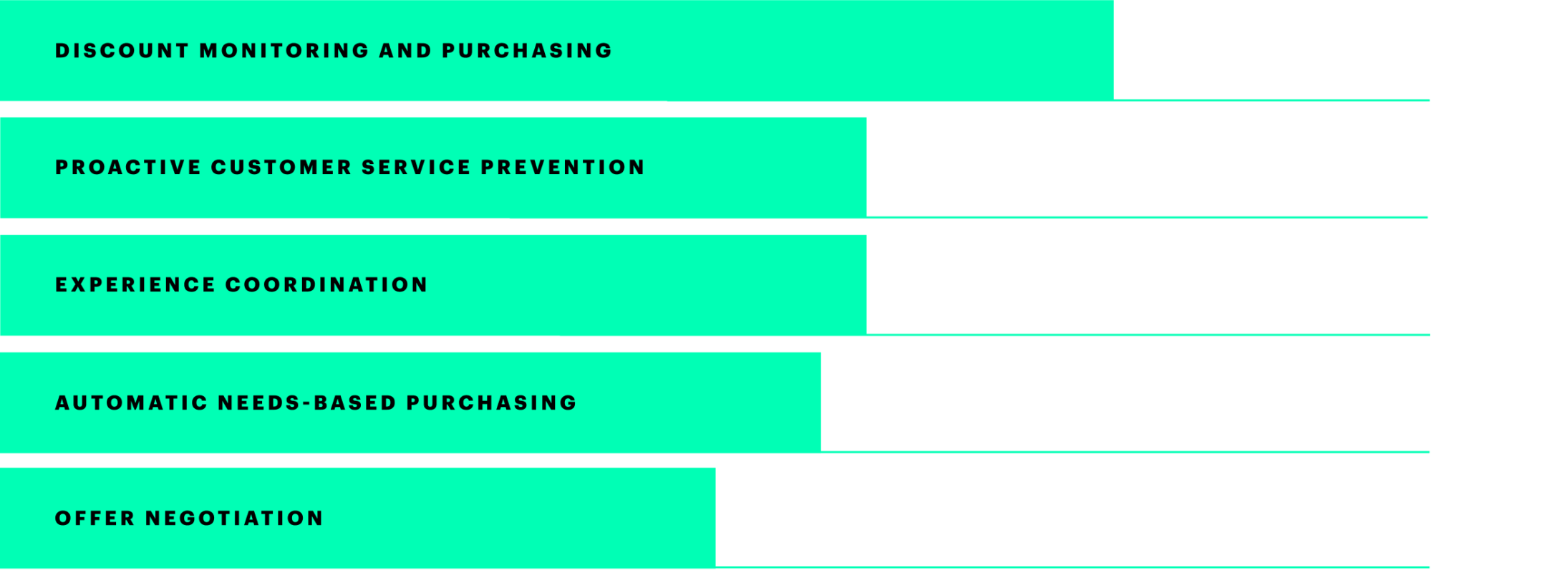
But the story doesn’t stop at pre-purchase. Consumers are using AI throughout the entire journey. At purchase, for example, 29% say they use AI to monitor discounts and make purchase decisions. Post-purchase, 37% use AI to create product reviews. We also see consumers using AI in ways that many of us may never have predicted from the average consumer. Examples include:
“I’ve set up a specific prompt sequence in Gemini that helps me plan my trip itineraries and find more local spots instead of just the usual touristy malls.”
–Gen Z, Singapore
“I’ll use Claude or ChatGPT to run through “what-if” scenarios when I’m weighing a big purchase. When I was debating a VR headset, I had AI help me weigh the long-term utility versus initial excitement. It helped me stay grounded and avoid impulse buys.”
– Millennial, U.S.
“I recently used AI to upload my X-ray results and asked for an interpretation – it helped me prepare for when my physician gave me a call later that day.”
– Boomer, U.S.
AI use is more personal and sophisticated than many expected, and people are increasingly willing to share deeper, more personal data when the value is clear. This shift challenges brands to keep pace as consumers turn to AI for meaningful, data-driven experiences that go beyond the traditional engagement models most brands are currently delivering.
When it comes to agentic AI – the systems that take autonomous action on a consumer’s behalf – consumer appetite is real, with 54% of people already viewing these agents as helpful. Here are the top five use cases consumers want, reflecting the demand for agentic AI, particularly in the commerce space.
Top 5 Agentic Use Cases Consumers Want
“I can’t imagine using a search engine again. AI seems to anticipate what I want and need”
– Boomer, UK
“I can’t imagine using a search engine again. AI seems to anticipate what I want and need.”
– Boomer, U.K.
Brands face a real threat. The risk of disintermediation is rising, with AI agents increasingly positioned to own more of the consumer relationship and make decisions on their behalf. The landscape continues to evolve rapidly—for example, OpenAI recently pivoted to scale back native in-app purchasing, while Google continues to invest in new agentic features (e.g., DoorDash delivery through Gemini). But through this rapid change, one thing is clear: Agentic use cases such as those above present clear potential to deliver value to consumers, and therefore likely where we can expect to see innovation continue to shift.
As AI becomes woven into daily life, businesses must design for both humans and AI agents —integrating seamlessly within consumers’ evolving agentic ecosystems. To unlock competitive advantage, leaders also need to innovate their own AI-driven businesses and experiences. Through these evolutions, success depends on evolving operating models that actively manage and empower both human and AI agents. Winning organizations will proactively upskill talent, adapt business processes, and embed dynamic human–AI collaboration at the core.
What This Means for Marketers and Business Leaders
Design for humans and their agents. As AI agents take a greater hold in consumers’ lives, the potential impact on direct-to-consumer engagement is enormous. With consumers continuing to rely on and delegate to AI agents, who may be getting to know them on a deep and personal level, brands need to reimagine how they will attract, engage, and win with both consumers and their agents.
Own the agent, own the relationship. Brands also need to decide where to offer their own agents to consumers, providing a critical advantage in driving full-journey engagement and data capture.
Prioritize AI change management and shifts in operating model. Building and/or integrating with AI agents for real consumer value requires a significant organizational shift, actively rethinking roles, capabilities, and ways of working around human/AI collaboration models.
The imperative for brands is to deliver distinctive value that meets consumers’ aspirational use cases, or risk losing direct access to their audiences. The brands and platforms able to create genuine, scalable value for consumers — and the agents acting on their behalf — will shape the next era of growth.
But what do businesses need to do to actually deliver that distinctive value? We explore this question in the next section by examining a key tension for consumers as this technology permeates daily life.
A Paradox Emerges – Usage Is Growing, While Enthusiasm Declines
28%
Average increase in adoption of AI use cases along the consumer journey
30%
Fewer consumers believe GenAl will be so integrated into their lives that they’ll rely on GenAl for most decisions
Here is the tension at the heart of this research: consumers are using AI more than ever, but they’re feeling less good about where it’s all heading.
Overall excitement about GenAI has dropped approximately 7% since our previous 2024 study. More significantly, the belief that GenAI will become so integrated into daily life that consumers will rely on it for most decisions has fallen by a striking 30%, signaling a meaningful shift in consumer psychology.
This trend signals that GenAI has entered what Gartner calls the “trough of disillusionment,” the natural dip in enthusiasm that follows inflated expectations in any technology cycle. But with AI, there’s a specific emotional driver that makes this moment distinct: peoplefeel anxiety over the impact that AI might have on humanity and fear the loss of the human experience.
“I use AI to help me track and set alerts on price shifts – but I do wonder if I’m now losing out on actually enjoying the experience of shopping. It’s also a fear of losing the ability to be spontaneous, without a screen telling me the best time to click buy. I don’t want to reach a point where I can’t make a simple decision without asking the app first.“
– Singapore, Gen-Z
A mistake would be to interpret this data as a reason to slow down AI investment. AI brings enormous benefits to consumers, as shown by the accelerated adoption we observe. But what this data does signal is the need to redirect AI investments, from delivering yet another chatbot focused on efficiency to innovation that speaks to this core tension for consumers, offering real value with both functional and emotional benefits.
The brands winning right now are doing just that, deploying AI to solve genuine pain points while elevating trust and empathy in the brand relationship through the experience delivered.
Some favorite examples:
ASOS
ASOSrecognized that online shopping can be high-anxiety and isolating, with uncertainty around fit, style, and self-expression creating real barriers. Its AI features address not just the transactional side, but the emotional experience too. Virtual Try-On lets shoppers upload a photo or choose from 20 diverse AI-generated models spanning a range of body types, sizes, and skin tones — reducing self-doubt and making the experience more inclusive. Style Match lets users upload images of friends or creators to instantly find similar looks, transforming shopping from a solitary task into something social and culture-driven. Together, these features blend utility with empathy, earning ASOS a more meaningful place in consumers’ lives and building ongoing engagement.
BANK OF AMERICA
Bank of America’s Ericais an example of how AI can address functional consumer needs while building a more trusted, empathetic brand, using a strategy Bank of America calls “High tech, high touch.” For consumers, money is a highly emotional topic often intertwined with self-worth and identity.Erica acts as an always-on, proactive financial copilot, providing insight and guidance along consumers’ key moments of truth (e.g., proactively detecting fraud, flagging spikes in monthly bills, or recognizing a milestone toward a financial goal). Under the hood, sentiment models monitor markers of frustration, allowing AI to adjust its tone and escalate to a human specialist when needed. Interactions focus not only on executing financial management tasks but providing peace of mind, which strengthens the brand resonance and relationships.
STARBUCKS
Starbucks’ Green Dot Assist found a meaningful way to use AI to augment staff rather than displace them, improving service by elevating the human warmth that defines hospitality. These AI agents work alongside baristas, providing instant access to recipes, equipment troubleshooting and operational information. That speeds service and improves accuracy, enabling staff to focus on what humans do best — delivering genuine, emotionally resonant service.
What This Means for Marketers and Business Leaders
Do not stop at utility and efficiency — generate emotionally resonant value propositions, and invest behind the experience. Look beyond delivering yet another chatbot and focus on how AI can help solve real consumer pain points. The winning formula for agentic value propositions is both functional utility and human experience.
Think of AI as a critical layer augmenting consumers’ ecosystem (not the whole story). Brands navigating this well are treating AI as an integrated layer within an omnichannel journey. It should augment human and community interaction, not replace it.
The Next Frontier: Emotionally Intelligent, Ambient, Anticipatory AI
We asked consumers about emerging AI capabilities that do not fully exist yet, and the responses painted a clear picture of where the next wave of consumer AI is heading.
Three connected themes came through strongest:
Emotionally Intelligent AI.
67%
of consumers want AI that guides purchase decisions based on their personal values and preferences – not just price.
That’s slightly more appealing than purely price-driven agent decisions (60%). Among heavy AI users, 47% already envision GenAI providing emotional support and companionship “similar to a trusted friend.” People want to feel understood.
Ambient AI.
62%
of consumers want AI that quietly notices things in their environment, and provides help proactively, vs. having to constantly ask the AI questions.
That’s slightly more appealing than purely price-driven agent decisions (60%). Among heavy AI users, 47% already envision GenAI providing emotional support and companionship “similar to a trusted friend.” People want to feel understood.
Anticipatory AI.
66%
of consumers want AI that can “read between the lines” to meet their real needs, not just what they literally ask for.
The prompt-response model that defines most of today’s GenAI interactions is already feeling outdated to consumers who’ve experienced more fluid, intuitive systems, mirroring what’s happening in enterprise AI. Consumers don’t want to become prompt engineers. They want AI that already knows what they need.
“If a flight to Singapore I have to go see my daughter gets cancelled, I don’t just want a list of flight numbers. I need AI to help understand the stress of that moment and prioritize the flight that is going to keep me most comfortable vs. just picking the fastest or cheapest option.” –Boomer, Germany
“I’d love my home assistant to know when I’ve had a day of back-to-back meetings, and help handle the mental load I feel. It could help order groceries or send a quick update to my wife. Maybe it could shift my environment – news summarized on the kitchen hub – drop me into the PM headspace so I can be present with the family when I’m off the clock.” –Millennial, U.S.
Together, these signals point to an AI future that’s less about answering questions and more about living alongside consumers — emotionally attuned, context-aware, and proactively useful. It’s these capabilities that can both help make AI more useful to consumers and bridge the critical sentiment gap we’re currently observing.
What This Means for Marketers and Business Leaders
Build your innovation roadmap around emotionally intelligent, ambient, prompt-less AI. The brands that anchor their next 12 to 24 months of AI development and partnership on these three themes will be the ones that lead the market in closing the sentiment gap and driving sustained growth.
Prepare for a world without prompts. If your AI strategy still centers on getting consumers to interact with a chatbot or type queries into a search bar, you are designing for the previous wave. The architecture of consumer AI is shifting toward systems that observe, infer and act. Start preparing your data structures, content and consumer touchpoints for that reality now.
Wrap-Up: Top Five Things to Do Right Now
AI is a moving target. But with so much at stake, growth-focused leaders can’t afford to wait and see. We recommend prioritizing:
01
Re-architect consumer journeys for human and agent ecosystems.
Establish your brand’s role and how it will create value within consumers’ evolving ecosystems of communities, creators, and agents. Map every touchpoint and ask: how does this work when the “consumer” is an AI agent acting on someone’s behalf? Where does humanity need to be elevated?
03
Innovate AI-enabled businesses, offers and experiences that resolve consumers’ core tensions.
Businesses that own the agents will have a structural advantage in maintaining consumer relationships, driving full-journey engagement, and capturing data. Decide where those opportunities exist for you and innovate value propositions that deliver technical utility and emotional connection.
New capabilities, roles, ways of working and culture will be required to manage emotionally intelligent agentic ecosystems at the speed and scale the market demands. Engaging the best talent in an increasingly automated environment requires a new approach. Driving organizational change should happen as soon as possible, while your strategy is being set.
02
Operationalize your brand to be discoverable and resonant with AI agents and the human trust signals they rely on.
Audit your content, data, and trust signals for LLM performance. Is your content answer-driven? Are you in the conversation with communities and creators? Evolve your owned assets and influence the external signals LLMs rely on.
04
Move from periodic to always-on consumer emotional intelligence.
AI agents act on real-time signals and are getting to know your consumers on the deepest level — your brand should too. Make consumer intelligence a continuous input to cross-functional decision-making and blend primary research with AI-enabled tools to create a new way of doing business.
AI is a moving target. But with so much at stake, growth-focused leaders can’t afford to wait and see. We recommend prioritizing:
01
Re-architect consumer journeys for human and agent ecosystems. Establish your brand’s role and how it will create value within consumers’ evolving ecosystems of communities, creators, and agents. Map every touchpoint and ask: how does this work when the “consumer” is an AI agent acting on someone’s behalf? Where does humanity need to be elevated?
02
Operationalize your brand to be discoverable and resonant with AI agents and the human trust signals they rely on. Audit your content, data, and trust signals for LLM performance. Is your content answer-driven? Are you in the conversation with communities and creators? Evolve your owned assets and influence the external signals LLMs rely on.
03
Innovate AI-enabled businesses, offers and experiences that resolve consumers’ core tensions. Businesses that own the agents will have a structural advantage in maintaining consumer relationships, driving full-journey engagement, and capturing data. Decide where those opportunities exist for you and innovate value propositions that deliver technical utility and emotional connection.
04
Move from periodic to always-on consumer emotional intelligence. AI agents act on real-time signals and are getting to know your consumers on the deepest level — your brand should too. Make consumer intelligence a continuous input to cross-functional decision-making and blend primary research with AI-enabled tools to create a new way of doing business.
05
Drive organizational change toward AI-human collaboration. New capabilities, roles, ways of working and culture will be required to manage emotionally intelligent agentic ecosystems at the speed and scale the market demands. Engaging the best talent in an increasingly automated environment requires a new approach. Driving organizational change should happen as soon as possible, while your strategy is being set.
The Bottom Line
AI agents will soon know your consumers on a deep and personal level, embedded into daily life as advisors and decision-makers. A central question for every growth leader right now is how to win with both consumers and the agents acting on their behalf.
The data is clear: consumers are ready. They are using AI in ways we didn’t anticipate, and they are hungry for AI that goes further. But they are also anxious. They don’t want to lose the human connection that enriches their experiences and makes their relationships meaningful.
The brands that close that gap—evolving their organizations to deploy AI as a powerful enabler of experiences that are both highly useful and emotionally resonant—will be the ones that define the next era of consumer relationships.
Ready to understand what this means specifically for your business? Prophet’s team of growth strategy, consumer experience, and AI experts can help you translate these insights into a clear path forward and action.
Contact us to start the conversation, or explore our AI and growth solutions to learn more.
Thank you for your inquiry.
If your submission requires a response, we will be in touch shortly. In the meantime, we encourage you to learn more about our firm and read some of our latest and greatest thinking.
Participants N=2015 people aged 18 who used at least one AI tool in the past 6 months for personal/consumer reasons
Fieldwork dates: Jan 2026 – Feb 2026
Markets: China, Germany, Singapore, United States, United Kingdom
Our study included a representative sample of the general population for each country, across a wide range of AI usage and familiarity.
Survey samples are nationally representative in each country.
The focus of the research was unpacking consumer attitudes, behaviors, and future aspirations for generative and agentic AI.
BLOG
Reinvention, Relevance, Growth
Prophet’s 2025 Corporate Earnings summary with 2026 implications
Each year, we review corporate earnings reports from across regions, sectors, and sizes, distilling the learnings, strategies, guidance, and big bets into key themes for industry leaders. Giving a sense of what the last year might shape for the landscape ahead.
Which, with 331 S&P 500 companies citing “AI” during earnings calls conducted between December 15 and March 11, 2026—up from 241 in the same period last year—it’s no surprise that AI is taking up a lot of visible horizon.
Let’s get into it.
1. AI: From Building Block to Growth Engine
2025 saw unprecedented investments from those leading the AI charge. $400B+ of total AI-related capex spending from the “Magnificent 7” alone. But with major investment comes the need to prove ROI. Questions continue to circulate across industries: How long will this take? What will make the payoff worth it? Are we doing enough?
At Davos, Uber’s CEO Dara Khosrowshahi claimed many companies are “play-acting” with AI, saying the right words without fundamentally changing how their operations function. The difference is visible between companies that added AI to existing systems versus those that rebuilt their processes around it.
First came the infrastructure. The AI data center buildout created a rising tide for anyone positioned to supply it—right place, right time, mixed with speed to market and operational efficiency. Corning’s optical segment surged 35% to $6.3B. Celestica’s Connectivity & Cloud Solutions segment grew by 64%. Caterpillar’s power generation sales jumped 44% in Q4. Vertiv surpassed $10B, a 26% increase from 2024.
Other companies have been weaving AI into the core of how they work. Duolingo used AI to launch 148 new courses in under a year. Walmart’s “Trend-to-Product” engine tracks social trends and feeds concepts directly into sourcing, while its self-healing inventory system reroutes supply before shortages appear, saving $55M+. JPMorgan Chase and Mastercard embedded AI across trading, fraud detection, and transaction scoring to transform operational tools into revenue-driving capabilities. Uber rebuilt its customer-service systems from scratch, replacing rigid rules with clear goals for AI agents.
The fatigue of talking about AI for the sake of talking about it is real. But when you look at what companies are building? The advancements are remarkable—and company leaders expect those to compound with each passing year. The challenge is extracting value and turning towards AI as a growth driver versus an efficiency play.
2. The AI Talent Restructure
As for taking a stance on the role of AI in the workforce, some have gone all in: Duolingo’s CEO Luis von Ahn boldly declared the company “AI-first,” signaling a fundamental shift in how it hires and operates. Others have moved forward similarly, only without public statements. PepsiCo promised a “record year of productivity savings” in 2026 to fund growth without once mentioning AI in their Q4 earnings, even while Coca-Cola’s incoming CEO Henrique Braun made AI and digital a defining strategic priority.
To deliver these promises, companies have led colossal workforce restructurings. Intel, UPS, Amazon, and Verizon have all made cuts in the tens of thousands. Jack Dorsey’s Block laid off nearly half its staff, framing it as becoming a “smaller, faster, intelligence-native company,” an operating model reset.
But for the AI powerhouses, these major talent shifts aren’t merely downsizing. Companies are paying a premium for the talent that can push them ahead. Meta, OpenAI, Google, and xAI reportedly offered $20M+ equity awards—and in some cases $100M packages—to recruit elite AI researchers. Capability-building now means smaller teams, higher talent density, and a few highly leveraged technical leaders.
Culture has proven to be a driver of uncommon growth across all industries. As AI implementation continues, organizations that communicate clearly and tie AI to employee impact and values are seeing faster, more sustainable adoption.
3. Reinventing Toward Relevance
The ripple effects of AI and last year’s ‘Proceed with Caution’ economy pushed companies to reinvent. We noticed a few distinct flavors of reinvention in 2025: the pivot, the shed, and the path to platform.
The Pivot
Tesla halted Model S/X production to build Optimus robots. Lemonade is reinventing insurance offerings to incorporate new AI realities. Southwest made a massive bet by introducing bag fees, assigning seating, and removing its “never expire” flight credits.
The Shed
Some companies are aiming to get smaller and stronger in specific areas. Comcast spun off its cable networks and leaned on theme parks and Peacock deals for revenue. Meta officially shifted its narrative from “Metaverse” to “Superintelligence,” no longer promoting Reality Labs for VR. Siemens is spinning off their Healthineers business. Medtronic announced the spin-off of its $2.7B Diabetes business to simplify operations and double down on procedural medtech, where its cardiac ablation solutions surged nearly 30%.
The Path to Platform
The companies that chose to keep adding were betting on becoming something else entirely. Robinhood evolved from meme-stock brokerage to financial super app—prediction markets, retirement, credit cards, banking, managed portfolios—with revenue up 52% to $4.5B and platform assets up 68% to $324B. The New York Times hit nearly 13 million subscribers by bundling news, games, cooking, and sports into a contained ecosystem. JPMorgan Chase continued rewiring itself as an integrated platform, backed by an $18B technology budget and the operational deployment of agentic AI.
For others, reinvention meant short-term loss for long-term potential. UnitedHealth absorbed a $1.6B restructuring charge against a backdrop of genuine turbulence and still grew full-year revenues 12% to $447.6B. The restructuring wasn’t a retreat, but a bet on what comes next.
Whether getting lean or integrating more capabilities, the underlying question remains the same: where and when will our investments pay off? We’ll see if that question drives continued reinvention in 2026.
4. M&A Outlook / The R&D Arms Race
From a muted M&A environment in 2024, deal volume and deal value were both up in 2025. There were notable acquisitions—Alphabet acquired Wiz to enhance AI-powered cybersecurity across multi-cloud environments, Verizon added fiber infrastructure through its Frontier deal, Paramount won the long battle for the premium-priced Warner Bros. Discovery, Dick’s Sporting Goods acquired Foot Locker, and Pfizer’s acquisition of Metsara brought it into the GLP conversation.
But there’s more to the story. Only about 7% of total corporate cash spending went to M&A; the rest? R&D and capex. Companies that try to buy growth are still waiting for the payoff. PE firms like Carlyle and BlackRock had successful fundraising and financial performance, yet the market still struggled to deploy capital in an environment where ROI is difficult, and AI makes future earnings less predictable.
The companies that drove growth in 2025 built it themselves. Meta is moving to own the entire AI stack, reducing reliance on NVIDIA and investing heavily in AI commerce. Palantir’s U.S. commercial revenue grew 137% year-over-year, with AIP becoming a repeatable growth engine. CrowdStrike pushed R&D spending up 38% to launch Falcon AIDR, a full AI-native security platform.
In healthcare, Eli Lilly invested $55B in manufacturing to scale GLP-1 production far beyond current demand, partnering with NVIDIA on AI-driven drug discovery to compress R&D timelines. Hims & Hers invested in proprietary telehealth infrastructure to build direct-to-consumer health at scale, and AbbVie is building a neuroscience franchise intended to rival the scale of its immunology business. The M&A window may reopen as clarity returns, but 2025 made a strong case that in an AI-driven economy, growth can be driven organically.
5. Customer Obsession: Know who You’re Serving
Despite a resilient (but wobbly) economy in 2025, some consumers acted as if nothing stood in their way. Moody’s Analytics reported that the top 10% of households were responsible for nearly half of all consumer spending, validating Powell’s characterization of a “bifurcated economy.” The companies winning at the top are commanding premiums by delivering differentiated experiences, and those winning at the bottom are using AI to deliver more for less. The companies in the middle—the ones doing neither—are getting hollowed out.
Winning at a Higher Premium
Netflix closed 2025 with over 325 million paid subscribers, and with another premium price hike on the way, it’s proving that relentless investment in IP consumers care about makes for inelastic demand. Crocs’ Jibbitz charm revenue hit $271 million in 2024, with 3/4 buyers purchasing charms to personalize their Crocs, turning a one-time shoe sale into an ongoing relationship. Colgate is pushing into premium with its Optic White Pro Series, positioning at-home whitening as a credible alternative to professional treatments.
Winning the Value
Costco raised membership fees for the first time in years, and, with a 92% renewal rate, no one flinched. Its private-label, value-driven Kirkland Signature brand continued to grow faster than the total business. DoorDash expanded well beyond food delivery into grocery, retail, and convenience, only adding value to its household name.
Stuck in the Middle
Target’s stock fell 34%. The company is investing in store remodels and trying to compete, though still not affordable enough to win the price-conscious shopper and not differentiated enough to command loyalty at the top.
Being ‘stuck’ doesn’t mean it’s over. Starbucks pivoted back to its beginnings, putting customer experience first with a $1B investment in its ‘Coffeehouse Uplift’ initiative to shift perceptions of a once dreaded destination to again being the token ‘third place.’ Even as they constantly evolve, focusing on core customers will likely be a key theme in 2026.
A special thank you to: Editors: Hannah Anderson, Moira Allen; Research: Harry Ball, Fabienne Haase, Caitlin Shin, Gibson Campbell, Zoey Gendler, Sophie Kang
The AI conversations, reinventions, and innovations show no signs of stopping. And in this rapidly growing area of an already ever-evolving market, there’s never been more risk or opportunity for growth. Last year’s winners harnessed their own capabilities and reinvigorated their approach to drive uncommon growth—how companies respond in 2026 and beyond will determine whether they become an Uncommon Growth Company.