BLOG

Will Your Organization Be Left Behind as Consumer Healthcare Transforms?

Offer more value, and be willing to meet your customers in the messy middle.

It’s no surprise that the pandemic has changed the way consumers interact with healthcare. We see it in the proliferation of virtual care across the care continuum, from acute to chronic, episodic and now primary and preventive care. We see it in the embrace of new digital devices and programs designed to monitor chronic conditions at home. And we see it in the uptake of digital pharmacy services that promise ever-faster delivery times and simple, easier, prescription transfers. These shifting consumer need states are forcing companies to action.

Those that will win with consumers in the post-pandemic age are the ones that will accelerate innovation as they reimagine their business models – integrating and re-configuring assets around emergent consumer use cases.

Here are three healthcare business design imperatives for making markets and capturing post-pandemic value through big, bold and transformative moves:

1) Trade the value chain for value exchange

The old news? Payers, providers, pharmaceuticals and MedTech companies once controlled discrete pieces of the value chain. Today, they are operating as collaborators and competitors alongside one another – with non-healthcare entrants (financial services and technology companies) also looking for a piece of the pie.

The new news? “Who does what” doesn’t matter to consumers, instead they value the promise of an integrated approach to health. Whether you build, buy or partner, leaning into the discomfort of superseding the value chain can lead to transformative, new offers. Teladoc Health is a great example of a company that bet big on the idea that virtual primary care is here to stay. It built the Primary360 platform as an entryway to take advantage of its unique portfolio of assets from acute and episodic care (Teladoc Health) to chronic care (Livongo), behavioral health (BetterHelp), and more.

Alternatively, a company that took the partnership route is Cigna. They joined forces with Oscar Health to create an integrated, easily navigable approach to health plans for small businesses. By bringing together Cigna’s provider network and Oscar’s technology platform, they’ve created a relevant solution for the small business population that meets their needs.

2) Meet consumers in the messy middle

If transcending historical value chains is one way to play, another is to exploit the current outages in the value chain and become the middleware that bridges a care gap. Emerging care gaps could include areas like post-acute care, kidney care, pre-and post-Cancer treatment, and health conditions at the intersection of health and wellness (e.g. sleep, behavioral health).

Take recently acquired startup PatientPing, which focuses on the post-acute care space. Through its technology platform, the company can coordinate care by “pinging” healthcare providers when their patients are treated at other facilities. For instance, a provider could be notified in real-time when a patient is transferred from a nursing home to another outpatient setting. Now, with its acquisition by Appriss Health, close to 1 million healthcare professionals across all 50 states can be connected across care settings.

“Those that will win with consumers in the post-pandemic age are the ones that will accelerate innovation as they reimagine their business models.”

In another direction, Alula Health is a startup tackling the “messy middle” of the physical, emotional and financial changes involved with a cancer diagnosis and treatment process. Alula’s platform focuses on patients and their caregivers. They provide organizational tools such as spreadsheets and calendars to ease treatment coordination and a curated list of cancer-specific shopping items (e.g. post-surgery bras and robes with extra room for prostheses or drain management, “Travel to Treatment” bundles with pill organizers, sickness bags, sanitizing wipes, and face masks).

A final example is Talkspace, a platform aimed to make behavioral therapy more accessible. In a world where the dominant method of therapy was administered through expensive 1:1 sessions, Talkspace broke the prevailing mode of thinking and dispensed therapy through bite-sized, text-based interactions – a new modality for meeting the needs of those struggling with mental health challenges discreetly and without confining therapy to a set date/time. In doing so, they normalized therapy for a whole new, addressable market and have since expanded to partner with employers to offer its service as part of workplace benefits.

3) If it doesn’t have their name written on it, it’s not for them

The third hack for making markets through transformation is to address the unmet needs of unique consumer populations. Traditional provider-driven healthcare focuses on triage to identify a treatment path for every patient. But flipping this approach on its head allows for a deeper level of focus, prioritizing time, resources and expenses to solve the needs of one population group more effectively than a general solution.

Segment-specific opportunities are everywhere and can include:

  1. Those with a stigmatized condition
  2. An underserved population with unique needs
  3. An overly generalized population.

A good example of the first opportunity is Ro, self-styled as “the patient company”. Ro started by providing telemedicine and prescriptions for erectile dysfunction via its Roman brand, but gradually expanded to include other medical challenges like smoking cessation (via zero) and weight management (via Plenity). With the technology infrastructure, brand architecture and consumer base established, the company can pursue additional disease states with room for growth.

An example of the second segment-specific opportunity is Included Health, newly acquired by telemedicine provider Grand Rounds / Doctor on Demand. Included Health focuses on the needs of the LGBTQ+ community, who have all too often faced challenges finding culturally competent and affirming providers. The company works with employers to provide benefits to individuals that help them connect to physical care providers, mental care providers, community support and gender-affirming care.

The third-dimension type of play is to identify an overly generalized population – and the field of women’s health is a great example. While some companies have developed “female” healthcare brands, women have different needs by life stage. The spectrum of startups in today’s women’s health space demonstrates different focus areas such as reproductive/sexual health, pregnancy and postpartum, as well as menopause. Within each focus area, individual companies target specific challenges. For example within the category of reproductive/ sexual health, some companies focus on areas such as fertility (Modern Fertility, recently acquired by Ro), cycle tracking (Glow), birth control (Nurx) and more.


FINAL THOUGHTS

The pandemic has created new and exciting consumer use cases. Uncommon growth will only be captured through transformative moves that reconfigure assets and ecosystems. To capture this growth, companies can deploy one or more of the three design imperatives.  Incrementalism is a direct path to low growth and missed opportunities,  and capturing uncommon growth will require high-conviction leaders, cultural resilience and organizational agility. To help companies forge a path to uncommon growth, Prophet approaches each organization as though it were an individual – with a unique DNA, Body, Mind, and Soul.

Contact us to learn more about our proprietary Human-Centered Transformation Model and how we can deliver uncommon growth for your business.

BLOG

19 Ways COVID-19 Is Shaping the Future of Innovation

It’s not all masks and sanitizers. The “coronocoaster” is spawning many valuable new ideas.

Necessity is the mother of innovation. And the ‘coronacoaster’ we’ve been riding has given birth to blue Skype thinking as businesses have stepped up and strapped in. As always, the winners have been the most innovative in responding to changing market dynamics and consumer needs – putting momentum behind ideas that create the most sales energy, scaling production when the time is right, demonstrating cultural resilience in sometimes plummeting conditions and showing agility through the loop-de-loops of competition. 

As we step off the ‘coronacoaster’ and onto (what we hope is) a new Roaring 2020s joyride, it’s critical that businesses innovate in ways that leverage how echoes of the pandemic will remain endemic in the future. The post-demic perspectives we’ve provided aren’t necessarily prophecies, but they are informed by recent Prophet thinking (and doing). Some are old trends that have been potentiated by the virus. Others are new to the scene as a result of the virus. 

So, pour yourself a stiff quarantini and let’s have a malaproper look at nineteen ways COVID-19 is shaping the future of innovation.

1. Birth of Distance 

Space has always been a luxury (especially in service categories), but social distancing has made it a necessity. Expect new environmental innovations that create psychological space as well as physical distance. Expect more in the way of exclusive boxes at events, private dining rooms in restaurants, etc. and other innovations so there is less ‘stranger danger’ from others in one’s immanent domain. 

2. Heal.thy 

There’s nothing like a global disease outbreak to get people to think more about ‘thy’ own health. Expect to see more innovation that plays to real or perceived health and healing from angles ranging from ancient homeopathic wisdom to lab-based neutraceuticals. Even naughty categories like alcoholic beverages are tapping into this trend through watered-down alt liquids and lower proof points that feel healthier to consumers.

3. @Home 

People have been increasing the amount of time they’ve been spending in their homes for some time now (Faith Popcorn coined the term ‘cocooning’ 40 years ago), but the pandemic has created a step-change in making more bodies homebodies. People want to continue to feel at home (especially in times of crisis), so expect to see more demand for home comfort innovations in the coming decade – creating a sense of ‘home sweet home’ instead of a feeling of house arrest. 

4. Mask.aura 

Masks were the fashion accessory of 2020 – and mascara was the beauty product of the year because eyes are visible above the mask. Think about other innovations that help consumers look (and feel) their best in times of potential lockdowns and coverups. What innovations can help consumers manage their self-presentation aura? 

5. Ment.all 

The stresses and strains of being locked up during lockdown are making all types of people more mindful of their mental health. We expect more neurons to fire in this direction as the decade progresses. Innovations that help people manage their day-to-day mental health and/or take their peak performance to a limitless level are a no-brainer. People are going mental for apps, like Happify, to train their brains for positivity. 

6. Mod.u.larity 

Companies and consumers alike need an innovative way to deal with public policy capriciousness. Modularity is part of an ever-adapting answer. Goods and services that serve us well should have the option of being switched on and off and/or sized up and down on-demand. Driving less today? Your insurance bill stays in first gear. More people in your business tomorrow? Your cleaning service rolls in harder and heavier. 

7. Pan.skilling 

The pandemic has required companies and consumers to upskill and reskill in a panoply of ways. The next generation of innovators will be pan-skilled in a way that flexes with agility. We expect new forms of learning innovation to help organizations and individuals to develop these pan-skills. 

8. Part.icipation 

Many companies have experienced mixed results with highly collaborative innovation approaches. We are consistently seeing more effective results by focusing collaborative participation on the most important parts of an innovation process instead of dragging everyone through the end-to-end journey. Think about it as a ‘minimum viable participation’ model to accompany ‘minimum viable product’ design thinking. 

9. Phygital 

Phygital fuses the best of the physical world with the best of the digital world. More advanced phygital experiences are increasingly being demanded as a result of our enhanced sophistication with the digital world under lockdown. The best phygital innovations deliver the 3Is — immediacy, immersion and interaction. The PS5 is becoming more phygital through the augmented haptics it delivers while a gamer is immersed in a digital world. The Nike flagship store in NYC is a phygital temple designed to navigate with your phone – If you like something you see on a mannequin, just scan it and someone runs it over it to you. When it comes to phygital innovation, just do it. 

10. Pivotry 

To ensure a steady stream of dollars in a fluxed-up decade, businesses need to pivot on a dime. Be prepared to rapidly innovate into spaces that are close (enough) to your core competencies and are reachable with a sensible stretch. The way dine-in pivoted to take-out, fast fashion pivoted to masks and ‘essential retailers’ started selling dubious essentials that consumers couldn’t get (offline) elsewhere. 

“It’s critical that businesses innovate in ways that leverage how echoes of the pandemic will remain endemic in the future.”

11. Pop-Ups 

Prime urban real estate is increasingly un or under-occupied. Nature abhors a vacuum and landlords abhor an empty property. We expect more and more innovative business models (and office space for businesses) to be strutting down pop-up catwalks designed with quickie contracts for ephemeral experiences and short-term shops. Here today, there tomorrow. 

12. Purposeful 

Many people woke up during the pandemic and continue to respond well to products and services that demonstrate a full commitment to a purpose – from beauty brands that are more than skin deep to socialpreneurs transforming the meaning of BOGOF to ‘buy one, GIVE one free’. Consider how your innovations can cause a stir with consumers via genuine links with a positive cause. 

13. Screen Standout 

With more shopping moving from the real world to the virtual world and word of mouth becoming the word of thumb, screen stand out is becoming more important than shelf standout. Innovations need to be designed with colors, shapes and materials that look fab on the small screen. Hero beauty shots should eliminate the shopper marketing clutter seen on many packs these days (it isn’t legible on small screens anyway) leaving only ‘extraordinary elements’ and ‘incisive information’ on screen-optimized designs. 

14. Sir.valence 

Big Brother is increasingly accepted if he helps ensure everyone is complying for the collective good. Surveillance and compliance innovation is expected to be built into a host of people processing systems that provide ‘certain.fication certificates’ of a clean bill of health. This will mean a smoother flow of human capital around the world (or around the neighborhood). But Taylorist employers will be counting keystrokes as WFH becomes less of a WTF. 

15. Social.learning 

People are social animals and social networking marched on with a tech-tonic shift during the pandemic. To be successful in the future, all innovations need to learn how to take full advantage of social platforms. Ensure your innovations are leveraging the latest in social seduction and consummation technology to always be within thumbs reach of desire. 

16. Surthrivalism 

Survivalists must be feeling a bit smug about their readiness for the pandemic. Expect more innovation to help people go beyond surviving to thriving in case of further untoward world events. Our 21st Century Archie Bunkers may not all be building bunkers, but many will take smaller steps to honor the Boy Scout motto of ‘Be Prepared’. 

17. Suss.tainability 

Many inquisitive minds have spent their lockdown sussing out Netflix ecomentaries like Cowspiracy and have become even savvier about the importance of living sustainable lifestyles. Innovation in the coming decade needs a sustainability angle – from how it makes a material difference with the materials it uses (or doesn’t use) to the 411 on its value chain that doesn’t raise a 911 alarm. 

18. Touch.less 

People have become conditioned to taking a hands-off approach to their interactions with the outside world. This is because every touch means an opportunity to pick something up (or pass something on). Innovation should consider how to minimize the literal ‘touch-points’ in the user experience (especially for products that are shared or taken outside the home). 

19. Tr.eats 

The self-treat strategy to mood management has worked wonders during the pandemic. Many people have harnessed the new age wisdom of ‘do something nice for yourself every day’ and many of these mood (re)setting treats have been eats. New innovations that inexpensively help people give themselves a treat every day are expected to continue to go down a treat for the foreseeable future. 

Interested in increasing your innovation capacity?

Prophet’s Experience & Innovation practice can help you to underpin a superior approach to innovation to help you realize your ambitions, get in touch here. 


FINAL THOUGHTS

From “phygital” to “surthrivalism,” the pandemic continues to unleash powerful–and business-changing–new perspectives. Develop a strategy to find those with the most potential for your brands.

BLOG

Three Signs You Need a Customer-Centric Transformation

These common blindspots get in the way of breakthrough insights.

The CEO of a large financial-services organization recognized that their customers were defecting to fintech disruptors, ranging from SoFi to Acorns to Robinhood. The customer base was shrinking and revenue growth was stagnant. But while everyone constantly talked about customer-centricity, the executive team didn’t realize how unfocused they had become. This became clear when they couldn’t explain why some customers were leaving and which customers should be their future source of growth.

“How can we find our way back to growth when we don’t even know who our customer is,” the CEO asked.

The company realized it needed to undergo a transformation.

Most Companies Aren’t as Consumer-Centric as They Think

The pressure for reinvention feels more urgent than ever as organizations look to find their way past the turbulence of the pandemic. Customer behavior has shifted radically and with it, so have customer expectations. Markets are resizing. Supply chains are disrupted. Digital commerce is growing rapidly. Customer experiences are the new product.

Despite these changes, companies, theoretically, are 100% committed to customer-centricity. Unfortunately, all that noise has caused many to relax their true commitment to customers — even if they can’t quite see it. (Of course, some have never been customer-centric, despite years of lip service.)

In our transformation work, we’ve come to understand the root of this lack of focus. Companies missing customer-centricity often struggle with at least some of these internal barriers:

Failing To Connect the Dots

Customer-centricity requires a deep and connected view of the customer, supporting real-time, integrated customer insights. This constantly refreshed stream of data is a tool that all functions should use, and should be buttressed by meaningful, qualitative research including deep listening and active interrogation. The data helps spot the critical shifts in customer behaviors. Tools like ethnography are critical to getting at the why behind the trends in the data. Both ingredients are critical to customer-centric growth.

“Customer-centricity requires a deep and connected view of the customer, supporting real-time, integrated customer insights.”

Too often, companies invest in one-off research studies without thinking through how the insights can be operationalized, distributed, and refreshed over time. Or, they over-rely on data collection as the sole source of customer truth without delving into the why behind the behaviors they are seeing. Without the combination of data and insights, companies can easily lose their way.

Finally, different business units typically “own” these insights, which means they aren’t shared or connected across the organization. The result is that sales, marketing, product and service teams each see a different side of the customer, and no one is connecting the dots or able to see the bigger picture.

True customer-centricity flows from an ongoing and distributed source of new insights — this includes a combination of survey and perceptual data along with database and behavioral insights. Staying on top of what consumers want today and in the future will be crucial to identify the right products, services and experiences that lend themselves towards new opportunities for growth.

Unwillingness To Put Yourself Out of Business

Companies that pay lip service to customer-centricity build products and experiences to fit existing capabilities or business models and then optimize margins based on testing. They think about what they want and what’s good for their margins. They look at existing resources and say, “What can we build with what we have?”

Customer-centric organizations approach innovation and experience design differently. They are unencumbered by how things are done now. Instead, think about how to best meet customer needs today and in the future.

This is inherently risky. Nike’s 2017 decision to sell directly with consumers meant ditching large wholesale customers. To some, that seemed reckless.  Within a year of adopting a direct-to-consumer model, their revenue grew by nearly 6%, and Nike continues to be one of the world’s most fast-moving, beloved brands.

Fear of Going All-in

Companies that aren’t all-in on customer-centricity might think that engagement is a metric only the marketing team needs to focus on, or that managing Net Promoter Scores is a role for the servicing department. They may be willing to overhaul some areas or happy to tweak the existing business model. But complete reinvention? That’s often off the table.

However, there is no such thing as a partial transformation. Genuinely customer-centric organizations know that to accelerate growth, it takes alignment through the entire company. Whether in sales or HR, supply chain or R&D, these organizations set shared transformation goals around the relationships they seek to create with their customers, and they hold everyone to account. Hiring, compensation and operating models are linked to these customer relationship goals in ways that reinforce the right behaviors and business decisions.


FINAL THOUGHTS

Customer-centric transformation strategies are powerful for companies to gain relevance and win a place in people’s hearts. When organizations put this objective arbiter – the customer – at the center of all decisions, it provides the clarity needed to unlock growth. Of course, these transformation agendas take digital and enterprise objectives into account. But by committing to a customer-centric path–and the promise to follow those customers anywhere, companies become increasingly more relevant. They become indispensable to the lives of their customers and they find uncommon growth.

That’s what we’ve achieved for our financial services client: A complete customer-centric transformation – a coordinated multi-year effort to impact every aspect of the business. Working with the CEO, chief growth officer and leadership team, Prophet helped design and operationalize this transformation agenda, prioritizing key markets and target customers, and reimagining products, services, and experiences to make customers’ lives easier. Within a year, new business revenue rose 8%, and new leads increased 20 times over.

Contact us to learn more about customer-centric transformation and what steps your organization needs to take to achieve uncommon growth.

BLOG

Ask These 3 Questions to Evolve Your Digital Transformation

Even companies far along in the change journey need these basic reality checks.

Digital transformation doesn’t mean what it used to. In fact, the term, as it’s been used to describe so many corporate efforts over the last 20-plus years, means something different today: Building digital businesses. And that goal is very much alive.

Today, when companies talk about digital transformation, it’s because they want to find new ways to use technology to serve customers better. They hope to build business engines that continually reinvent themselves. They understand “transformation” isn’t an endpoint but a state of constant evolution.

Businesses also know that the need is urgent. Research from Altimeter, a Prophet company, finds that 92% of leaders believe their current business model won’t remain viable if digitization continues at current rates. However, many companies are conflicted about how to transform.

It doesn’t help that digital transformation conjures images of expensive failures. According to a 2019 study, companies like General Electric, Ford, Procter & Gamble and others have sunk up to $1.3 trillion in digital transformation efforts, and about 70%–roughly $900 billion–was wasted.

But the consequence of not pursuing digital transformation is worse. Almost every recent notable bankruptcy–from Toys R Us to Hertz to Frontier Communications–is linked to failure to transform.

Typically, efforts fail because those in charge keep insisting that digital transformation is rooted in technology. That’s where people get it wrong: digital transformation is based on people and enabled by technology. More specifically, initiatives collapse because leaders don’t approach their strategy with the right mindset. In the race to find easy wins and weak consensus, they focus on tech-driven tools and tactics rather than what these tools are in service of.  They also skip the three most important conversations required for successful transformation:

What Are Our Goals?

For the many companies that lurch from one quarter to the next, articulating a bold vision is difficult. And even for those skilled in adaptive business strategies, following customers in wholly new directions is daunting.

But it’s essential. Transformation can only succeed when leadership sets a clear, measurable vision for how digital will transform the business. Further, executives must do more than simply state their transformation agenda. They must champion the initiative and hold everyone accountable for their part in creating the necessary capabilities, products and services to bring that vision to life. Transformation cannot happen in silos. It must reach across the entire business and be embedded in all functions for real change to happen.

This is inherently risky. Nike’s 2017 decision to use digital muscle to connect directly with consumers meant ditching large wholesale customers. To some, that seemed reckless. But it paid off: its share price has nearly tripled since, and Nike continues to be one of the most fast-moving, beloved brands in the world.

Goals should be specific, and they must acknowledge the need to move at two speeds, with short-term optimization and long-term iterative capability building.

“Digital transformation is based on people and enabled by technology.”

Electrolux, for example, knew consumers wanted every aspect of their home to be connected. It not only included the appliances they use but the way they shop for them. So, the company set goals to make digital integral to every phase of the customer journey. This required a dedicated cross-functional executive team, including marketing, product, sales, IT and critical markets.

These solutions are, of course, tech-enabled. By developing marketing mix guidelines that optimized spending by brand, product and channel, Electrolux improved its operating margins by nearly 20% in just one year.  But these changes grew from a deep understanding of people’s preferences and the explicit goal of transforming a manufacturing business into a consumer marketing-driven company. Like Nike, Electrolux has become a more people-focused enterprise that’s turned it into a relevance-seeking machine, always in motion and constantly evolving.

How Do We Find the Capabilities To Get There?

A new digital business requires new capabilities. Companies must confront the question of how they will obtain these new skills. Will they build them? Buy them? Partner with another company?

Consumers think of Starbucks as a coffee shop. However, Starbucks has long known that it can only fulfill its purpose if it puts the right technology in the hands of both customers and baristas. Consistent investment in loyalty and payment systems has paid off in a digital universe that now powers 50% of U.S. sales. with a quarter of sales from mobile devices. For Starbucks, building that proprietary technology was the right path. Tech has even become a revenue source on its own, with the company now licensing systems to international franchisees.

Acquisition is another route, sometimes chosen by some of the most innovative companies. That includes Apple, which recently bought Mobeewave, a payments company based on nearfield communication, rather than build its own. Even digital natives need help given the pace of change in customer expectations.

All three approaches may make sense, depending on an organization’s near-term goals and long-term ambitions. Deciding among these options requires a candid assessment of current organizational capabilities and what it will take to achieve them.

What Do Our People Need To Take Us There?

Organizational change is always tough and managing for digital transformation is even harder. If companies want people to work and think differently to transform the business, they can’t expect them to do it on demand. Behavior and mindset are emergent. Organizations need to enable the workforce with the right skills to create value, whether through upskilling or temporary support.

This requires evolved governance and tools that make it easy for them to do the right thing for the new strategy, and in the right way. Incentives must be realigned to give people space for experimentation, so they can navigate the ambiguity that comes along with almost all transformation strategies.

To do this right, most companies will require a complex revaluation of their capabilities, governance systems, talent mix and employee value proposition. They need new recruiting, retention and incentive practices as they prepare for the future and must enlist a diversity of talent that is new to them. They need short-term innovators and long-range thinkers, fast movers and patient tinkerers. Transformation requires a cultural revolution, hiring new types of people and skillsets, and then leading them differently.

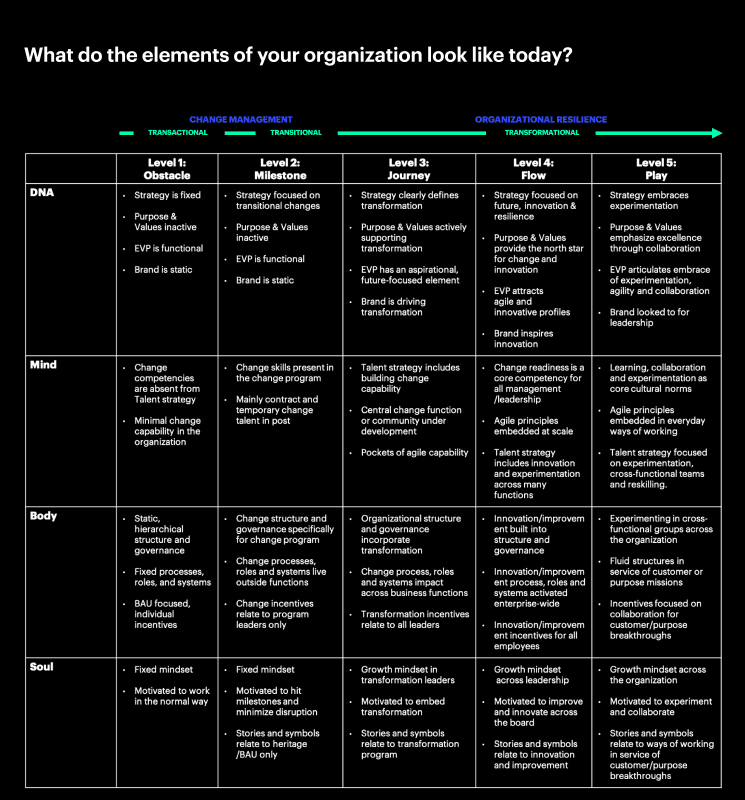
At Prophet, we talk about the “body, mind and soul” of an organization; and that to digitally transform, a business needs to address all these elements. In Prophet’s Human-Centered Transformation Model, an organization first determines what it wants its DNA to be – its purpose, its brand proposition and its strategic plan to win. Next, it goes to work on the “mind” (its talent, capabilities, and skills), the “body” (governance, process and tools) and the “soul” (its values, behaviors and rituals).

All are necessary for the digital transformation to have its full impact.


FINAL THOUGHTS

The risks inherent in digital transformation are real. But those risks must be weighed against the consequences of not pursuing digital transformation at all. Those include countless lost opportunities, and ultimately, extinction. Increasingly, people want to buy products and services in multiple channels, on their own schedule. And employees want to work with companies gaining in relevance. They’ll give up on digital laggards.

It takes bravery to convince corporate boards that it’s time to reinvent a company’s operating model. (After all, it isn’t supposed to be easy.) But by defining a digital vision, adding the required capabilities and building a future-ready workforce, companies can become responsive, adaptive and genuinely digital businesses.

Talk to us about how might we can help your organization digitally transform using Prophet’s Human-Centered Transformation Model.

BLOG

Business Transformation for Growth: Three Rules you Can’t Ignore

How customer-first thinking, sharpened digital strategy and renewed purpose drive high-impact change.

Companies are aggressively pursuing business transformation to drive top and bottom-line growth and establish a more effective business model for the future. The pressure for reinvention feels increasingly urgent as organizations look to find their way past the turbulence of the pandemic. Markets are fluid, technology is shifting and people are demanding more digital solutions than ever before.

Companies that settle for incremental progress simply won’t be able to keep up with fast-moving customers.  Companies that embrace this new landscape, however, can achieve uncommon growth – purposeful, profitable, transformative and sustainable. With agile and adaptive approaches to transformation, they can uncover new sources of revenue and relevance in record time.

“When a company’s purpose is clear, that North Star illuminates everything they do. It informs an approach that bridges corporate purpose with its promise to customers.”

Business transformation for growth isn’t easy and companies, especially ones burdened by unsuccessful transformation efforts, are justifiably reluctant to try again. Another common barrier is knowing where to focus and how to start. Too often, leadership gets derailed by decisions about technology. However, all transformation efforts – even ones undertaken as digital transformation – aren’t about tech. They’re based on people.

Taking a human-centered approach to transformation, and working with a variety of organizations in multiple industries, has shown us that no matter what the goals are, companies must follow these three rules of transformation to achieve sustainable growth.

Three Ways To Approach Business Transformation

1. The Customer Is Everything

Companies have been giving customer-centricity lip service for years, but they often fail to appreciate its transformative potential. When organizations put this objective arbiter – the customer – at the center of all decisions, it provides clarity and focus.

This requires an organizational obsession with customers and potential customers. What makes these people happy? What ruins their day? What can your organization do to help their lives run more smoothly? What makes them trust you? What inspires them?

As this customer focus permeates an organization, it gets easier to stop thinking about just selling products and shifts the focus to serving holistic customer needs.

Using this lens, companies can analyze demand opportunities and create a customer value matrix, complete with specific, measurable, time-bound goals. This allows them to identify, prioritize and activate initiatives that deliver on this strategy.

Customer-centric companies don’t spend much time fixing potholes in a customer journey. They don’t have to. Instead, they’re looking for ways to leapfrog expectations. And they also become more adept at changing course, quickly abandoning areas that no longer serve customers.

2. Be a Digital-First Company. But This Time, Do It Right.

All transformation is digital, and companies have known that for decades. But even as businesses invest trillions in digital transformation, they still fail more than they succeed. In our view, that’s because they fall into the trap of thinking technology is the answer. It’s become clear, that tech alone isn’t the answer. The goal is to become a digitally built business, which requires people who use digital-first thinking.

Digital transformation can only succeed when it focuses on people. To be effective, they must transform value drivers that impact others, including both external experiences and internal ways of working.

Companies can begin by setting an overall digital vision that resonates with both customers and employees. That vision requires a clear understanding of which areas will drive the most business and value, complete with specific, measurable objectives validated by key results.

Of course, the technology involved is a critical element, but the bigger issue is about the people in an organization. Do they have the right skills? Are they led and incentivized in a way that allows them to be digital-first? How are they recruited and retained? How does the culture flex and evolve to position the organization for growth in this digital-first world?

With clarified digital goals, companies can begin to iteratively deliver new products, services and experiences. They can regularly re-evaluate strategy and tactics based on key results and customer input.

3. Build an Agile, Purpose-Driven Organization

Companies that know what they stand for are inherently better at customer obsession and building businesses digitally. When a company’s purpose is clear, that North Star illuminates everything they do. It informs an approach that bridges corporate purpose with its promise to customers. This commitment to the customer, with investments aligned to support it, is the growth lever. It creates greater relevance and impact in the market.

This past year has demonstrated just how critical it is to have a clear and authentic purpose. It must resonate with every stakeholder group – not just investors and employees but also customers and members of all its communities.

Today’s consumers, especially millennials and Gen Z, want to do business with companies that make the world a better place. They want to see companies commit to sustainability, diversity and fairness. And they’re demanding increasing transparency. Consumers can forgive brands that make and admit their mistakes. but as soon as they catch a company putting profits ahead of purpose, they’ll move on.

Achieving this agility and commitment to purpose often requires sweeping changes in a company’s culture, capabilities and organization.

Prophet believes human-centered transformations– purpose-driven, customer-focused and digital-first – are the best path to uncommon growth. We talk about the “mind, body and soul” of an organization; and that to transform, a business needs to address all these elements.

For instance, a large financial services company came to us with declining revenue as customers turned to newer fintech entrants. Our business transformation agenda helped guide the CEO, chief growth officer and leadership team to a new company purpose, making life easier for key customer segments. This digital-first strategy vastly improved its agility, so it could quickly pivot to meet people’s needs. Within a year, it increased new business revenue by 8% and drove a 20-fold increase in new leads.


FINAL THOUGHTS

To help companies make this leap, our model approaches organizations as a macrocosm of the individual: having a collective DNA, Body, Mind and Soul. This model overcomes cultural roadblocks, making it easier for companies to manage the complex changes required.

As each aspect of the business is swept into the transformation strategy, companies don’t just improve. They evolve. They increase relevance and reputation. And they achieve uncommon growth.

Contact us to learn how Prophet’s global, multi-disciplinary teams bring bold ideas and rigor that deliver growth through our breakthrough human-centered transformation model.

BLOG

3 Ways We’re Creating a Supportive Workplace for Women

To foster leadership and prevent burnout, Prophet keeps exploring new ways to lift women up.

It’s been a tough year for many women. The pandemic exposed how much support working women can use–and how shockingly little most receive. COVID-19 has sparked a “she-cession,” driving nearly three million women out of the labor force. And roughly one in four are considering quitting or downshifting. Even those dedicated to staying at work are paying the price. A new Stanford University study found that endless Zoom calls amplify longstanding gender dynamics and drive fatigue and exhaustion for women.

This situation has led to Prophet renewing its commitment to elevating women’s voices and finding new ways to build allyship with our colleagues, clients and communities. And we have reexamined what it means to support women at the firm.

Prophet Initiatives to Better Support Women

Over the past year, we’ve made several moves to provide better support to the women of Prophet. From fueling open discussions about the pandemic and social unrest to welcoming honesty and vulnerability – we’re creating a workplace where women can feel supported while reckoning with the emotional intensity of these events. Ways we’ve advanced our cause in the past year include:

Finding Flexible Forums

For decades, women have struggled to elevate their voices in large meetings. Video calls can make being heard even more difficult as it is hard to read body language and easy for users to get lost in the sea of squares. We’ve acknowledged this reality and have encouraged teams to take “pauses,” moments for women to speak, weigh-in, and have their voices heard.

We’ve established new virtual forums. Our weekly firm-wide “Pulse calls” bring our global community together, while smaller breakouts allow the space for everyone to share and contribute their thoughts. We’ve introduced one-on-one meetings through our Women in Leadership Mentorship network and small-group sessions to discuss and share around specific events, such as the recent targeted murders of Asian women in Atlanta.

Building Better Boundaries

Workplace disruption related to COVID-19 has created a burnout problem. A CNBC survey found that 65% of women believe work stress has worsened and more than half feel burned out. Lean In’s research shows women feel this exhaustion at up to twice the level as men.

As remote work blurs the lines between our professional and personal worlds, Prophet’s leadership team has tried to help build boundaries between the two. These are some of the ways we’ve offered support:

  • For the last several months, Prophet’s offices have closed on the last Friday of the month to provide employees with a dedicated time to rest, recharge and take a break – without having to return to a full inbox of items to respond to.
  • We’ve offered benefits that provide meaningful relief to parents, including a dependent care assistance program for households with children ages 0-13.
  • We’re improving parenting-specific policies, including offering more paid leave for parents.
  • And we’ve invited health and wellness experts to speak to our people on topics from setting boundaries to managing the challenges of remote education.

Unleashing Shared Passions

Despite spending the year physically apart, we’ve seen a surge in community building. Propheteers have demonstrated their care for listening, learning, and taking action through their participation as a member or ally to the firm’s employee resource groups like Women in Leadership, Pride at Prophet, Black@Prophet and Latinos at Prophet.

These groups have allowed our people to speak up and share what’s on their minds (both personally and professionally), educate peers on topics of passion, and reflect on recent events in the news. And these communities have created opportunities for associates at all levels to take on leadership roles and elevate their voices.

“We’re creating a workplace that women can feel supported while reckoning with the emotional intensity of these events.”

Some of these topics and discussions can be heavy, so we’ve looked for ways to brighten our days too. We started our first-ever Music League, which connects Propheteers through a shared passion for music, specifically the tracks that celebrate the different identities that make up our firm. For example, over Black History Month in February and Women’s History Month in March, Propheteers around the world submitted their favorite songs to playlists like “All the Singing Ladies,” “Motown Classics,” “Songs from Women (Or About Women) Who Shaped Our World,” which highlighted female artists who’ve made a substantial impact on the music industry.


FINAL THOUGHTS

Every woman is different, and no singular initiative will fit the needs of all female team members. We’ve learned this year that nuance is important. Each facet of our identities–race, class, education, religion, sexuality and parenthood–impacts how we show up for one another. More than ever, we need to acknowledge that.

While we know we have more work to do, we are proud of these steps we’ve taken toward a more equitable Prophet. We will continue to find more ways to elevate women’s voices and serve as true allies. We’re elevating women’s voices. We’re listening to what they have to say. We’re pushing back against broad-stroke assumptions. And we’re finding new ways to support one another in challenging times.

BLOG

Why Leaders Should Turn to Historically Feminine-Coded Traits

Trust, compassion and the ability to collaborate used to be dismissed as weakness. We need them more than ever.

In the last year, between a renewed focus on racial injustice and the reality of a global pandemic, we have been challenged on our perspectives of ‘business as usual’ – including what we consider great leadership. We believe this is an opportunity to embrace – and prove – that a different way of leading is here to stay and we’re better off for it.

It is well-documented that we perceive leadership traits to be either more masculine-coded or more feminine-coded. For example, we associate being collaborative, cooperative or nurturing as feminine-coded, while being analytic, authoritative or ambitious is more masculine-coded. This “coding” has led to bias that has not historically supported women advancing in leadership. Amongst other things, this is because traits that are more traditionally feminine-coded, while seen as advantageous, are viewed to be “bonus” or “plus-ups” for leaders, versus being the core attributes required for success.

“In times of crisis, we look to our leaders for trust, compassion and collaboration— leadership dimensions that are all feminine coded.”

Enter the era of COVID, where we suddenly saw traditional models of leadership upended. The pandemic environment is highlighting the tremendous, and even mission-critical, benefit that more feminine-coded traits bring to the table. In times of crisis, we look to our leaders for trust, compassion and collaboration— leadership dimensions that are all feminine coded. (For more on this, there are many research studies to be found, but here and here are a couple of notable ones).

This might be why we have seen so many articles with titles like “Why Do Women Make Such Good Leaders During COVID-19?” But closer inspection shows us that it’s not just female leaders, it’s all leaders—regardless of gender—that are finding success in the current pandemic by exhibiting these historically feminine-coded traits.

No matter our gender identification, we can, and should, all lean into these more historically feminine-coded traits to have a critical impact. We see examples of this all around us right now, and they offer blueprints for better, more effective leadership:

Trust

Driving trust through transparency and focusing on facts have already been critical to strong leadership. However, a demonstrated comfort with uncertainty is one dimension of trust that has revealed itself at this moment. Gone are the days of defining leaders by their total certainty in what’s to come—vulnerability might, in fact, be the new marker of confidence.  From German Chancellor Angela Merkel’s science-led explanations (that still acknowledge what’s unknown) to New Zealand Prime Minister Jacinda Ardern’s plainspoken Facebook briefings to San Francisco Mayor London Breed’s calm, early response, we find enormous comfort in a focus on known facts with a transparent acknowledgment of what we don’t know.

Compassion

During an election season filled with pain and uncertainty, President Joe Biden and First Lady Jill Biden showed compassion and empathy at each turning point. They found ways to connect with voters over a shared sense of loss rather than just focusing on what the Biden administration would do if elected. And by speaking so candidly about their tragedies, Biden was able to impact compassion, empathy and resilience as a human first,  and as a leader second.  Regardless of what political affiliation, he created a level of connection through this in a way perhaps historically “strong” leaders may not have and gave a sense of hope from the top-down.

Collaboration

Our historical views of a strong leader probably more often emphasized being a lone warrior, but it’s a willingness to listen to many different voices and to bring teams into decision-making that is providing comfort and calm in this environment of unknowns. Synchrony CEO Margaret Keene (long known for her inclusiveness) has explicitly noted how leaders must solicit and listen to many voices to successfully navigate the crisis. You can see her doing this, looking to external expertise to inspire and support her bold decision making, bringing in outside mental health support for employees and holding weekly company-wide calls with an infectious disease expert. She’s both leading the way and working with others to do so.

Airbnb CEO Brian Chesky has been commended on the company’s handling of their recent layoffs. And in it, we can see elements of all of the above. He provides the facts about what went into the decision-making, and also, the unknowns remaining. He demonstrates empathy for his team and the pain this situation brings. And he builds and strengthens his community, calling on everyone to work together to support the exiting employees. He is leaning into all of these more feminine-coded traits to be a strong leader.


FINAL THOUGHTS

With all of the terrible things COVID has wrought, we also see many good things happening— clearer skies, an increase in kindness and the rapid digital transformation of businesses. We can only hope this revelation will be one such advancement: that our template for leadership becomes a more balanced aspiration, one that women and men alike can see themselves achieving.

As leaders at Prophet, we’ve been actively working to embed all of these traits into the way in which we work with our team. Have we done everything right? Probably not. But we’d like to believe that we, too, are making progress in learning the type of leadership skills and styles that will not only help us wade through the current crisis but make Prophet come out stronger on the other side. We hope all of you are doing the same, challenging traditional views of how we work together and finding ways to embrace a new, more inclusive normal.

At Prophet, we work with leaders across industries who are transforming businesses and growing their leadership skills to meet a new world. We believe that many voices and perspectives strengthen our work and the work of our clients, and we work internally and externally to advance inclusivity in leadership. If you have thoughts, comments, or questions related to these topics, please get in touch.

BLOG

M&A: Maximizing Value in a Post-Pandemic Economy

The right deals don’t just boost revenue. By clarifying purpose, they increase value.

The global M&A market is blazing hot across every major sector. Just look at the headlines announcing a pending deal between Amazon and MGM. And before that, the big news was AT&T’s deal with Discovery Inc. With deal volume rapidly approaching $2 trillion in just the first half of 2021, that’s more deal activity than any corresponding period on record, according to Bloomberg. And there are signs the party is just getting started. With vaccinations trending upward, stimulus flowing in, borrowing costs at record low rates, corporate coffers awash in cash and global economies shifting into a new gear, companies are feeling more bullish about taking big bets on the future.

Many of these recent deals are substantial. The AT&T announcement to merge Warner Media business with Discovery Inc for $43 BN, joins a roster of other major deals such as S&P Global’s $44.5 BN purchase of IHS Markit and Canadian Pacific Railway’s $25 BN purchase of Kansas City Southern. These corporations are rightly looking to acquire new capabilities and access new business models that can help them adapt and grow effectively in a post-Covid world. With M&A deals likely to hit an all-time high in 2021, here are three things business leaders can do to maximize the value of post-pandemic deals:

1. Sharpen the Value Proposition

The pandemic reset customer behaviors and expectations, both globally and across categories. Companies that invested in digital customer engagement and agile operating models were able to pivot in order to address rapidly shifting customer needs and new, often virtual use cases. As the world emerges from lockdown, the needs and behaviors during the pandemic will combine with pre-pandemic use cases to shift market requirements, once again, into post-pandemic need states.

Shifting customer needs demand refreshed value propositions, which accelerating M&A activity seeks to address. Smart players will use M&A to not only acquire capabilities required to compete in post-pandemic markets but will push their organizations to refresh their comprehensive value proposition including – product, service promise, customer experience and branding.

Example: When Danaher acquired the life sciences assets of GE Health, it retooled the value proposition of that business. In creating a new operating company called Cytiva, Danaher brought a sharpened, stronger value proposition to its biopharma and research customers through a comprehensive product portfolio that dramatically and demonstrably accelerates the discovery-to-development-to production lifecycle of biopharmaceuticals.

2. Expand the Revenue Platform

Platform businesses have attractive revenue dynamics — cross-selling and customer penetration, low customer acquisition costs, the ability to extract first-party customer data and switching barriers that get higher as customers go deeper into the platform. Smart M&A uses acquisitions to not only acquire new capabilities, solutions or customers, it also actively adds and recombines to strengthen platform dynamics.

Example: When Cigna purchased Express Scripts (the largest single deal in 2018), it acquired ESI’s significant PBM and pharmacy assets. Last year, Cigna combined the ESI business with several legacy Cigna capabilities to create Evernorth, a robust health services platform with significant data assets. In combining and reconfiguring assets into Evernorth, Cigna is driving platform revenue dynamics through data-enabled solutions that draw from capabilities across the platform, and drive higher clinical outcomes while lowering costs, what the company calls “the value of integration.”

3. Clarify Purpose for Employees and Customers

Big deals can ratchet up expectations externally and raise anxiety internally. Post-Covid deals are likely to have an even more unsettling effect on the employees needed to power deal success. Office workers have endured a roller coaster year of change. After adapting to work from home, they face another round of seismic changes as re-entry begins and companies call them back into the office. Priorities for these workers have shifted during the pandemic and so has their status quo. Time with family is more precious, commuting is optional and office culture has gone online.

So, when asking employees to undertake a post-merger integration, there better be something meaningful to come back for. Companies undergoing a mega-merger should use this moment to clarify their purpose to the market and to employees. A 2019 Cone/Porter Novelli study found that purpose can drive real business impact, with 86% of respondents claiming that they were more likely to purchase purpose-driven brands and 79% claiming to be more loyal over time. Purpose also drives higher rates of retention, productivity and happiness at work among employees according to a 2017 Great Places to Work study.

Example: When CVS merged with Aetna, the newly combined entity promised to create a new data-driven healthcare model that’s more personal, more convenient and more tailored to individual patients than ever before. They’ve since continued to make good on their purpose to help people on their path to better health by creating a rolling thunder of moves aligned to their purpose and setting clear ESG targets for 2030 and holding themselves to account. Since the deal was announced in 2017 and closed in 2018, CVS Health has shown steady year-over-year revenue growth.

“These corporations are rightly looking to acquire new capabilities and access new business models that can help them adapt and grow effectively in a post-Covid world.”


FINAL THOUGHTS

It’s clear that as the pandemic recedes and companies look to build new capabilities to meet changing customer demands, the M&A market is just heating up. In order to capture the full value of these deals, it’s critical to understand the lasting implications of a post-Covid world and be ready to take the necessary steps of defining a clear value proposition that stakeholders can easily understand and relate to, strengthening existing platforms to deliver more value – not just building new ones – and finally establishing and living up to a purpose in an authentic way.

Going through a M&A? Contact us today to learn more about how we help our clients power growth after a merger.

BLOG

Converting Anti-Vaxxers: The Power of Fear & Stories

Evidence is mounting that even entrenched positions can be changed with the right appeal.

The country’s economic and social well-being, as well as the mental health and lifestyle of its people, is dependent on cooperation from those who are skeptical of or refuse vaccination. And that cooperation is being withheld by many people. In a recent Kaiser Family Foundation survey, 17% have a wait-and-see approach and another 20% say they will never have the vaccine unless required. An NPR/Marist poll found 25% would refuse the coronavirus vaccine and another 5% are “undecided.” According to these statistics, around 20% of the population is made up of committed anti-vaxxers. Current projections indicate that herd immunity may not happen, and that would be a disaster—unless some of these people get motivated to change their minds. So, what should be done? 

Those that are reluctant or undecided may be influenced by the right medical authorities, such as the family doctor or the hospital consortium led by Mayo Clinic and Cleveland Hospital who can reassure them the vaccine is safe. Other reluctant individuals may be open to incentives. A $100 reward for vaccination has been shown to work on some. Still, others admit that their opposition will only be affected by needing a vaccine to gain admission to activities, such as going to work, traveling or attending a sporting event. The Ad Council’s “It’s Up To You” campaign highlights the “treasured moments” that will be missed and has tested well. But these efforts will still leave many of the people on the sidelines and will not impact those fixated on not vaccinating. 

Some leaders have made the judgment that the committed anti-vaxxers, those who have hardened views based in part on political, religious or ethnic views, are a “lost cause.” In my view, that position is misguided for two reasons. First, however difficult, it is crucial to convert at least a part of this group (and more of the skeptical whose reluctance persists), because achieving herd immunity may depend on it. Second, there is evidence that entrenched positions can be changed with the right appeal. We do know that framing the discussion around safety, incentives or lost special moments will not be effective enough. Research on similar contexts has shown that it will only elicit coping strategies. They will ignore, distort, forget, counterargue and actually be reminded of why they oppose vaccination in the first place. But what can work is framing messaging around tragic coronavirus outcomes using powerful first-hand stories.    

Vivid Stories of Death and Long COVID-19 Suffering Can Work

The role model is the “Stop Cigarette Smoking” experience campaigns. The government and other institutions challenged long-term smoking habits with campaigns that featured highly emotional personal stories about people struggling with smoking-related health issues, including cancer, gum disease, premature birth and stroke. The stories, often graphic, showed suffering people who told of or implied how regretful they were about cigarette use—some when the end was clearly near. Studies showed they were effective. For example, the CDC ran two short bursts of anti-cigarette advertising in 2012 and 2014. By 2016, over 400,000 people had quit smoking for good and millions more attempted to stop. In contrast, arguing whether smoking caused lung cancer or other diseases was not effective. The fear appeal worked then, and it can work again.   

“The effort needs to involve vivid, emotional, personal stories that dramatically show the unbearable grief over a virus-caused death or the destructive effects of lingering symptoms.”

The urgent task at hand is to create a communication effort that reframes the discussion around the “long COVID-19” outcomes that degrade or destroy life, outcomes that can be prevented by vaccination. And communicate the messages relentlessly. Watching from a distance as a beloved family member takes their last breath. Seeing a real person living with debilitating long-haul COVID-19 effects, such as the lack of energy to even function, brain fog, dizziness, memory issues, breathing problems, the loss of taste and smell, or the need for a lung transplant. That is the frame in which those opposing vaccination will become uncomfortable and a change in beliefs or behavior will become possible.   

The effort needs to involve vivid, emotional, personal stories that dramatically show the unbearable grief over a virus-caused death or the destructive effects of lingering symptoms. Stories are powerful. An enormous body of research shows that involving stories attract attention, distract from counterarguing, are more memorable, and are much more likely to persuade than facts and logic.  

Facts can still be presented, but they need to be motivated by or embedded in a story to penetrate and make a difference. For example, a vivid story featuring a person living with long-term COVID-19 effects compounded by the fact that 500,000 people in the U.K. are sharing that fate will be processed, whereas, without the story, it would fall on deaf ears. Such facts or logic by themselves just will not breakthrough. 

These stories need to be part of a professionally produced communication effort that is strategically targeted and given enough time, enough stories and adequate resources to complete the job. Repetition and story variety will be needed for the campaign to maintain energy and create a change in mindsets. Powerful videos that are graphic, emotional, personal and memorable with visible and credible spokespeople telling their personal stories will be effective in part by gaining exposure through news, commentaries and interviews on various media platforms.  


FINAL THOUGHTS

The best way to convince the inconvincible is to leverage storytelling as a mechanism to connect emotionally, attract attention, distract from counterarguing, and ultimately change the hearts and minds of enough of the anti-vaxxers to make a difference. If the media, government and consumer brands lean into the storytelling to push the pro-vaccination message, we will see greater majorities scheduling vaccine appointments. It can work, but we must act now.  

If you are interested in further discussing this topic or know someone who can help make this change at the national level, please email me at daaker@prophet.com, or please pass this message along to anyone who can help influence anti-vaxxers. 

BLOG

Your Digital Maturity Is the Best Way to Evaluate Technology Vendors

Our research shows that it’s time for a maturity-based approach to technology development and selection.

One of the biggest challenges for organizations pursuing digital transformation is parsing through the myriad of digital solutions available. For example, I’ve been diving into the world of customer data platforms (CDPs) for the past few weeks and it’s a dizzying array of jargon and solutions. 

One approach is to reference the technology evaluations from analyst firms like Gartner’s Magic Quadrant and Forrester’s Wave — but those are already several years old. There are also several peer-based evaluation and review sites like Capterra, Gartner’s PeerInsights, Trust Radius, which can be filtered by reviews from by company size, industry, and region in some cases. 

But I think they all miss one major factor when it comes to selecting technology — digital maturity. Our research at Altimeter found that digital maturity drove substantial differences in not only the strategic objectives and initiatives of digital transformation but also in technology priorities. And yet, the element of digital maturity rarely factors into the selection process or shows up in the marketing of these solutions. 

“Digital maturity drove substantial differences in not only the strategic objectives and initiatives of digital transformation but also in technology priorities.”

What’s missing is a maturity-based approach to technology development and selection. Organizations can be better prepared to discuss their needs by understanding their digital maturity and knowing how they will evolve their technology stacks over time. And vendors could clear out much of the confusion in the marketplace by making clear not just how they help organizations but where and when they best do this throughout the transformation journey. 

In this post, I’ll review how digital maturity impacts digital transformation and provide specific recommendations for both organizations and technology vendors. 

Digital Maturity’s Impact on Digital Transformation Strategy

Let’s take a deeper dive into how digital maturity impacts technology selection. In our State of Digital Transformation 2020 report, we identified five stages of digital maturity relevant to digital transformation (see Figure 1). Most organizations are at Stage 3, focused on the digital transformation specific departments and hoping to move to Stage 4 where they start to knit and integrate across department silos.  

Figure 1: The Five Stages of Digital Transformation Maturity

We also found that the top initiatives differed substantially depending on maturity levels. For example, organizations in Stage 4 prioritize modernizing IT at substantially higher levels (55%) than other organizations because of their focus on updating legacy platforms for better integration across the enterprise (see Figure 2). 

In contrast, Stage 1 and Stage 2 organizations prioritize operational ability (41% and 32% respectively), especially around updating policies and processes. And organizations at Stage 5 of digital maturity indicate that accelerating innovation (39%) and integrating customer touchpoints (39%) are among their top initiatives because they’ve already done the heavy lifting of digitizing and integrating their operations. 

Figure 2: The Top Five Digital Transformation Initiatives by Digital Maturity Stage

Given that digital transformation initiatives differ by digital maturity, the technology priorities also vary significantly depending on maturity. More advanced in their usage of and reliance upon data, Stage 5 organizations are more likely to focus their investments on technologies that support cohesive, data-enabled initiatives — such as machine learning/artificial intelligence, cybersecurity, and 5G to (see Figure 3). But differentiation based on AI/ML or conversational technologies will matter less to organizations in earlier stages of maturity as they are still getting their data backends in order.

Figure 3: The Top Technology Investment Priorities for 2020 by Maturity Stage

What It Means

If you’re an organization going through digital transformation: 

  • Assess your digital maturity. Know where you are starting and very importantly, align across your department and organization on where you are. To get started, take Altimeter’s Digital Maturity Assessment and benchmark it against the other 628 companies we surveyed. 
  • Audit your strategy and roadmap. Once you know the stage of your digital maturity, examine your digital transformation strategy, especially the focus and sequencing of initiatives. How long will you need to wait for more departments to reach a critical level of digital maturity before moving forward with integration plans? Where are you missing critical capabilities? And timing is everything. Layout how major initiatives unfold over the next 18-36 months by quarters to ensure that everyone understands the roadmap. 
  • Begin conversations with vendors differently. Instead of asking what they do, explain your roadmap so that they understand where you are today and where you are heading. Favor vendors who understand how to support your initiatives as your maturity and needs change. If the vendor doesn’t acknowledge or address your digital maturity stage, then walk away and quickly. Statements like “We serve every stage!” or “We can evolve with you!” reveal that they haven’t done the heavy lifting of truly understanding how you will evolve. Instead,  
  • Resist the urge to buy technology ahead of when you are ready to use it. It’s tempting to invest in the “best” technology platforms, especially when they offer features like real-time personalization or AI-driven predictive analytics. But if your organization lacks the expertise and procedures to use these amazing features, you’ll be paying for wasted capabilities. Worst case, the platform is so complicated that few people end up using it. The alternative is to use a less sophisticated platform but one that is right-sized for your needs for the next 6-18 months. While platform vendors will raise the specter of switching and integration costs in the future, trade off the opportunity costs of slower and lower adoption rates.

For technology vendors, there are three ways to better address the evolving digital transformation needs of organizations: 

  • Focus solutions on specific stages of their transformation journey. Resist the urge to say that your solution serves everyone and instead demonstrate you understand the priorities and needs at each stage of the journey. Instead of pitching AI and personalization features to Stage 1 and Stage 2 organizations, explain how dashboards deliver relevant KPIs to key executives. 
  • Highlight which stage you serve best. While it’s tempting to want to serve every company at every stage, you know where your sweet spot is. Put a big, bright spotlight on how you understand and address the needs of organizations at that maturity stage — and then explain why you can also support them going on to the next stage. 
  • Partner with vendors whose strengths complement yours. Knowing that you don’t serve all stages well will free you to find and partner with vendors who complement your offerings. Go beyond having APIs to craft deep integrations in marketing, sales, and service to develop go-to-market strategies. Make it easy to upgrade the technology stack and conversely, partner with someone who specializes in support organizations earlier in their transformation journey. 

FINAL THOUGHTS

Taking digital maturity into account in your digital transformation strategy is crucial to your success. If you’d like to learn more about how Altimeter and Prophet can support you in assessing your digital maturity, updating your digital transformation strategy, or creating a technology roadmap, please connect with us.

BLOG

Branded Customer Experience: Three Steps to Higher Impact

The right positioning, experience principles and design parameters reinforce what is unique about your brand.

Companies have become hyper-focused on delivering frictionless customer experiences, often stripped down to the simplest elements, that brand identity has become an afterthought. With many brands using the same technology platforms and focused on the same goals of “ease” and “speed,” the experiences often begin to fade into a sea of sameness. Too often, the three clicks customers used to book a luxurious escape to a high-end resort, feels exactly the same as that of an overnight at a roadside motel.

Branded experiences remind consumers why they prefer some brands over others and reinforce unique company positioning while encouraging ongoing brand loyalty. Yes, they should be streamlined and seamless. But simple doesn’t have to mean bland. When customer interactions consistently reflect your brand’s unique values, they create lasting impressions that drive loyalty. When everyone is offering speed and convenience, companies must find ways to be memorable. That’s because each customer experience, no matter what channel, is a valuable chance to gain relevance. When businesses offer experiences that feel generic, they miss opportunities to deepen connections with customers.

“Simple doesn’t have to mean bland.”

Some companies excel. No one thinks of Costco as just another supermarket – they remember all the times an enthusiastic employee has offered them a tasty free sample or satisfied their cranky toddler with a $1.50 hot dog. And who doesn’t love the way Disney’s magic band allows beloved park characters to know your child’s name without asking?

But when experiences are off-brand, they are destructive. Ask anyone who has recently flown an airline that promised safety but then crams passengers together or has shopped a fitness brand that focuses on self-care but shames larger body sizes.

Critical Connections for High-Impact Experiences

When companies produce unremarkable customer experiences, we typically find the same cause: marketing, product and experience don’t come together early enough. Instead, each group works in their individual silo and by the time they meet to “collaborate,” they’re already entrenched in less-than-ideal solutions. While all three teams are focused on customers, the internal dynamics need to align to provide more clarity on the role each plays.

To be effective, companies need to spell out:

Brand positioning: The brand strategy is the foundation of customer experience. It is what encircles every aspect of how customers meet your brand. Brand positioning delineates a brand’s purpose, promise and principles and should be internalized by employees and resonate with customers.

Experience principles: Overseen by the experience team, these carefully developed standards explain how a company delivers its brand through user experiences and categories of interactions. Experience principles are inspired by brand principles and act as a filter for what differentiates the branded customer experience from its competitors. They guide the team as they develop experience concepts and signature brand moments.

Design parameters: These are the nitty-gritty details that ensure experiences are both helpful to customers and offer genuine moments of brand connection. They guide audience-specific touchpoints, such as products, channels and service. They reflect the brand and experience at the most precise moments, like when a Chick-Fil-A employee says, “My pleasure” instead of “You’re welcome.”

These three components make up the tenets of success. When teams use them to develop projects they are no longer just functional moments —they become branded building blocks that drive emotional responses from consumers. Each parameter clicks into a growing universe of interactions, deliberately reinforcing the brand’s relevance in people’s lives.

3 Tenets of Branded Experience Design

The Three-Step Secret to Powerful Customer Experiences

There are three moves organizations can make to immediately enrich customer experiences.

Come to a High-Level Agreement on the Value of Branded Experiences: Once companies understand that these are a critical component of brand relevance, it’s easier to break down silos. Organizations can avoid tensions and increase productivity when their goal — to create memorable moments of engagement — is aligned from the beginning.

Infuse Brand Strategy in Each Step: It’s important to make the distinction that brand is not more valuable than customer experience. Though brand positioning should be considered at every level of decision-making, encouraging brand police is also not the answer. To do this, the brand team must work harder to distill and communicate a positioning strategy that is most helpful to the experience and product teams. They should also check in with one another early and often, to make sure brand identity isn’t compromised.

Prioritize the Branded Moments That Matter Most: In an ideal world, there would be enough time and money to make every touchpoint perfect. But for most companies, certain moments matter more. Using the experience principles and journey maps will illuminate areas where your brand can best delight customers and differentiate itself from that sea of sameness.

By identifying these areas, teams can focus on what we call signature moments. Signature moments are proof points for customers, embodying the brand’s promise. They aim to elicit specific, positive emotions that relate to the brand’s positioning. Signature moments deepen the relationship with customers, reminding them of what the brand stands for and why they’ve made the right choice. Whether it’s Spotify’s Year in Review, Nike’s self-driven in-store digital exploration or BMW’s driver experiences (including on-ice training in Austria), these connect with customers in ways that are much larger than a single transaction.


FINAL THOUGHTS

Companies need to bring brand, product and experience teams together early on to create branded customer experiences that stand out in a sea of sameness. Not only does early collaboration result in powerful signature moments, but it also paves the way for a smoother experience evolution as market needs and consumer expectations remain ever-changing.

Looking for ways to help your organization create branded customer experiences that lead to growth? Contact our team today.

BLOG

To Transform Digital Selling, Must Sales & Marketing Converge?

Despite historical differences, sales and marketing teams now see that more collaboration equals more revenue.

In our 2020 State of Digital Selling global research report, we found a consistent theme: the more in sync sales and marketing was, the better the outcome for sales, in terms of revenue, customer satisfaction and other metrics. That, and the tremendous growth of executives managing both functions—LinkedIn has identified the Chief Revenue Officer as the fastest-growing C-Suite role—has led to an emphasis on studying this convergence as part of my research on the digital transformation of sales. In this post, I’ll look at the impact of this convergence, which was discussed in my recent webinar with our research director, Omar Akhtar.

Convergence or Collaboration?

Convergence of sales and marketing today is embodied by the rise of new C-suite leaders, often with the Chief Revenue Officer (CRO) title, who manage both sales and marketing—often with a new combined Revenue Operations team supporting both. What is the line between convergence and collaboration? It’s undoubtedly possible for these teams to align and collaborate so well that they could appear converged and achieve the same benefits. A question my research will answer this year is: what points of convergence or collaboration are required to digitally transform sales?

Clearly, the trend is in favor of convergence as shown by research indicating the CRO title is the fastest growing in the C-suite. What benefits are CEOs seeking with convergence?

An important benefit was a clear finding in my recent report which found the high performance of Account-Based Marketing (ABM) and Account-Based Selling (ABS). One factor we evaluated was the type of digital sales model employed, in terms of scale as measured by the size of the deal, lead time and level of collaboration employed. Our research found that high-touch, high-value, long lead-time sales that rely on a well-coordinated team and unique sales planning with marketing paid off well. Top performers (represented in the purple bars in the chart below) follow this model, and it was even the most frequent model among average performers as well (shown by the index in blue).

The benefits of collaboration are high. Consider the enormous investment marketing teams have made in technology, data, and skills development. Much of that investment can be leveraged by sales to digitize selling. By sharing the same data, enablement tools and customer experience platforms, costs can be reduced, and effectiveness increased, as near-real-time decisions can be used to nurture leads and provide the intelligence needed to up-sell, cross-sell and re-sell.

Barriers Are Deep-Rooted

Too many times, sellers and marketers don’t see eye-to-eye. In a recent conversation with a marketing leader, we discussed whether this is a left-brain/right-brain issue: marketers being more analytical and sales being more relationship and instinct-driven. Yes, these are broad generalizations, but they hold in my experience too. This impacts trust. Sales’ digital transformation will rely on new levels of trust among sales teams for the data and tools they use to navigate digital selling. This trust is lacking among the average digital seller, but high among top performers. For example, when we asked sellers if they trusted marketing’s data, 61% reported that they don’t—they want their own.

Perhaps the most fundamental challenge is misaligned priorities. In our recent 2020 State of Digital Marketing report, we found that marketing deprioritized sales-focused efforts, such as creating more sales qualified leads to buyers, supporting sales team productivity and growing e-commerce.

“An equal partnership in the form of an executive steering committee—or through CRO convergence—can address these barriers.”

Building trust is essential to sales’ transformation: if, as I believe, sales needs marketing’s help to digitally transform, we must tackle cultural mindsets and increase alignment focus. It may not be easy for sales leaders to accept marketing’s help given the risk of marketing dominating sales’ digital transformation, at the expense of what makes sales different from marketing. An equal partnership in the form of an executive steering committee—or through CRO convergence—can address these barriers.

What It Means & What You Can Do

The place to start is to look at the key touchpoints between sales and marketing that represent hand-offs, which tend to be problematic. The table below shows what I believe to be those key areas and the relative digital maturity of marketing and sales. As you can see, marketing and sales are complementary:

Planning. Much of planning integration is solved when sales and marketing collaborate through ABM/ABS. I’ve spoken with one large manufacturing business that plans GTM strategy holistically: team members from marketing, sales and service create a strategy through carefully structured workshops, spanning up to 5 days together working as a team. This not only ensures alignment, but time together can bridge cultural barriers.

Content. The content touchpoint includes selling assets, like playbooks, scripts and content that nurture leads to conversion. This area is most often led by marketing, but I continue to hear sales complain about the content they’re asked to share: it may not be easily personalized for the buyer, or the seller may not know how to position it for the prospect’s unique needs. Often training is the heart of the issue, but part of the root cause is a misalignment in strategy and insights. Sales need to be much more involved in content strategy and learn the tools necessary to use and measure content effectiveness.

Lead Management. Best next moves during lead nurturing are important in digital selling, because of the near real-time response that must be coordinated between sales and marketing. For example, after a lead downloads a white paper provided by marketing, what shared customer intelligence signals the best next step for sales? I’m also questioning whether lead management belongs in a digitally transformed sales organization that can do its own prospecting. As sales become increasingly comfortable with automation and data, the definition of a “marketing qualified lead” and “sales qualified lead” will surely evolve.

Data. My digital sales research has shown that top performers align performance metrics between sales and marketing, such as customer satisfaction, revenue goals, etc. In fact, there was a 34% spread in digital selling maturity between the index and top performers when KPIs, incentives and compensation were aligned between teams. But I also found that sales don’t necessarily trust marketing’s data—which brings us back to the cultural issues that must be addressed. The solution is also found in last year’s 2020 State of Digital Selling report: top performers collaborate with marketing on both a data architecture and technology stack roadmap to keep aligned—much more so than the index of average performers.

Technology. Technology touchpoints are dual: internally, represented by sales and marketing enablement (e.g., CRM, SFA, etc.), and externally, customer-facing digital experiences, such as websites, apps and social media. Marketing is leading CX work today, but as sales become more digital, they need to be part of a highly collaborative process with marketing and service teams to create a seamless customer experience that crosses their functions.

Ongoing Teamwork. Customer experience worries for the sales team don’t stop after the sale. Some of the most integrated sales and marketing teams work within a growing part of the economy: Software as a Service or SaaS. For example, a salesperson who has sold a SaaS HR system needs to understand whether their customer is utilizing the system to its full potential. If the customer is underutilizing the system, they may have bought the wrong product; if they’re overutilizing the system, there’s an upsell opportunity. Even if your product isn’t SaaS-oriented, it helps a lot to think of it that way by demanding marketing and service customer insights that may guide your sales strategy for an account.


Your network connection is offline.

caret-downcloseexternal-iconfacebook-logohamburgerinstagramlinkedinpauseplaythreads-icontwitterwechat-qrcodesina-weibowechatxing