BLOG

7 Steps to Building a Digital Marketing Strategy

Understanding your target and setting goals are important. So is clarifying what you need to get there.

Digital has become increasingly integrated into who an organization is, what it does and how it grows. As a result, a digital transformation strategy becomes more interwoven in a company’s marketing approach. However, even in these digital times, it would be a mistake to not also plan for digital as its own separate entity.

While all marketing has a digital layer, all-digital encompasses more than just what’s apparent in traditional marketing. For this reason, we’ve put together a complete guide to building a powerful digital marketing strategy in 2020. We’ll cover what digital marketing is, its key elements and how to get started.

What is Digital Marketing Strategy?

Digital marketing strategy defines how a company can achieve its business objectives using digital channels, platforms and thinking. It asserts clear targets, prioritizes audiences, recognizes customer needs and behaviors, and details channel use and platform requirements. Put simply, it sets out how you plan and use digital to remain relentlessly relevant.

“All-digital encompasses more than just what’s apparent in traditional marketing.”

Intersections of digital marketing exist not only within branding and CRM but also in user experience (UX), customer experience (CX) and customer care as well:

  • Artificial Intelligence (AI) and the Internet of Things (IoT) embed the brand into our product experience.
  • Content strategy includes not only traditional marketing assets, but all content that can be levers for growth.
  • Digital innovation is creating new services, products and experiences – things actually worth marketing.

How to Create an Effective Digital Marketing Strategy

In our work with clients across industries and markets, we’ve identified the seven steps needed to form a modern digital marketing strategy.

1. Determine the Potential

The status quo has changed and digital is imperative to be current, competitive and attractive in the market. On which channels are your customers engaging with you? What are your competitors doing to be transformative in digital? How discoverable is your brand and how many inbound leads have been converted to sales? If you don’t know, you’re probably already behind.

2. Define the Role of Digital Marketing

How does digital marketing contribute to the business? This shouldn’t be a laundry list of marketing objectives, but instead a deliberate vision and series of intentional choices that indicates what digital marketing can and should do for the organization.

Ensure that you recognize the relationship digital marketing has with related elements in your ecosystem, which often include: brand, data, marketing, content, CX, UX, CRM, support/customer care, product innovation and media. By simply writing out what is at stake and which opportunities are available, you can quickly clarify your focus. Based on this assessment, you can then develop key performance indicators (KPIs) that clearly communicate to your executive team how digital is impacting the business.

3. Understand Your Target Audiences

Create robust digital profiles (what they want, how they behave, how to engage with them and with whom else they interact), map the customer journey in detail and identify value exchanges all along with it. These profiles often start with traditional segmentation, but you need to go steps further to recognize behaviors, interactions and content, functionality and experience needs.

With many clients, especially in B2B, digital profiles aren’t necessarily built around precisely who the customers are, but rather which objectives the target audience is trying to solve. Goals versus roles. Doing this early on keeps you cognizant of customer needs and allows you to match your objectives to meet them.

4. Take a Multi-Channel Approach

Create a modern channel strategy by taking advantage of and activating key channels like search, web, social and email. Specific platforms and touchpoints may beg for unique ‘channel charters’, identify how to best use them for the brand and the business, and what’s needed internally to pull it off.

  • View social as a sales driver, not just a media or customer care channel. How can social be used to meet your business objectives?
  • Be clear about search. Can incorporating organic or paid search engine optimization (SEO) help build brand credibility, drive web traffic or fend off competitors?
  • Think fresh about web. Is your website positioned to attract, obtain and convert leads?
  • Do you nurture former, existing or potential clients effectively using email or marketing automation platforms.

5. Identify the Resources Needed

Use all of the information charted above to determine what you need to execute against this strategy – include headcount, budget and your marketing technology system (platforms, APIs, services and data integration points). As Mayur Gupta of Spotify said, “Technology is the interface of marketing” and “the pipes connecting the different pieces together.”

Governance is crucial – build guidelines and playbooks for people (roles, responsibilities and skills), processes and tools. Many companies don’t pay enough attention to governance, yet it’s needed so people know their role and how they contribute to the success of the program. Plus, if you’re a global or complex organization, you’ll need to establish “market types” to help local leaders see where they are and understand what’s needed to grow in a new direction.

6. Create a Roadmap for Execution

Organize and prioritize initiatives into a roadmap that takes you from strategy to execution, even if it’s paced and phased over six, twelve and 24 months. Don’t be too slow or too cautious, don’t wait for annual planning cycles; be ready and agile with alternative scenarios available. Organizational digital transformation may take time, but marketing should be the nimblest driver and ready to act on available opportunities.

7. Support Your Digital Transformation Strategy

Identify how digital marketing can go beyond doing its day job efficiently and act as a powerful lever in this new era of digital transformation. It could be by using creativity in storytelling, innovating digital services or allowing the customer voice to influence media spend, uncover engagement opportunities and discover new audiences. Embracing digital in your marketing function can serve as a catalyst internally, as your culture becomes more comfortable and emboldened by the opportunities of digital transformation.


FINAL THOUGHTS

Constructing a digital marketing strategy that includes all seven of these components will allow your digital team—and the executive suite—to have a clear understanding of how digital can impact your business, plans for how to best do so and appropriate measures in place to benchmark and assess the effectiveness of your efforts.

If digital is a priority in your organization, as it should be, you’re likely going to need some experts in strategy and execution to assist with creating your digital strategy, identifying opportunities for digital disruption or driving digital transformation in your organization.

Contact our team and learn how we can help jumpstart your digital transformation journey.
BLOG

Digital Transformation in China: Opportunities for Growth

Our research shows that while CEOs are great transformation leaders, they are less skillful communicators.

At the end of 2020, global companies know that digital transformation is a critical piece of moving their businesses forward. With the challenges brought by COVID-19 and other geopolitical factors, new opportunities and industry patterns have emerged. It is now imperative for companies in China to seize these opportunities and accelerate their digital transformation agendas.

“It is now imperative for companies in China to seize these opportunities and accelerate their digital transformation agendas.”

In our new report “The 2020 State of Digital Transformation,” Altimeter, a Prophet company. surveyed more than 600 executives, including 100 in China, about how they are pursuing digital transformation. The research revealed some distinct regional differences and highlighted the opportunities for companies in China to achieve uncommon growth. (Download the full China report here)

The State of Digital Transformation in China: Understanding the Driving Force

Digital transformation is a firm-wide agenda that requires a clear vision and commitment communicated from the top.

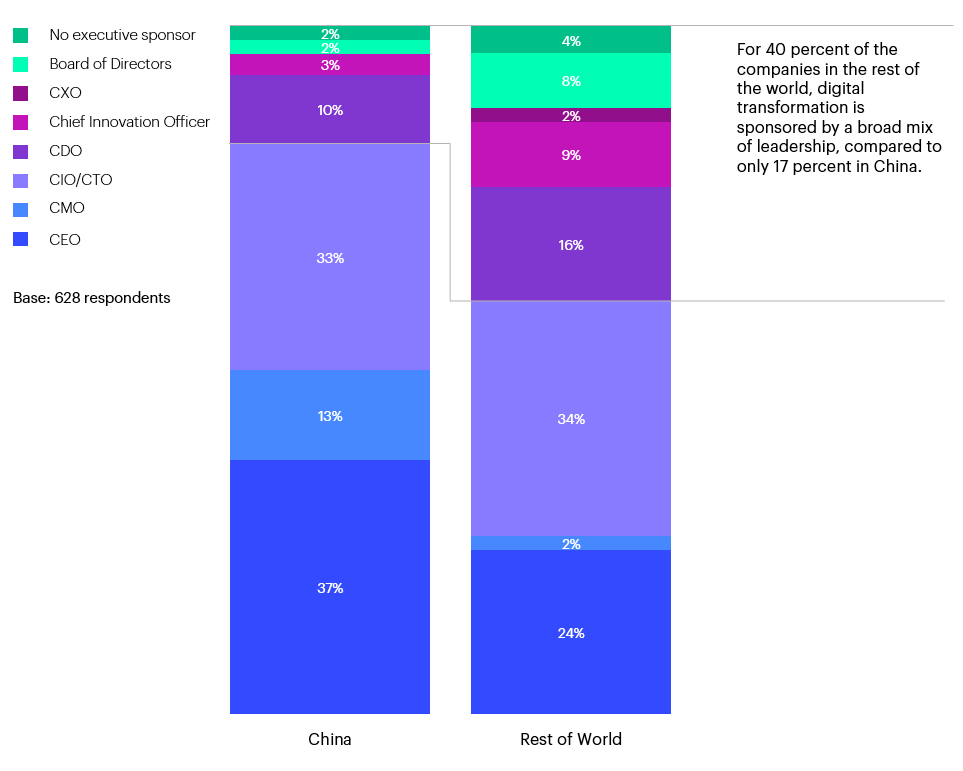
In China, digital transformation initiatives are mostly sponsored by the CEO, CMO and CIO/CTO. Together, these roles provide sponsorship for digital transformation in 83 percent of the Chinese companies. That differs from other regions, where a broader mix of leadership is typically in charge, including the Chief Digital or Chief Innovation Officer, as well as the Board of Directors.

Figure 1: Executive Sponsorship of Digital Transformation

“Which executive officially owns or sponsors the digital transformation initiative?”

Most notably, significantly more CEOs and CMOs in China are ultimately responsible for digital transformation, at 37 percent and 13 percent respectively, compared to 24 percent and 2 percent in the rest of the world.

But there’s a problem. While CEOs lead the charge and appreciate the strategic importance of digital transformation, they often fail to communicate those transformation initiatives are considered a top priority. And they don’t provide enough visible follow-through and strategic guidance.

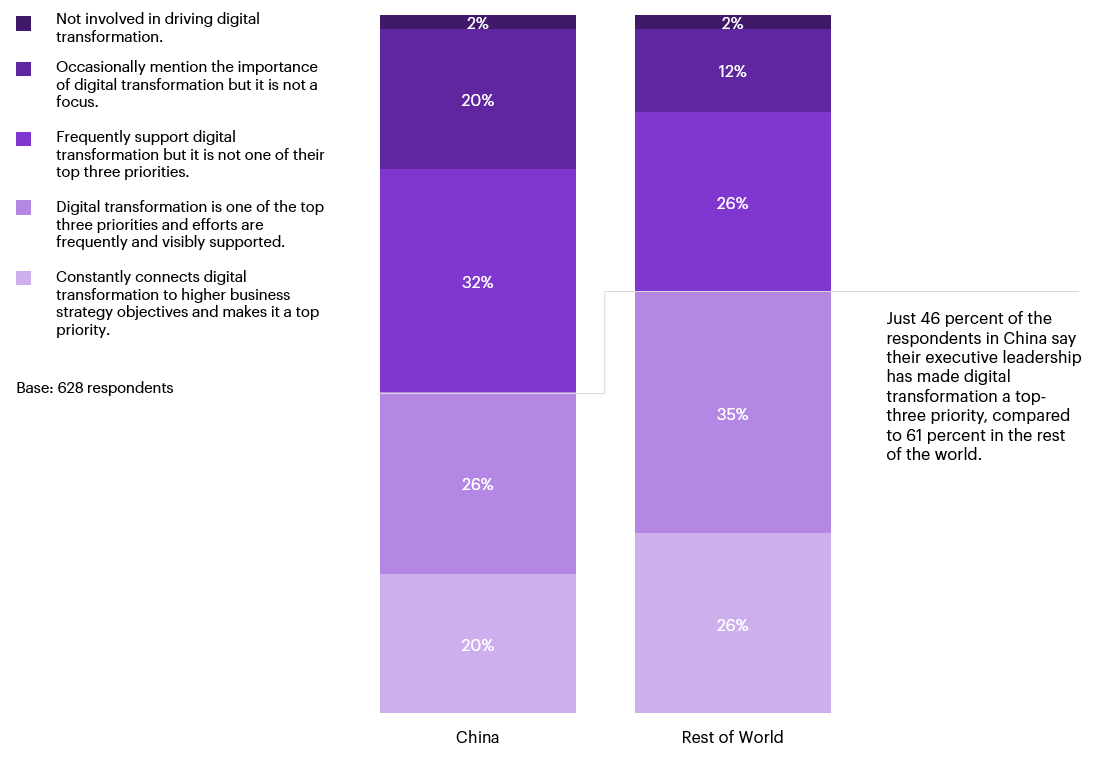
Figure 2: How Digital Transformation is Driven by Leadership

“Which of these statements best describes the nature of executive leadership in your organization?”

Because they fail to articulate the vision adequately and don’t actively promote it, mixed signals can lead to confusion for employees and customers. Just 46 percent of the respondents in China say their executive leadership has made digital transformation a top-three priority, compared to 61 percent in the rest of the world. And 22 percent say their executive leadership doesn’t see digital transformation as a focus.

Top drivers of transformation in China: Building a more resilient and high-performance culture and operation.

The events of 2020 have changed the way the world looks at digital transformation. Instead of focusing on external drivers, such as finding new markets and customers, they are more driven by internal needs to focus on their operations.

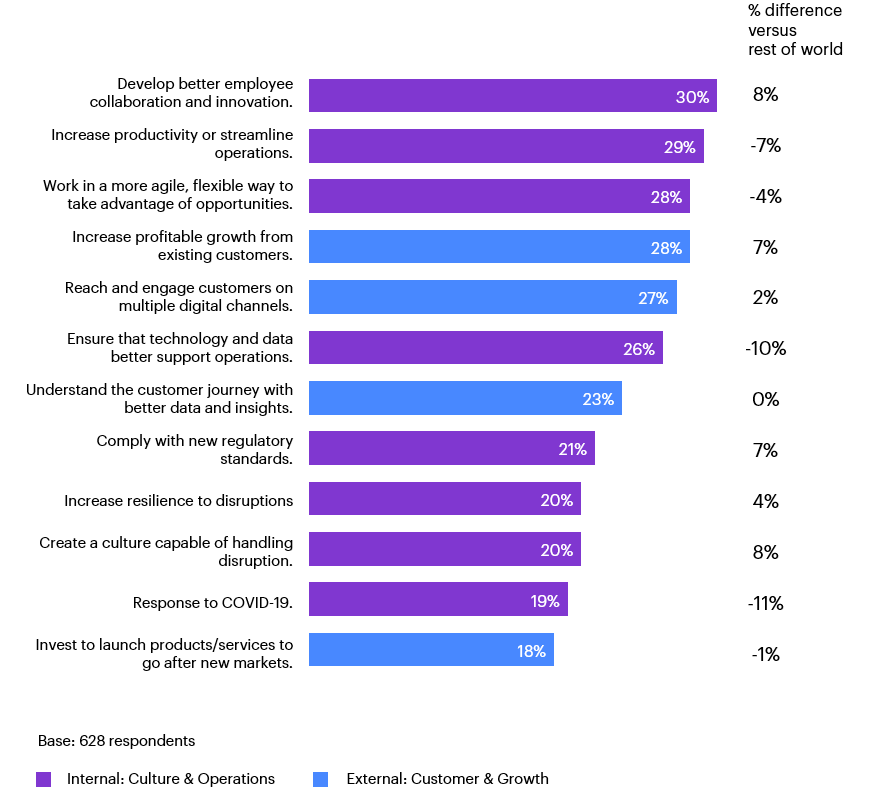
Figure 3: The Top Drivers of Digital Transformation

“What are the key drivers of digital transformation within your organization? Select up to three.”

Chinese companies say that developing a better culture, with more collaboration and innovation, is now the leading digital transformation driver. It was named by 30 percent of Chinese executives, compared to 22 percent in the rest of the world. That is closely followed by increasing productivity (29%) and working in a more agile, flexible way (28%).

Companies here are also more sharply focused on building resilience to keep up with change and global disruption. Some 21 percent of Chinese executives say they are looking for an increased ability to comply with new regulatory standards, compared to 14 percent of the rest of the world. And 20 percent hope to become more resilient to disruption, versus 16 percent. Notably, more believe they can actively create a culture capable of handling that disruption, at 20 percent, versus 12 percent in other regions.

Advance the Transformation: Opportunities for Building Strength

We observed some distinct characteristics of how companies approach digital transformation and identified three opportunity areas they should focus on to move faster toward transformation goals:

Lean into the future by pursuing multiple technologies

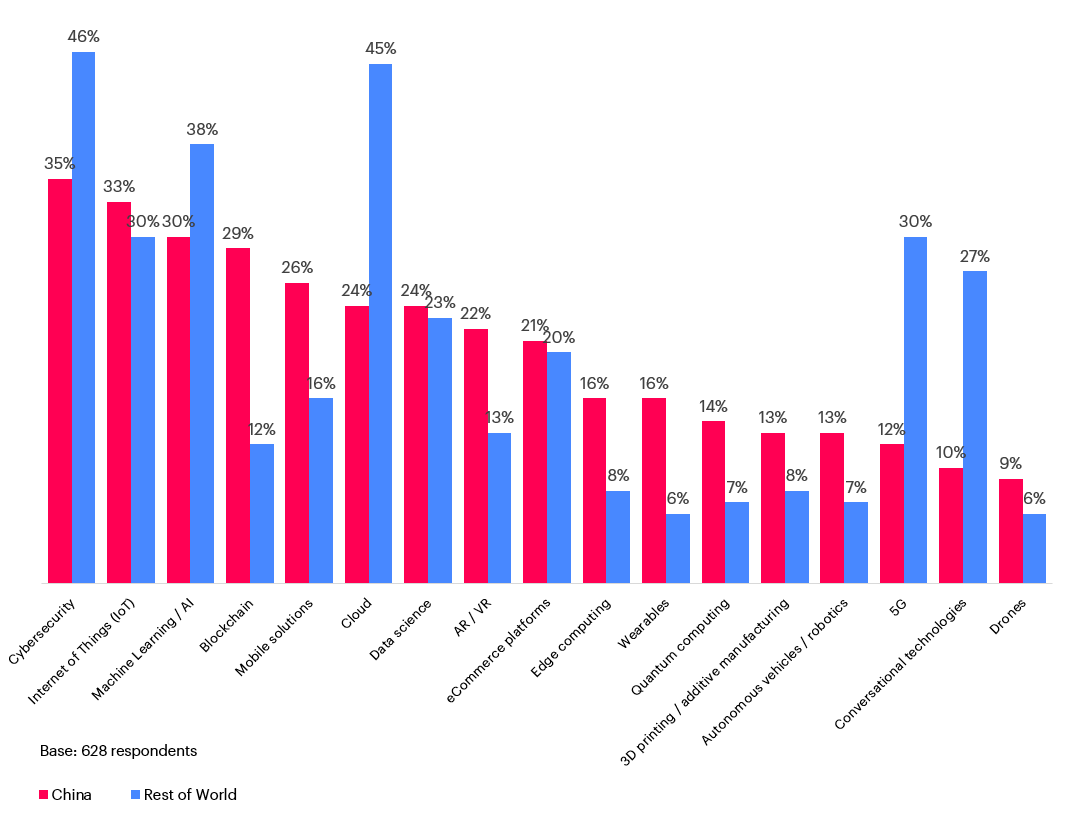
Figure 4: Prioritized Technology Investments

“What are your top priorities for technology investments in 2020? Select up to five.”

Around the world, companies are heavily investing in the same five technologies: Cybersecurity, Cloud, Machine Learning and Artificial Intelligence, 5G and Internet of Things.

Although Chinese companies are investing in these technologies too, they are also more diversified, putting their eggs in far more baskets.

Continuing to invest in emerging technology – and hiring the talent that can best help leverage it – will build competitive advantages and enhance agility, enabling companies to move quickly into new directions.

Integrate more, collaborate better

Chinese companies are also behind other regions in their ability to get employees to collaborate.

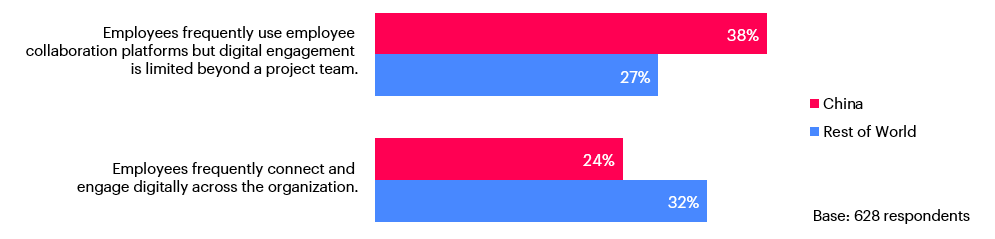
Figure 5: Employee Collaboration and Engagement

“Which of these statements best describes how your organization is transforming employee collaboration and engagement?”

In China, just 24 percent of the respondents say their employees are connected throughout the organization, versus 32 percent in the rest of the world. And 38 percent of Chinese companies say that while workers frequently use employee platforms, digital engagement is still limited when working beyond the project team, compared to 27 percent of the rest of the world.

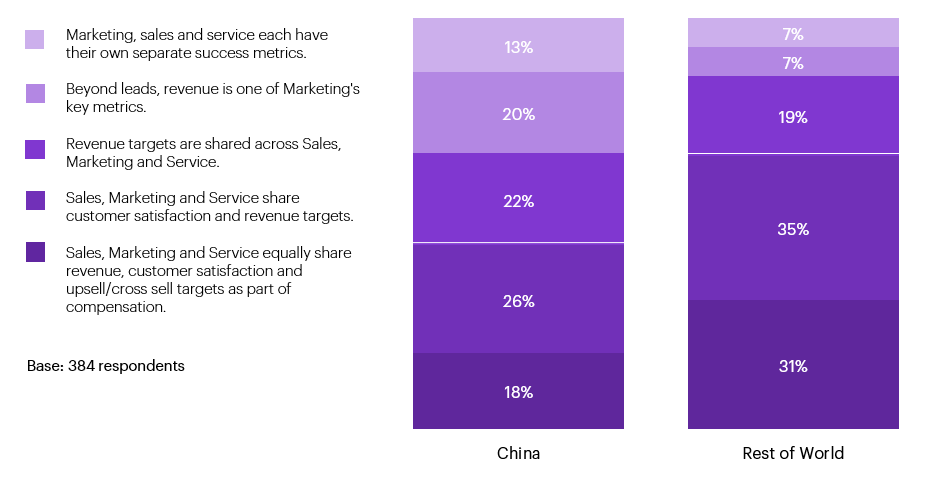
Figure 6: Success Metrics Across Functions

“How do you currently measure success across marketing, sales and service teams?”

Moreover, less than half (44%) of Chinese executives say their companies have aligned customer and revenue KPIs across marketing, sales and service teams. Yet 67 percent of those in the rest of the world have achieved this. As the report emphasizes, unifying metrics is an essential requirement for digital maturity.

Our experience substantiates that. While Chinese companies seem especially skillful at building and deploying highly effective project teams, they need broader collaboration across different functions to achieve maximum impact.

Double down on data

Chinese companies trail other regions in leveraging data as a core strategic component.

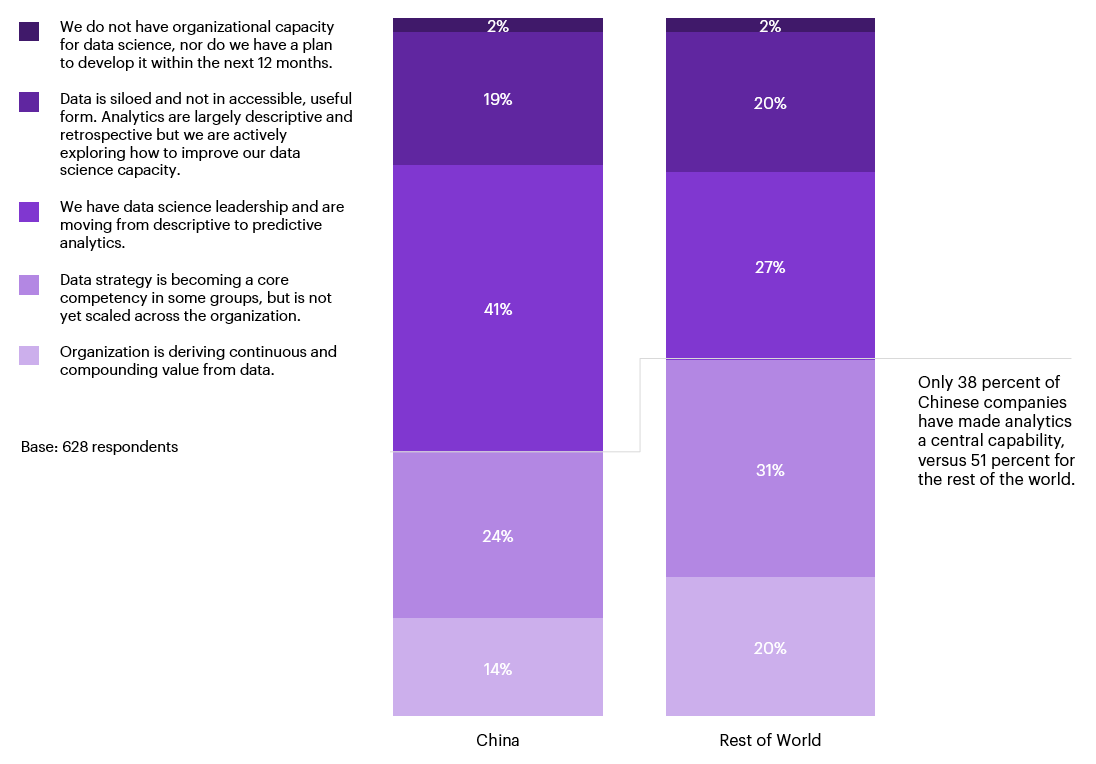
Figure 7: The Use of Data

“To what extent do you have clean and accessible data, clear processes, and organizational support for and discipline around data science in your organization?”

Only 38 percent say their company has succeeded in making data analytics a central capability, compared to more than half (51%) for the rest of the world. That means 62 percent still have the opportunity to expand and build their data capabilities.


FINAL THOUGHTS

Beyond digitizing marketing and sales, digital maturity is also about strengthening organizational operations and driving innovation to increase revenue. That requires a new kind of leadership. CEOs and other leaders must become cheerleaders for digital progress.

Digital leaders can’t afford to lose sight of the need to invest in digital transformation, even when budgets tighten. While no one can predict future moments of opportunity, they will continue to come, creating digital leaders’ chances to further outperform digital laggards.

Download the full PDF report, or get in touch to learn more about how to advance your digital transformation in China to grow better.

BLOG

A 2021 Strategic Planning Guide for CMOs

Why it’s important to use this year’s planning to start a fresh agenda.

As challenging as 2020 has been for marketing executives, it’s also been an accelerator of change. Amid pandemic disruptions, many companies found ways to reset, making fundamental–and often overdue–changes in their marketing organizations.

Those resets have opened doors to opportunities. As we help our clients map out 2021 marketing plans, we see important new ways for marketing to continue to enhance and even transform its role in accelerating a company’s growth.

We see several shifts that present a rare opportunity to develop the kind of marketing organization many people have been aspiring to work in, and lead, for more than a decade. These changes are built into marketing plans now and will sharpen focus and create more impact in the year ahead, as well as serve as building blocks for long-term growth.

Important Focus Areas for CMOs Developing Their 2021 Marketing Plans

Blur the Lines of Marketing

The best CMOs understand that solutions lie beyond their own departments and functions. The first wave of alignment has traditionally been marketing and sales, and more recently, deeper coordination with corporate communications. Increasingly, we also see CMOs building into their marketing plans integration with experience, tech, digital and HR teams. That’s because a genuine cross-functional approach is no longer nice to have, it’s essential for growth. While marketing may have responsibility for its plan and budget, leaders must see how collaboration with other functions is critical to the company’s success.

Elevate the Insights Function to an Operating System

As adept as many companies have become with transactional customer analytics and data, CMOs are keenly aware that insights often lag behind the accelerated pace of change happening across industries. That means plans are always a few steps behind what’s going on with customers right now. The pandemic, especially, has triggered profound changes in people’s behavior, making the need for constant pulsing imperative. Marketing leaders need a system that combines transactional customer analytics with current insights on human, consumer and user attitudes and behaviors.

Develop New Digital-Selling Strategies

Marketers can add value in the long term through brand reputation building, but they also need to play the critical role of generating leads and demand. Luckily, sales teams aren’t just welcoming this change, they’re pleading for it. Unable to jump on planes or meet face-to-face, salespeople need new digital tools, content and tactics to nurture every step of the sale. While there has always been a desire to push marketing and sales together, the pandemic is realizing the true merge of these two functions.

“A genuine cross-functional approach is no longer nice to have, it’s essential for growth.”

And, while this is certainly true for direct-to-consumer sales, an even larger opportunity for marketing is in B2B transactions. These customers, who are also enthusiastic digital consumers, are hungry for seamless solutions to procurement problems. By helping sellers answer that call, marketing has a rare purview to transform the selling process.

Create a New Talent Strategy

Finding the right people to run these intensely cross-functional operations requires a new approach. CMOs need to hire people who can look inside marketing and beyond, quickly jumping into a sales or product or experience or a tech conversation. And it’s likely recruitment efforts won’t be enough, at least to answer 2021’s pressing needs. What gaps can be filled by hiring? Partnering with other organizations? Upskilling? Even an acquisition?

Build-in Quarterly True Ups

CMOs need to be lighter on their feet than ever. Plans must be dynamic, allowing companies to be more responsive to shifts in the market and adjust in real-time. And this flexibility needs to be embedded in the day-to-day fluctuations of the company’s core businesses. Thorough scenario and contingency planning are mandatory for each goal and objective to be ready and responsive, with closer tracking of brand and sales performance.  Dynamic planning, responding and acting will now become the new normal for marketing. At the same time, making smarter tradeoffs in the near-term will be part of the secret sauce for reframing marketing’s role in driving a long-term growth agenda.


FINAL THOUGHTS

Marketing planning can traditionally be an optimization exercise. Improvements in last year’s plan, with tweaks and adjustments here and there. This coming year, especially now, it’s an opportunity to use the planning cycle as a moment in time to: set a fresh agenda, harness the digital acceleration already underway, reorganize around outcomes, re-energize your team and redefine what success can look like.

BLOG

CEO Perspectives: The 5 Most Pervasive Mistakes in Acquiring a Healthcare Startup

Acquiring small companies can open many doors for healthcare brands. Here’s how you can do it right.

Over the past three decades, acquisitions have shifted from acquiring for scale to acquiring for capabilities – often to accelerate digital transformation efforts. Prophet’s M&A team has noticed an unfortunate pattern of these new “acquisitions-for-capabilities” failing. This topic is often studied from the acquirer side, normally around the deal structure and integration management office (IMO).  However, less is understood from the side of the acquiree side, particularly the younger, smaller startups that are quickly picked up by large multi-billion-dollar enterprises.

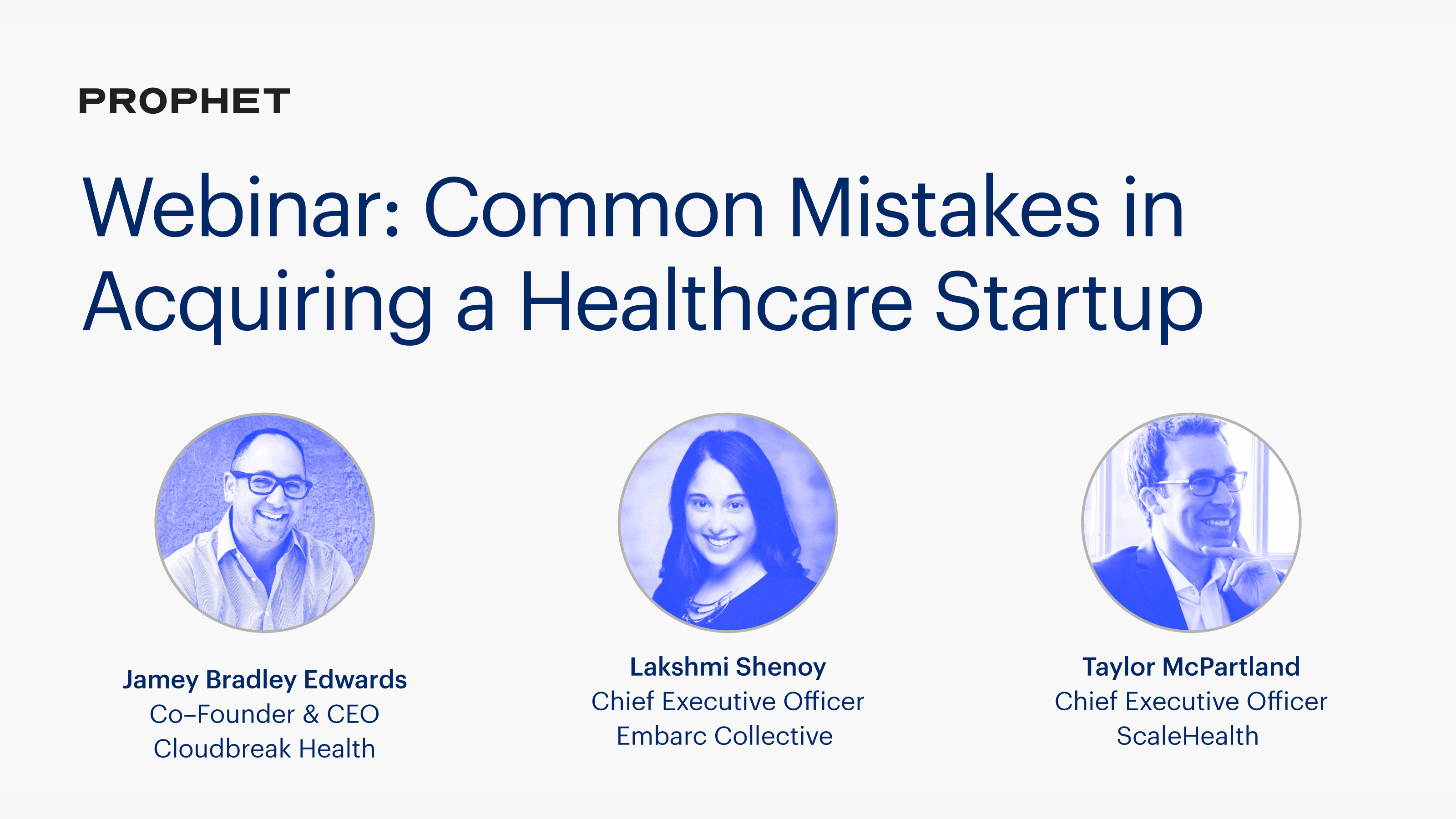
I sat down with three leading CEOs in the startup space – Taylor McPartland of ScaleHealth, Lakshmi Shenoy of Embarc Collective and Jamey Edwards of Cloudbreak Health – to better understand both sides of a startup acquisition deal.

Based on our discussion, here are some of the more pervasive mistakes in acquiring a healthcare startup:

Mistake #1:  Thinking the startup views the acquisition as the finish line

As Jamey puts it, “Most people don’t realize that entrepreneurs view an exit as one chapter ending, and another beginning. But, it’s still the same book.”

Many founders want to see their vision continue to flourish and grow.  There is a misperception that founders are in it for a big payday, but that’s not always the case.  Particularly in healthcare, where most startups are mission-driven,  the acquisition is the beginning of something newer and better for the founder.

Lakshmi added, “Even if you’re not working 24/7 after the acquisition, as a founder, you’re thinking about your startup 24/7.  Founders need to consider whether they want to part ways and let someone else be the custodian of their vision.”  This is equally important for the acquiring enterprise to understand these intentions as well (beyond the contracted incentives).

Mistake #2:  Not being clear on the “why”

“You have a 50/50 chance in creating value from an acquisition,” Jamey explains.  “So, the ‘why’ is really important.”

The “why” often gets lost in the contentious negotiating phase, where each side is more focused on the price of the transaction, and little attention is paid toward life afterward.  As Taylor puts it, “One of the first pitfalls is that a lot of hope is put on the acquisition, and one way to mitigate that is to have a clear understanding of the purpose of the transaction.  Is it for the talent?  The culture?  Technology?  Market access?  Either way, the mission and intention of the acquisition need to be kept front-and-center.”

Mistake #3:  Letting process get in the way of problem-solving

Most multi-billion-dollar healthcare enterprises are not digitally native.  As a result, their heritage stems from scaling research (pharma), services (health systems) or engineering (med-devices). Hence their DNA is process and mastering and repeating that process.

“Most people don’t realize that entrepreneurs view an exit as one chapter ending, and another beginning. But, it’s still the same book.”

– Jamie Bradley Edwards

Process is often a good thing, but if not viewed with open eyes, it can accidentally become limiting. The intricacies of enterprise decision-making can be very foreign to a startup. As Jamey explains, “There’s a lot of enterprises that have been very successful being focused on the process.  If you go from getting decisions made in a week and it now takes a month, that is going to be very frustrating for development teams that are used to working in agile.”

Lakshmi highlights that process -in the worst cases – can push away great talent.  “You might have the right tech.  You might have the right people.  But the messiness occurs within the process.  If you are impeding the team’s ability to solve problems – which is what founders of startups do – that is a very fast way to demotivate them.”

Mistake #4:  Assuming the acquisition deal is understood throughout the entire organization

It’s important to recognize that a founder is often negotiating with the enterprise’s deal team.  Those individuals will often not be the people (s)he interacts with daily after the transaction.  More importantly, you’ll have dozens of people that need to gel and work together who are not part of the deal conversations at all.

As Lakshmi puts it, “You must think of the team members who are not in the room when promises are being made, as many did not necessarily join that startup to be part of a giant organization. It can challenge the many motivations as to why they do their job.”

Taylor added, “It can be hard to quantify what culture means but it really is the through-line that made the company attractive to begin with. If you’re not hyperconscious of the new culture you’ve created, you run the risk of alienating team members before you ever realize the value you hoped for.”

Mistake #5:  Letting perfect be the enemy of good

It’s important to know that larger enterprises have different risk tolerances than smaller ones.  According to Jamey, “Large organizations have existing cash cows that they want to protect that.”  And that risk-averse culture often weaves its way into excessive processes.  This in-turn begins to work against the agility of the acquired startup, and that agility is often the desired trait that the acquiring company wants to adopt.

He continues, “Founders start by doing a bunch of missionary selling with scrappy individual reach-outs, and over time that begins to morph into more tech, Salesforce CRM, SEO, etc…  And we’ve learned, as a startup, that perfect is the enemy of good.  Get something out there and continued to learn via continuous improvement.”


FINAL THOUGHTS

Broadly speaking, everything comes down to alignment and empathy throughout both organizations.  It appears that when things go wrong, too much emphasis is on the “thing and processes.”  And when they go well, there is a strong connection through a shared purpose, an understanding of where each side thrives and a shared ambition around where they are collectively moving next.

BLOG

How to Effect Culture Change in Financial Services

By dialing up agility, empathy, inclusivity and curiosity, companies can inspire effective transformation.

Financial services companies have been pursuing transformation for years, but the events of 2020 have only underscored the need for these firms to rapidly evolve. In a few months, the world has achieved years of digital progress, shining an unflattering light on the many companies that lag. Many legacy financial services organizations, hierarchical and slow-moving, stand to lose as much as 35% of banking revenues to more tech-savvy rivals. That’s on top of an estimated $1 trillion in losses the sector may give up as a result of COVID-19.

Legacy companies are difficult to change by design. They were built for capital longevity and regulatory compliance, not agility and innovation. But they can’t afford to stand still. The ones that are making the most progress are moving forward at two speeds. First, they’re executing multiple plans at lightning pace to get teams and market positions back to “normal.”

But they’re also operating at a second speed, radically reimagining their future. They know that to survive, they have to innovate. And they have to create change throughout the entire organization – to transform, in the truest sense of the word. Prophet’s Catalysts in Action: Applying the Cultural Levers of Transformation report analyzes how companies around the world are achieving that transformation, identifying four essential pathways of change:

  • Defining the Transformation
  • Directing the Transformation
  • Enabling the Transformation
  • Motivating the Transformation

Here we dive deeper into each of these pathways with some industry examples:

Defining the Transformation: Driving Clarity

This step establishes a unifying ambition that is powerful and actionable, and that appeals to all levels of leadership.

We recently ran research with hundreds of leaders to study the cultural levers of transformation, including 100+ from financial services companies, who were more likely than average to say that their initial transformational efforts are proving effective.

But there are still roadblocks. Financial services companies often stumble when developing a transformation mission that is clear and actionable throughout the organization. It’s essential for leaders to get key stakeholders throughout the enterprise on board with the transformation plan in order for it to succeed.

Capital One, for example, has achieved extraordinary success by committing to a clear technology mandate. With a rallying cry of ingenuity, simplicity and humanity, the mission makes as much sense to thousands of software engineers and cloud executives as it does to customer-service representatives. Not only does Capital One excel among its peers, but its recruiting clout is on par with the best tech firms.

Directing the Transformation: Adapting the Operating Model

Financial companies, with their complex hierarchies and sprawling brand portfolios, often find that changing their operating model to support these ambitions is daunting. It involves overhauling governance, processes, roles, systems and tools. But these changes are essential: All parts of the organization need to line up with this leaner, faster thinking.

“Many legacy financial services organizations, hierarchical and slow-moving, stand to lose as much as 35% of banking revenues to more tech-savvy rivals.”

American Express offers an example of successfully directing the transformation. When it decided to shift its operating model away from relying on merchant fees to increasing card use, it re-engineered itself so that all functions could support the company’s new goals. That means decisions can be made quickly and laterally, without hierarchical delays.

But others struggle, in part because once a plan is prepared, executives are reluctant to share those roadmaps throughout the business. Our research finds that financial services companies tend to restrict these blueprints to the C-Suite – only 34% make it visible to the broader organization. That guarded attitude impedes financial-services companies from successfully adapting their operating models. Everyone needs to know where the company is headed in order to direct the transformation

Financial-services companies do have some advantages, though. Compared to other industries, they are more likely to update their roadmaps often, with 42% evaluating progress on a weekly basis compared to 31% in other industries. They’re also better at developing key performance indicators – 78% believe KPIs were well executed and measured transformation progress well.

Enabling the Transformation: Building a New Talent Model

None of these changes can take hold if the right people with the right skills aren’t in place. That requires shaking up methods of finding new talent and developing skills and competencies among current employees.

This includes hiring a diverse workforce and learning to listen to what they say. Leaders “who are inherently inclusive and collaborative and encourage good ideas to surface from wherever” are critical, says Mary Ann Villanueva, head of brand culture and engagement at Citi.

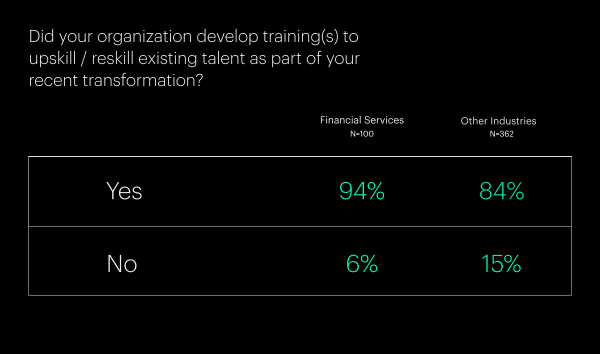
Our research finds that financial services companies are somewhat more willing to train and upskill employees than other sectors. One recent home run comes from JP Morgan’s $11 billion annual investment in tech, including an army of 50,000 technologists. That powered it to record results before the pandemic and continues to fuel the company’s exceptionally resilient performance so far this year.

Motivating the Transformation: Inspiring the Change

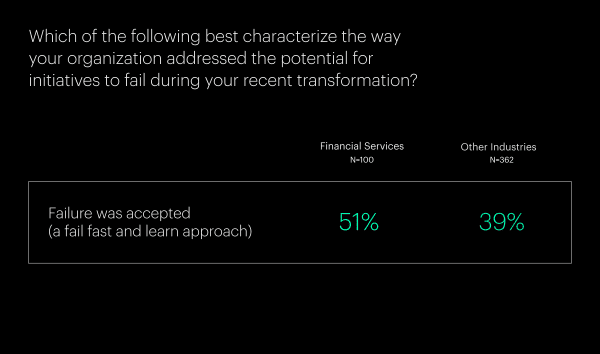
This aspect of change requires leaders throughout the organization to bring the transformation plan to life. In companies that are successfully transforming, executives don’t just talk about change – they exemplify it in ways that inspire employees to become evangelists for the new ways of working. Above all, they cultivate a tolerance for failure. Missteps are inevitable and failure is where an organization often finds opportunity. When teams fear failure, they seek broad consensus, which slows decision-making.

“We’re trying to enable employees to fail on small things, such as experiments in the innovation lab, to achieve success on the big targets,” Trung Vu Thanh, head of digital banking for MB Bank Vietnam, tells our research team. “We’re trying to push to the limit and use innovation, as more ideas will help.”

It’s hard to find a better example than USAA in this realm. USAA is best known for its intense focus on families and pride in military service. But its commitment to customer-centricity is so deeply ingrained into the test-and-learn culture that employees submit more than 10,000 customer-experience improvement ideas each year. Almost 900 are so good they’re patented. (And 25 of them came from a security guard, who – like all employees – is also a customer.) It’s an organization that draws its strength and energy from trying to find new ways to excel.


FINAL THOUGHTS

Taken together, these four pathways – harnessing curiosity, agility, inclusivity and empathy – can help financial services companies navigate their transformation. They build deep cross-functional engagement and collaboration. When combined with a shared sense of purpose, they can follow the transformative path to uncommon growth.

If you want to learn more about how our expert team can help your company accelerate change by transforming from the inside out then contact us today. 

BLOG

Human or Abstract? Defining Your Conversational Brand Experience

Gender, name, visual identity and personality all factor into what a brand should sound like.

Consumers are becoming increasingly comfortable with voice technology. Digital assistants, whether chatbots or voice agents, can bring brands to life in new ways, adding personality, differentiation, warmth – and even humor. They can turn static digital experiences into dynamic conversations, deepening the connection between brands and their customers.

The Conversational Brand: Strategy for a Digital-First World report by Altimeter, Prophet’s research arm, outlines the key decisions to consider to bring a conversational experience to life. The report seeks to answer the following questions:

  • What is the role of the conversational experience in the broader brand portfolio?
  • How closely linked should it be to the master brand?
  • What use cases will it deliver on?
  • What benefits will it bring to its users and to the company?

If the goal of the conversational experience is owned by one product or channel, it may look and talk very differently than if its role is to represent the master brand and provide a connective thread across different touchpoints.

Human or Abstract: That Is the Question

First, one must decide how to design the persona –either human-like or abstract. The main factor that should influence this decision is the strategic intent of the conversational experience: is the goal to humanize the brand? To create a deeper relationship with customers? To stand out in the market with a relatable character? If the answer to these questions is yes, then a human-like persona may be preferred. If, on the other hand, the goal of the experience is to automate repetitive tasks, to increase the speed of transactions, or to simplify processes in the background, then an abstract persona may be preferred.

In practice…

When AXA asked Prophet to create a conversational experience, we aligned on some clear strategic objectives: deepen customer engagement while humanizing the AXA brand as it was making the shift from payer to partner. A human-like avatar made the most sense, and so Emma was born. We built Emma to become an empathetic navigator, helping customers easily navigate the journey – from accessing services and making claims to reviewing health information and checking symptoms.

“The experience is futuristic and high-tech to create a futuristic and high-tech identity.”

Choosing a human conversational identity is an approach other companies are finding success with, as well. For example, Microsoft recently announced that it would turn Xiaoice, its highly empathetic chatbot, into her own entity, paving the way for new licenses and ventures.

Microsoft has described this virtual teenager as “sometimes sweet, sometimes sassy and always streetwise.” She’s fond of joking with users, even offering encouraging advice on life and love. With 660 million users worldwide, Xiaoice works on multiple chat services and is trained on data that Microsoft gleaned through the Bing search engine.

In addition to its abstract Google Assistant, Google is developing Meena, a human-like avatar that observers expect to deliver the best conversational AI yet.

But for some purposes, abstract identities offer more possibilities. For example, Bixby, Samsung’s digital assistant, is designed to help customers unlock their Samsung devices’ full potential. Bixby is an always-on feature. But instead of simply following commands, it’s built to have conversations. It encourages exploration and offers insightful curation, all the while making the everyday tasks feel easier.

In other words, it acts as a users’ bright sidekick, bringing together more information than a human could possibly manage. And while the technology is friendly, its features are best expressed through an abstract experience, not a human one. The experience is futuristic and high-tech to create a futuristic and high-tech identity. Even its name is not human, which allows it to appear and perform consistently in markets worldwide.

Developing Your Brand’s Conversational Identity

Once a company has decided what type of AI assistant it will create, there are still many decisions to make in developing its identity. For example, we established guidelines for the many ways Emma communicates with consumers, allowing personality to shine through in every interaction. She is curious, smart and thoughtful, determined to help users take care of their physical, financial and emotional well-being. Even her physical appearance is distinctive: She’s an approachable Pan-Asian woman with a little French flair.

Often, these seem like minor details. But digital assistants are functional, transactional touchpoints that benefit from small, purposeful doses of personality, including:

Gender

Users expect a gender even in abstract assistants. If it’s not immediately apparent, they’ll often ask. Both Apple’s Siri and Amazon’s Alexa, for example, are positioned as vaguely female. And Samsung made this question a core part of the Bixby’s user experience, with devices prompting people to assign Bixby a voice that is either male or female.

Names

Even beyond suggesting gender, names are a key part of developing an identity. Some names sound young. Some sound formal. Choosing a too familiar name might at first make customers think they’re dealing with an actual human. And some names have specific class, geographic or even religious associations.

Visual Representation

Since users see these assistants while they are talking, aesthetic considerations are important. These questions go far beyond simple graphic design and are at the heart of strategic positioning. Should the assistant look like it is closely connected to the master brand? Should the visuals be able to translate into more extensive advertising efforts? Or can it take on new dimensions, possibly paving the way for new offers, markets and customers?

Personality

Customers will only respond to digital representations that are likable. Like in real human relationships, personality traits shape communication. Should it be bold? Curious? Serious? Funny? Thoughtful? Clever? A Gen Z customer expects a different type of conversation than a Baby Boomer does. Use cases also matter – customers probably won’t feel like joking if they’re sick or just lost their credit card.

But ultimately, the best choices all support the strategic foundation, turning digital assistants into brand allies. And built carefully, with thoughtful updates as more data is collected, they can spark growth and deepen digital connections.


FINAL THOUGHTS

When designing the conversational experience’s identity, merely finding an interesting avatar or mascot is not enough. It is crucial to consider the strategic imperatives to make the experience consistent with the master brand.

Interested in developing a powerful digital experience and virtual assistant for your brand? Contact us today.

BLOG

Digital Transformation for Financial Services: Three Reasons to Hit the Gas

Legacy companies are moving faster, keeping up with their fintech competitors.

While the financial services industry is undergoing almost constant transformation, fintech startups drive most of it. As these rising stars continuously find new ways to introduce customer-centric innovation, incumbent financial institutions are struggling to keep up. “The 2020 State of Digital Transformation,” a new report from Altimeter, a Prophet company, finds that even as these tech-savvy newcomers surge to record valuations, 68% of traditional financial services companies report that they are only in the early stages of digital transformation. And they say that COVID-19 has slowed their progress even further.

While validating the obstacles many legacy companies face as they navigate their way forward, this research makes clear that this is no time to slow down. The sooner companies lean in and accelerate digital efforts, the more revenue and market share they can reclaim from newcomers.

Fending off the fintech onslaught

There’s no doubt that capital markets are favoring these fintech startups. In 2019, KPMG reports that investment hit $135 billion. These companies are growing in scale and revenue, with 68 achieving “unicorns” status, a valuation of at least $1 billion, as of this past September, according to CB Insights. And while they span consumer banking, payment solutions, insurance technology and trading, they have plenty in common: They’re disruptive, customer-centric and digital to their core.

Chime, a neobank startup offering digital cash management services and debit cards, is one of our favorite examples. It has tripled its transaction volume and revenue this year, achieving a $14.5 billion valuation.

“The sooner companies lean in and accelerate digital efforts, the more revenue and market share they can reclaim from newcomers.”

And Robinhood, a commission-free brokerage platform, saw daily average trades skyrocket to 4.3 million in June, surpassing all traditional brokerage firms. Among the household names left in the dust: TD Ameritrade, with 3.84 million, Charles Schwab at 1.8 million and E-Trade at 1.1 million.

But some traditional banking institutions, such as Marcus, Goldman Sachs’ consumer banking platform, have also seen rapid growth during the pandemic. It’s grown to more than $27 billion in savings from 500,000 customers, indicating that even legacy companies can successfully transform into digitally-powered institutions.

How legacy companies can catch up on digital transformation for financial services

Altimeter’s report delves into how incumbents are trying to catch up. Based on an in-depth survey of 600 executives, including 137 in financial services, three clear imperatives emerge.

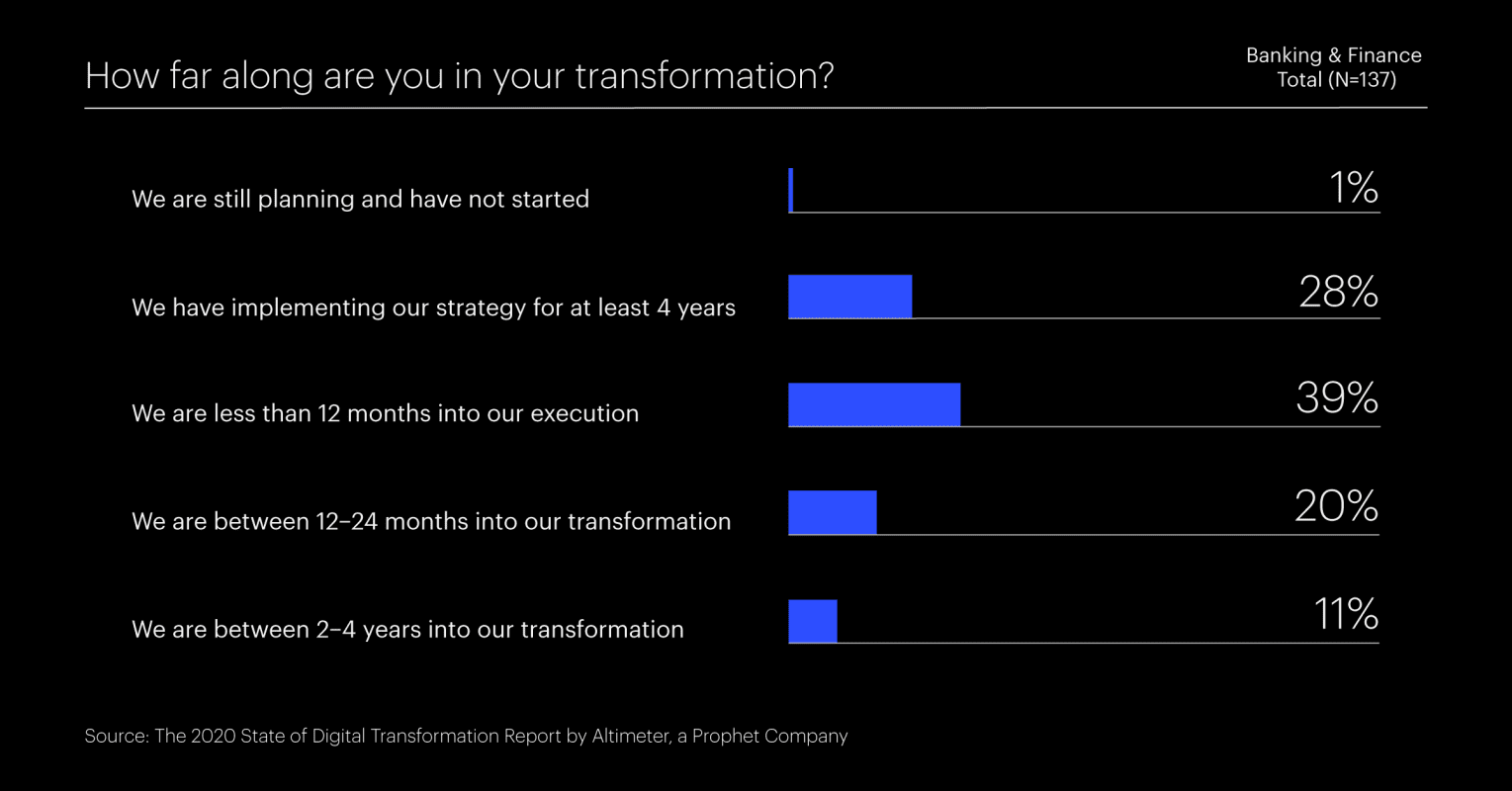
1) Move faster. The majority of financial services firms are still early in their digital transformation journey.
Altimeter’s research measures digital transformation through a five-stage model. First, companies make their case for investing in digital. Next, they develop foundations for more comprehensive investment, seeking to understand customer journeys and improve employees’ digital skills. From there, they build operations, digitizing them at scale. Fourth, they integrate these platforms to use data more strategically, and finally, optimize for growth, leveraging data and AI for great customer experiences.

Only 25% of the companies in our study have moved beyond this to the final two phases. Financial-services execs say they are moving even more slowly. Some 68% say their companies are still in the first two years of their transformation journey, and only 38% say they’ve reached the third phase (building operations). That compares to more than 50% of healthcare, tech and retail companies.

And that’s far too slow for consumers. The latest banking satisfaction research from J.D. Power, for example, shows that the more digital the customer, the more significant the satisfaction gap. And dissatisfaction is highest among Gen Z customers, a fast-growing demographic.


Source: The 2020 State of Digital Transformation 

2) Make new ways to reach customers a higher priority

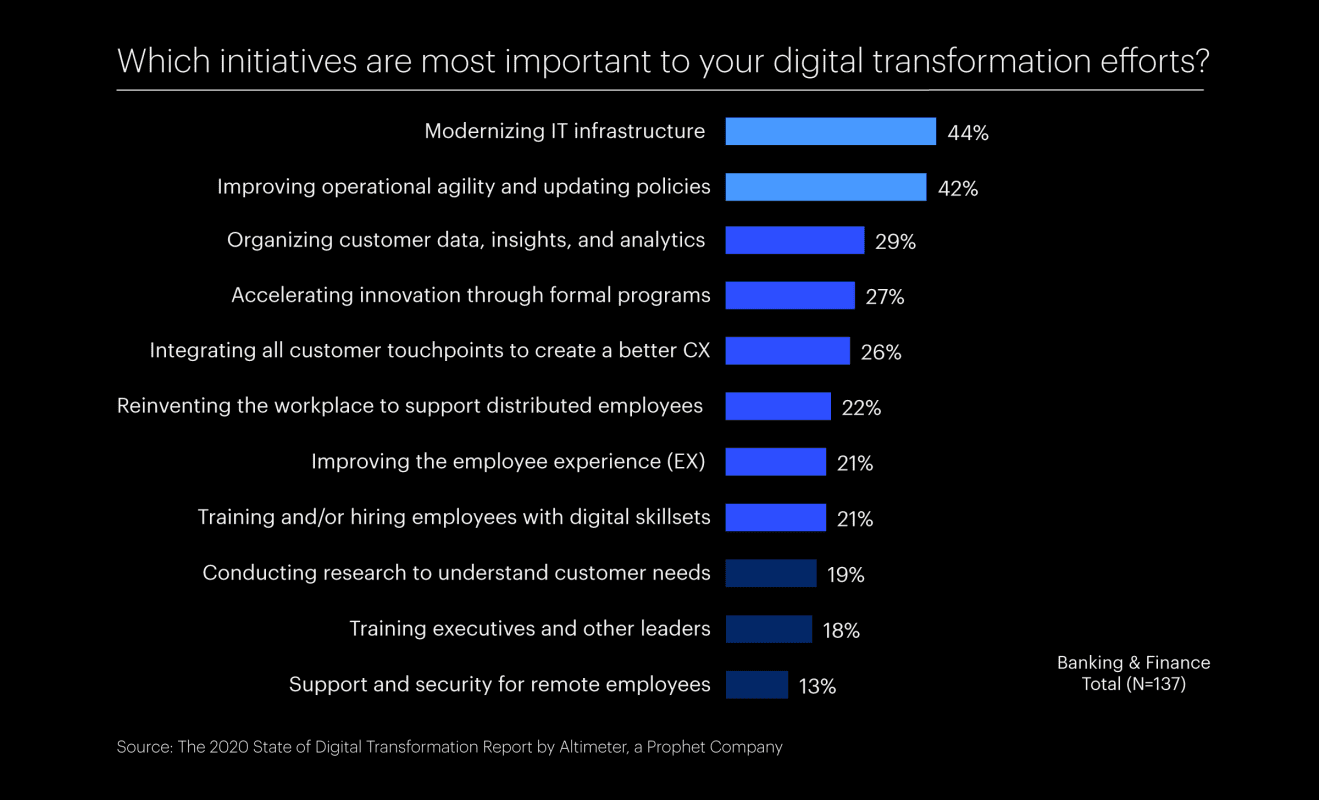
Optimizing internal processes is a compelling reason to pursue digital transformation, named by 40% of respondents and 33% name responding to COVID-19. And to create the resilience to navigate the current economic and health crisis, financial service executives recognize that their digital transformation should focus on improving operations and enable them to operate in a more agile and flexible way.

But our data suggest that these companies should give more weight to the many ways digital transformation could provide firms with opportunities to reach customers through new digital channels, particularly as more consumers look to engage primarily online.

As the market continues to change, and consumer preferences and tendencies evolve significantly due to COVID-19, financial services brands are picking up on the need to leverage advanced technology and data to become more flexible and agile.

Source: The 2020 State of Digital Transformation 

3) Acknowledge new barriers

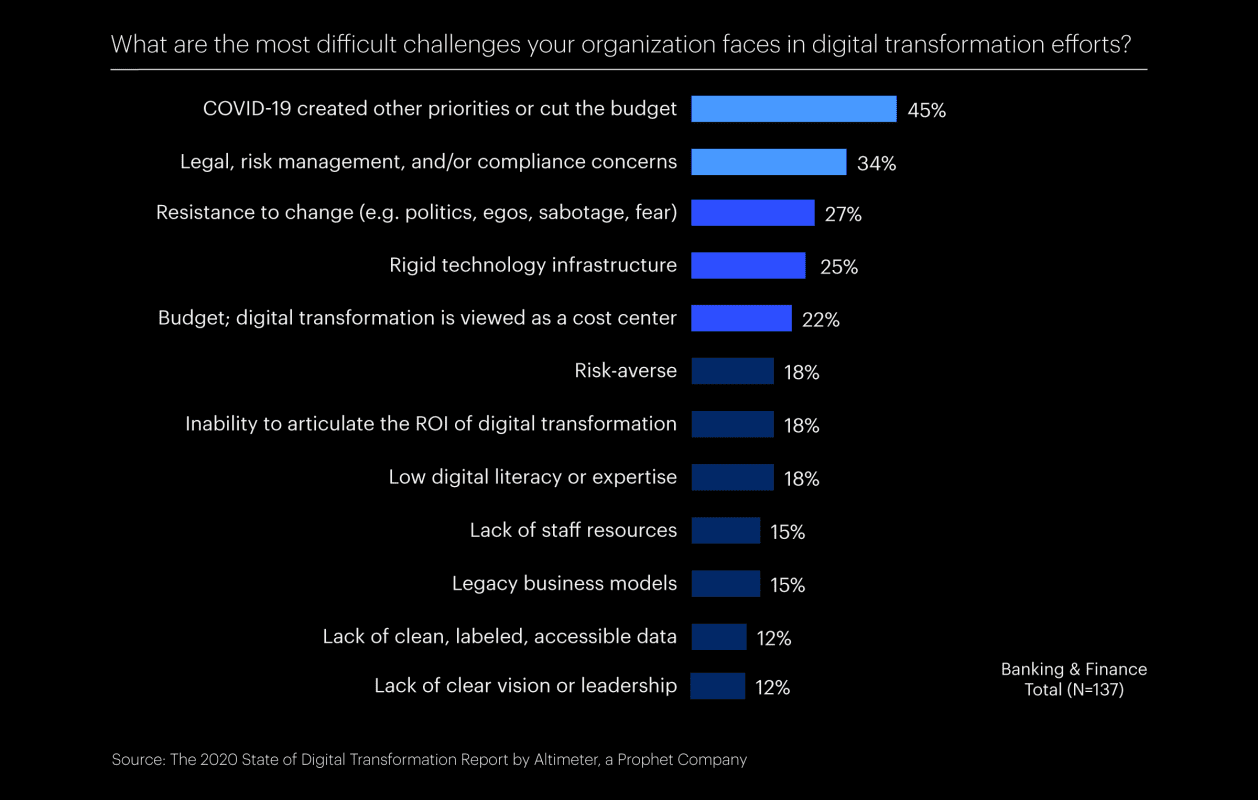
Transformation has not been easy, given legal hurdles and inherent resistance to change. And COVID-19 is creating new challenges. With urgent demands for supporting remote work and developing digital marketing and selling tools, the pandemic has hijacked many corporate priorities. In fact, 45% of our respondents say pandemic response and related budget considerations are the most significant challenge they face. And of course, traditional obstacles like risk management, resistance to change or rigid structures haven’t gone away.

Source: The 2020 State of Digital Transformation 


FINAL THOUGHTS

The global economic and health crisis has impacted the way we think about digital transformation. This research underscores questions leaders within these companies should ask, to accelerate the transformation and achieve growth.

  1. How has your organization accelerated or reprioritized its digital transformation initiatives in response to the current environment?
  2. What obstacles are you encountering as part of that acceleration?
  3. Is your agenda building greater operational resilience for your business?

Prophet’s financial services practice has been partnering with many clients in accelerating their digital transformation journey. Please contact us to learn more.

BLOG

Five DTC Growth Moves to Optimize Your Investments

These 10 real-world examples will show you how to optimize your investments in the rapidly shifting direct-to-consumer landscape.

For the right investors, the rapidly shifting direct-to-consumer (DTC) landscape presents plenty of possibilities. Many of these digital natives are just one cash infusion away from dominating their category–as long as they make the right strategic DTC growth moves.

“We find companies that have the potential for market disruptive growth and profitability, and the positioning to generate the most likely–and fastest–returns on investment.”

The pandemic-fueled surge in all things e-commerce is pushing many to record sales, with business booming at companies like Peloton, Quip and HelloFresh. But not all DTC companies have the same growth potential, and there have been plenty of notable flame-outs. In our work for funds looking to make DTC investments, whether it’s in due diligence or consulting on the use of funds post-transaction, we’re intent on optimizing investment. We find companies that have the potential for market disruptive growth and profitability, and the positioning to generate the most likely–and fastest–returns on investment.

Beyond assessing fundamentals, including how well possible targets have penetrated their customer base, brand staying power and competitive moats, we zero in on potential, based on specific growth moves. We’ve seen that companies with the ability to lean into these five strategies have the best chance to achieve uncommon growth.

We look for companies that are ….

1. Continually Tapping Unmet Needs

The most successful DTC brands started with an unmet need, filling some area of behavioral white space. Millennials, for example, wanted to start investing but felt ignored. Companies like E-Trade and Charles Schwab seemed like their parents’ tools. Robinhood, with its “investing for everyone” credo, stepped in to draw millions of new stock-market investors, with impressive (and occasionally controversial) results.

Lemonade

Our favorite example is Lemonade, which has used behavioral nudges and machine thinking to become the most disruptive force in homeowners, renters, condo and now pet insurance. In return for signing the honesty pledge, customers get transparent prices and lightning-fast service. While many Gen X and older customers may not have heard of it, young people love it. “I just bought insurance on Lemonade,” one of my young associates told me the other day. “And the user experience was freaking awesome.” Has anyone ever said that about insurance until Lemonade came along?


2. Ending Churn Through Customer Obsession

Given the massive spending needed to acquire customers, the strongest brands are those that maximize that investment. Strong retention requires a shift in focus from product obsession (the natural starting point for so many DTC companies) to true customer obsession.

Stitch Fix

Stitch Fix is continually updating its offer, finding new ways to please existing customers and new customers to please. Its core offer is a fashion fix with five carefully curated choices, and millions love how the personalization gets more accurate over time. But many don’t want to shop this way. So it recently introduced Direct Buy, enabling old and new customers to dive deep into single categories, boosting incremental sales.


3. Uncovering Value Through Deep Customer Analytics

The fastest-growing companies are those that do the most with their data.

Looking closely at questions of price elasticity, for example, can make all the difference in expansion, particularly in new territories. And while this has long been the promise of DTC companies, the reality is that the more data they collect, the less likely they are to use it. IDC estimates that about 90% of what businesses collect is “dark data,” and never used at all–let alone effectively.

Canoo

So we pay close attention to those that dig into data in every channel. Canoo, for example, is so expert at harnessing tech and innovation insights that it’s poised to launch its electric vehicles after 19 months, not five years. And based on analytics, it’s confident that higher-end consumers will love its subscription-only model, with as little as a one-month commitment.

MeUndies

Another data-savvy company is MeUndies, which has used what it’s learned from social media to sell more than 10 million pairs of underpants. Even rarer for DTC companies, it’s been profitable for three years.


4. Finding New Adjacencies

While many DTC brands build their business on a single product, they eventually need to expand to keep growing, either geographically or by adding new categories. This is a moment when many need more cash, new investors or the ability to acquire or partner with other companies.

Casper

Broadening offers while maintaining category credibility often comes down to the right messaging and positioning. Casper, for example, launched in 2014 and quickly became successful. But as competitors piled on, it’s needed to find new ways to expand. With a promise to become “the Nike of sleep,” it now sells pillows, sheets and weighted blankets. But more importantly, it positions itself as the expert on sleep wellness.

Airbnb

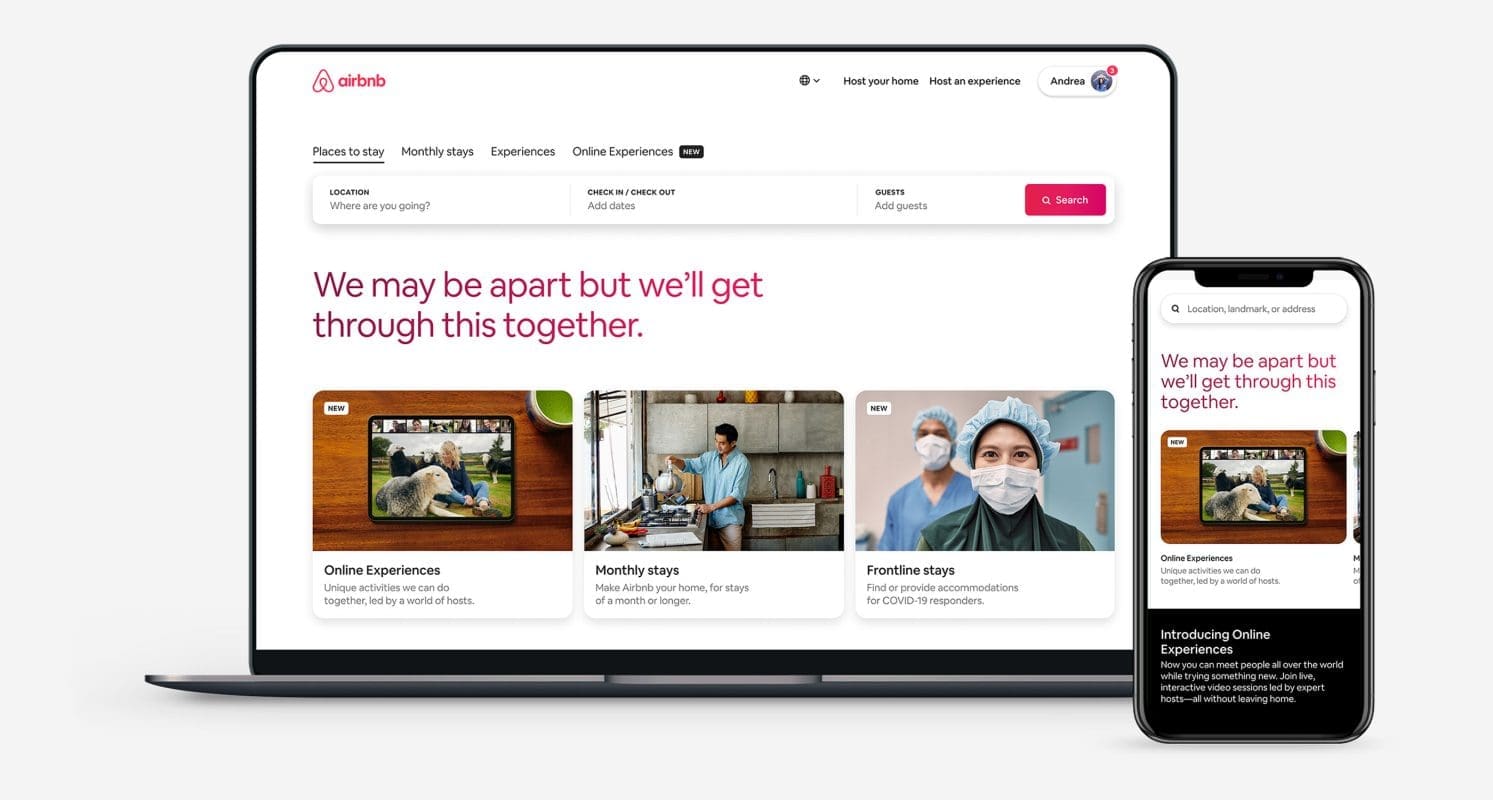
Similarly, Airbnb recognized that it could find growth by moving beyond lodging and selling experiences that make people want to travel. From sushi tours of downtown Tokyo to paddleboarding with sea lions, these adventures are adding millions in revenue. (When COVID-19 struck, they also provided a quick pivot to virtual experiences.)


5. Partnering Strategically to Scale the Ecosystem

Headspace and Spotify

Finding partners is a way to access new customers and stay relevant. Headspace, the popular meditation app, has increased its influence exponentially by partnering with Nike, Spotify and the NBA.

Everlane and Nordstrom

Retail is an obvious choice and can be a game-changer. Even non-digital consumers can discover brands like Native, Harry’s, Barkbox and Quip at Target, for instance, or find Everlane and Birdies at Nordstrom.

Alo and Animal Crossing

Others leverage pop culture. Alo, a yoga company, and Tatcha Beauty teamed up with Animal Crossing for product launches within the popular video game.

Allbirds and Adidas

The partnerships that we believe spark the most growth are those that combine scale and purpose. Allbirds, which has built its impressive valuation on sustainable fashion sneakers, recently partnered with Adidas, which has been trying to increase visibility for sustainability efforts. Interestingly, this unlikely partnership with competitive brands introduced a collaboration that pairs Allbirds’ innovative approach to materials with Adidas’ marketing and manufacturing might, and is set to produce the world’s first carbon-neutral performance shoe next year.


FINAL THOUGHTS

As they sift through DTC companies, investors should look for potential targets that can make some (or all) of these five growth moves. These are the nimble brands that can unlock the fastest returns for investors and find exceptional growth for themselves.

Prophet is obsessed with helping clients win with their customers and unlock uncommon growth in this digital age. Contact us to learn more about what we are doing in all things direct-to-consumer.

BLOG

The Acceleration of Digital Transformation in Europe

Our research shows that employee collaboration and a new kind of agility are fueling regional gains.

Every January, the Prophet team sets out our predictions for what the year ahead might bring. This year one of the predictions we made was that 2020 would be the year when failed digital transformation initiatives would face a reckoning.

And then 2020 happened.

Since COVID-19 first emerged in Asia at the start of the year and then took hold in Europe in March, we have lived through a period of dramatic change – the pace of which nobody could have predicted.

This is especially true when it comes to the adoption of digital technologies in our professional and personal lives. In the UK, the e-commerce share of total retail jumped from 20 percent to 30 percent in just two months, and even as lockdown eased, online grocery purchases continued to rise, almost doubling from mid-May to mid-June. In France, in just one week, there were almost half a million online telemedicine consultations, compared to 40 thousand the month before. And, following a surge in-home streaming in March, Netflix agreed to reduce the bitrate for its streams across the EU to lessen the demand on networks.

In the 2020 State of Digital Transformation report, my colleagues at Altimeter, a Prophet company, have surveyed leaders across the globe to understand how their organizations are responding to the shifts and trends that are shaping how they transform. For those of us in Europe, it provides a fascinating snapshot of the way coronavirus has dramatically shaped the role technology plays in transforming businesses.

Agile Becomes More Than a Buzzword

One of the most significant shifts in this year’s study is the key drivers of transformation efforts. In 2019, the top driver for digital transformation was growth opportunities in new markets. But in 2020, in reaction to the global pandemic and the associated economic pressures, leaders have shifted their focus to operations.

It is in this area we see one of the key differences between the leaders of transformation efforts in Europe and their North American peers. In North America, the top transformation driver is increasing productivity and streamlining operations (41%), but in Europe, the need to work with greater agility is more likely to drive transformation efforts (35%).

“It has become vital for organizations to become more digitally mature.”

The need for agile business practices is particularly pressing in Europe, which experienced a faster and deeper lockdown than North America. This lockdown has required leadership to adapt its transformation efforts to address rapidly shifting customer demands.

Europe Leads the Way in Employee Collaboration

COVID-19 has accelerated the need to shift to virtual ways of working, which has been mirrored by a boom in virtual collaboration tools. The 2020 State of Digital Transformation report shows that Europe is leading the way in this area, with 58% of respondents reporting that platforms to enable employee collaboration was either a top strategic objective for digital investment, or that employees frequently connect over digital platforms. This is particularly pronounced in Germany, with 65% of respondents in the top two levels of employee collaboration and engagement.

Seamless Experiences Command a Price Premium

The rapid adoption of digital technologies throughout the pandemic has shone a light on the points at which experiences break, with issues around technology being the most commonly received complaint.

The 2020 State of Digital Transformation report reflects this, with 52% of respondents reporting that they were yet to achieve a seamless sales and service experience.

But the benefit of doing so is also clear, and it’s an area where Europe leads the way, reflecting a relatively higher adoption of digital tools for sales teams.

29% of European respondents reported that they were able to charge a higher price premium as a result of offering a seamless sales and service experience online, compared with only 15% in North America and 9% in China.


FINAL THOUGHTS

The global pandemic has undoubtedly changed our relationship with technology, and many organizations cite it as a key driver of their own digital transformation.

As we begin to think about the “new normal” shaped by the global pandemic, it has become vital for organizations to become more digitally mature. The 2020 State of Digital Transformation report provides organizations with the opportunity to measure and benchmark their stage of digital maturity.

The report also offers encouragement for European organizations planning for what comes next. EMEA-based organizations are twice as likely as ones in North America to be at the highest stage of digital maturity. Because they have built a strong digital foundation, their focus is now on leveraging data and AI to create great customer experiences.

Helping organizations advance their digital maturity is one of our primary focuses at Prophet, from marketing to brand, experience to culture. As you look to the months and years ahead, we’d love to hear where you are focusing your transformation efforts. Comment below or reach out to us directly.

BLOG

The Future of Work Demands a New Approach to Learning and Development

Our research shows that learning and development can slow the Great Resignation.

Much has been written about the new capabilities required for companies to thrive in the future of work. These needs add to the already significant demands on organizations to upskill their employees in the face of ongoing technological shifts related to digital transformation

Prophet’s 2021 global research study “Fit for Change: Driving Growth and Transformation in the New Future of Work” showed that companies recognize the importance of equipping employees with the skills demanded by an ever-changing landscape. In our global survey, 81% of leaders noted that “our organization has increased investments in upskilling and reskilling our employees to thrive in the future of work.” Additionally, Fast Company recently reported that companies spent $165 billion on learning and development in 2020, yet 70% of employees say that they aren’t taught the skills needed to do their jobs.  

“High-quality, relevant learning and development help reconnect employees to their organizations by creating visibility and access to the skills needed to succeed.”

So, how might organizations ensure that learning investments pay off in terms of achieving their business ambition and engaging and empowering employees? The answer: by taking an intentional, modern approach to designing, delivering and governing learning and development experiences that go beyond transactional training to continuous skills-building and growth.  

Learning and Development is at a Tipping Point

Learning and development opportunities have increasingly been a key factor in employment decisions – and even more so now in this period of the Great Resignation of 2021. High-quality, relevant learning and development help reconnect employees to their organizations by creating visibility and access to the skills needed to succeed. It also allows employees to demonstrate commitment to long-term career paths.  

Meeting the accelerated demand for modern skills development and relevant learning experiences has elevated the important role played by learning functions and departments. The time is now to ensure that employees receive real value through engaging learning and development content that can be applied and translated to day-to-day work and drive measurable business impact. 

Four Steps To an Enhanced Learning Model

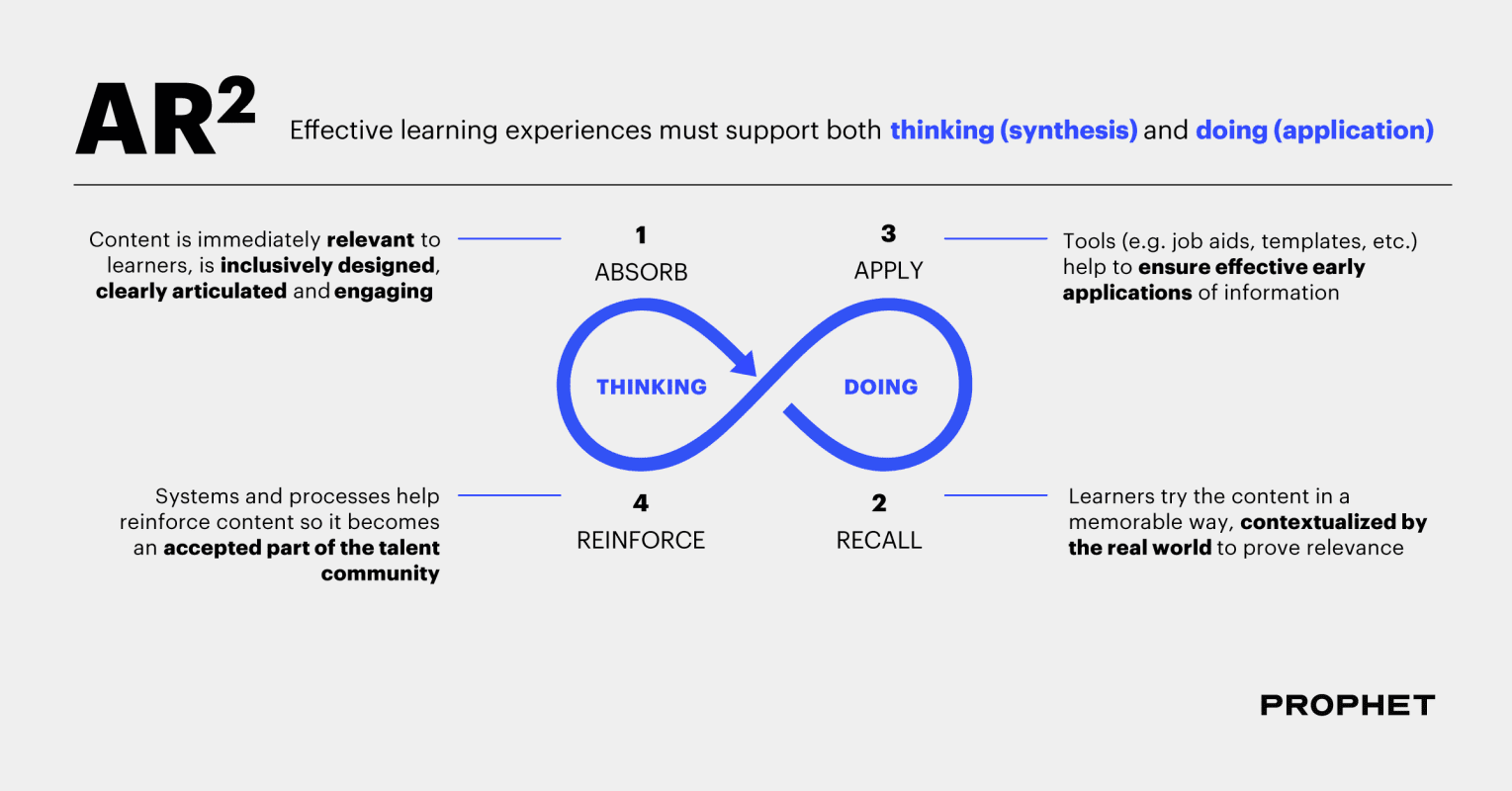
At Prophet, we’ve synthesized adult and transformative learning theory to develop our AR2 model for designing and delivering compelling learning and development experiences. The four steps of this model (Absorb-Recall-Apply-Reinforce) are designed to ensure learning experiences support both thinking (synthesis) and doing (application).

Below we walk through each of these four steps, to help you on your way to enabling transformation in the “Mind” of your organization:

1. Absorb

Initially, what is being communicated is still just information, not knowledge; the key is making the information something that the recipients will want to convert to knowledge. First, define clear learning objectives to ensure the information presented is targeted and relevant. Then, consider varying how recipients will consume the information to sustain engagement and stimulate different mental muscles. How might you deliver information in a way that requires recipients to alternately read, see, listen to and feel this content? 

For example, Prophet worked with a large global appliance manufacturer, which needed to broadly upskill its marketing organization to enable digital transformation. We designed a full learning curriculum, in which one key module was focused on helping marketers truly understand and embrace their target consumer segments. The segmentation data was translated in a way that brought these consumers to life, versus treating them as data points on a page. 

Also, an immersive exhibit allowed the marketers to “choose their own adventure” in terms of when and how they consumed information. Rich material within the exhibit included visuals that invited participants into the kitchens of these individuals and they were actively engaged through the use of an augmented reality app, which allowed them to hear the voice of the consumer first-hand through the unlocking of quotes and videos.  

2. Recall

The Recall step is where learners “try” the content in preparation for its application in context. Studies show that every time a memory is retrieved, that memory becomes more accessible in the future. So, Recall focuses on retrieval and continual practice. Today’s virtual learning platforms offer plenty of functionality to find creative ways to aid recall. Real-time quizzes and visualization of results through tools like Mentimeter help drive instant engagement, while the breakout function offered within Zoom enables small groups to consider a thought-provoking question and how it links to what they’ve learned.

For example, with this global appliance manufacturer, our learning curriculum included designing two-week gamified online “Expeditions” around key topics related to digital transformation. After first absorbing the information, participants were engaged through quick quizzes, with points awarded for correct answers. Participants could also earn points and badges for posing questions, commenting and sharing related information, all ways of driving recall as well as a sense of community and competitive spirit. 

3. Apply

Within the Apply step, learners must be guided to do something with the knowledge they’ve gained in the context of their job. Adult learning is most successful when knowledge is made clearly relevant to the learners and their lives. In fact, organizations can’t afford to not drive toward application within their learning and development programs.

The Apply step is where knowledge is connected to meeting key business objectives. Applying knowledge in a simulated and supported environment ensures individuals are equipped to apply this knowledge again when they’re faced with a similar situation in their day-to-day work. Tools such as templates, action plans and job aids (like checklists) both support and drive successful applications.  

For example, a capstone of the learning curriculum for the global appliance manufacturer was a three-day summit for their top marketing leaders. Action planning often gets crammed into the final module of a session, but an “apply as we go” approach was taken instead. Time was carved out each day to iteratively build action plans, applying the knowledge gained each day to build and refine the thinking. Teams for action planning were carefully constructed to mirror typical working teams. This was, to ensure the action plan was relevant to real objectives, versus a theoretical learning exercise. Finally, the summit incorporated mechanisms to drive accountability, such as sharing action plans with peers and inviting feedback. 

4. Reinforce

The fourth and final step is to Reinforce. This means both creating incentives to sustain new behaviors related to the knowledge gained, as well as developing long-term opportunities for reinforcement (to ensure knowledge is not forgotten over time). Simple incentives, such as social kudos or visible symbols (e.g., a custom notebook, with a checklist insert), are fun and effective. The most powerful incentives, however, are ultimately those that are incorporated into development objectives and performance management, to help embed the learning within day-to-day work and expectations. 

For example, the learning curriculum for the global appliance manufacturer paved the way for a more expansive effort to transform and embed digital capability within the marketing function. The skills taught throughout the learning curriculum became core to job expectations for the company’s marketers and each marketer was expected to apply the knowledge gained to help the company evolve toward world-class, consumer-led marketing. 


FINAL THOUGHTS

Relevant, compelling learning experiences – designed through approaches such as the AR2 model – are necessary to help companies make the leap in leveling up their workforces around critical new skills. Executed as part of a comprehensive learning and development curriculum, these learning experiences create greater employee capability, engagement and ownership in the new future of work. 

If you’re looking to pursue an upskilling/reskilling agenda and want to understand how to adapt employees’ skills and roles to the future of work, then our Organization & Culture experts can help – get in touch today.  

BLOG

Is Your Employee Value Proposition Ready for the Future of Work?

Serving diverse audiences requires multiple perspectives, harnessing the contribution of many voices.

Every employer has a value proposition to deliver on to its people, which includes looking after both personal and professional growth and wellbeing.  That has taken on new dimensions in 2020, as employers find themselves needing to be their employees’ friend, therapist, safety supervisor, community builder and megaphone for social justice. That’s a lot of hats to wear, and yet it’s clear these and more will be part of the new baseline expectations employees have. 

The pressure mounts to craft the right employee value proposition. 

Companies are finding they must make sometimes large transitions to play these roles, and are doing so amidst a background of significant tensions. The current economic climate is forcing a contraction of the workforce at the exact moment employers are being called on to deepen their commitment to their employee base. Financial concerns are ever more urgent but are often at odds with being a good world citizen. And digital transformation is accelerating faster than ever before, at a moment when people are desperately seeking more humanity. Let’s take a closer look at what to keep in mind as your organization begins developing an employee value proposition for the future. 

The facts of developing an employee value proposition for the future

The pressure to be on the right side of history in such a cataclysmic moment is very intense, and historic efforts haven’t always threaded the needle of these tensions successfully. We’ve all seen companies that have made big statements on purpose, culture, social responsibility and diversity—but in an effort to prioritize customers and shareholders, many have not delivered on them. 2020 has served as a fresh reminder that businesses can’t pick and choose amongst stakeholders anymore—the survivors of this crisis will prioritize customers, shareholders and employees, as well as communities and society, to truly be good corporate citizens. 

“The survivors of this crisis will prioritize customers, shareholders and employees, as well as communities and society, to truly be good corporate citizens.”

This moment demands that employers strike a new deal with their employees.

  • Serving customers means serving teams. Customer centricity is critical, but your teams can’t be customer-centric if they are themselves drowning. Taking care of employees’ health, wellbeing and work-life balance need to be an explicit part of any go-forward plan. In fact, 64% of employers believe that COVID will have an outsized impact on employee wellbeing and many are already expanding their efforts to respond. 
  • Serving diverse audiences requires having multiple perspectives in the conversationSupporting a diverse network starts by harnessing the contribution of all voices within an organization. A business that makes diversity and inclusivity part of its business strategy now will see this investment pay off when it acquires better, more relevant work and when its position is elevated as a desirable place for top talent to build careers. Interesting that in our own recent research into successfully managing transformation, “harnessing many voices” was seen at the top attribute required by leaders at global organizations.  
  • Serving employees’ hearts and minds means serving the world. Corporate Social Responsibility is fast becoming a thing of the past as companies are being called into Corporate Social Justice. The calls for social justice made in 2020 are only solidifying the existing trend toward employee-employer shared values. The workforce of tomorrow will only work where they see their employer not only aligning with their values but also making non-optical external commitments to advancing a better world.  

Deals go both ways – employers also need new things from their teams: 

  • Flexibility and agility. Agile is not a new concept. Events of 2020 have demonstrated the need for workforces that are able to “embrace the unknown” and pivot on a dime.  
  • Learning at the speed of change. With the increased acceleration to automation, companies are imagining fewer and new types of roles. The moment of “meet your new colleagues, they’re robots” is coming to us all. Not just keeping pace but learning ahead of and outside of one’s current job will be critical to success.  
  • Resilience. If this year has taught us anything, it’s to expect the unexpected. Employers will value team members that are not just able to change, but willing to lean into what’s next—even when the future is still shrouded in ambiguity. 

3 Steps to Future Proof Your Employee-Employer Relationship

To successfully achieve this new contract, employers will need to go beyond standing up one-off efforts to the side of their central business strategy. Serving employees and the world cannot be done with an “initiative,” because it needs to show up at many levels every day and must include many voices to be relevant. The annual planning season is upon us! So what can your company be doing right now to future-proof your employee relationship? 

1) Take stock of your entire employee value proposition.

Identify the current deal you offer to your employees and set a vision for what you will offer and expect from your workforce tomorrow. Go well beyond traditional mechanisms like salary and benefits to think about long-term progression, social impact, education and community.  

2) Prioritize building an employee data strategy.

Data will be central to this story. You’ve likely spent years building up your customer data strategy, but most companies either have poor workforce data or are not set up to use it well.  Workforce data will be crucial for responding to real-time dynamics and quantifying your impact on people. 

3) Seek an active relationship with your employees.

Look to move from a passive relationship with employees to more active, dynamic participation. Just as companies have now practiced maintaining ongoing relevance with customers in a changing world, they must look to build their employee relationships in the same way. They must truly get to know them as individuals not just numbers. 


FINAL THOUGHTS

Successfully setting this new deal will bring us closer to hiring, retaining and building the workforce we desire to achieve our business and social goals. And we’ll probably see happier and more productive employees too. 

If you need help future-proofing your employee value proposition, our organization & culture experts are ready. Reach out today. 

BLOG

Customer-Centricity: Closing the Gap Between Digital and Human

As bots get better, brands are challenging their assumptions about effective machine communication.

The past few months have made it more apparent than ever that shifting to more virtual offerings and seamless interfaces are now the main way for businesses to survive and thrive in our online post-COVID world. These changes – accelerated but not triggered by the pandemic – have fundamentally validated one of Prophet’s core convictions: customer-centricity shouldn’t be determined by what companies think is technically feasible. It has to start with us human beings, putting the real needs of people at the center of every decision. It is clearly digitally driven, but at the core, customer-centricity is always a deeply human endeavor.

For too many companies for too long, the strategy has followed what is technically feasible instead of the other way around. But for the few that have been focused on a people-first approach, having their strategy informed from what humans need first before shifting to what is possible on the back end, the success is apparent.

“It is clearly digitally driven, but at the core, customer-centricity is always a deeply human endeavor.”

Companies like Amazon or Netflix – two highly relevant brands and businesses everyone would agree – are heralded as paragons of the digital age but these brands have become the powerhouses they are because they are human-focused. While there are billions of dollars of tech investments behind each, their unwavering focus on their customer and delivering an experience for them that is fast, simple and incredibly gratifying drives what they do and their bottom line.

Of course, for companies in manufacturing, life sciences or financial services, reinventing themselves as digital entities is more complicated than for say a company with a digitally native business model and their failures often show a similar pattern – namely that their strategies demonstrate a lack of clear thinking from the customer’s standpoint. They’re preoccupied with their products, their sales and their success. But now it’s time to look at everything through the lens of the customer, this is where it should start. Success starts with knowing the buyer. What is then required is a holistic view of the digital landscape with technical feasibilities assessed early on. That is how you bridge the often missed gap between a customer-centric digital strategy and a human-focused one.

Faux humans: The rise of bots

The reason we have opened our doors in such large numbers to tools like Siri and Alexa comes down to convenience, ease of use and the fact you speak to them as you would a human. They are customizable, often adapt to your preferences and deliver an experience you can consistently count on. And companies are eager to take advantage.

One of our favorite examples of the successful use of artificial-intelligence-driven empathy comes from the global insurance company, AXA. To help it successfully grow its business in Asia, AXA had the desire to develop a new digital customer engagement proposition, one that humanized the experience and provided a consistent customer journey and brand experience across the region. Emma was born – AXA’s first humanized user interface, which has become the core of the brand’s new digital customer experience, handling everything from claims to servicing, health content to symptom checks and helping individuals find the solutions and content most relevant to their needs. She’s not just efficient and accurate. She’s a friendly embodiment of a brand committed to assisting people as they strive for financial wellness, whilst successfully bridging the gap between digital engagement and financial advisor partners.

And recognizing the massive gap in helping people deal with the mental-health challenges posed by the pandemic, AXA expanded Emma’s skills to deftly field calls about mental-health questions. That’s a high-risk undertaking, but initial tests show customers don’t just appreciate the effort, they’re using the service extensively.

Challenge definitions: What does it mean to be human?

It’s easy to make assumptions, and companies often mistakenly believe they know everything there is to know about their customers. That’s seldom true, especially in a period of such massive upheaval. It’s critical that companies take this time to go deep as they gather insights, with an entirely rededicated sense of empathy and rigorous analytics. For us, that typically means finding out which drivers are the most essential, right now, for customers and prospects. What makes one brand relevant to them and another forgettable? Are they looking for inspiration or efficiency? Do they feel the brand is available to them when and where they need it? Do they sense it meshes with their own values?

With each new wave of technological development, the digital age shifts shapes and speeds up. And it’s vital that leaders focus on the potential of emerging technology. It’s critical that companies do not let themselves fall behind in efforts to continue to be as connected, nimble and data-driven as can be. They need to continually ask: What tools do we have? How digital is our go-to-market approach? How automated is our production?

But too often, we have seen companies spend tens of millions – and sometimes hundreds of millions – in tech investments before understanding how these initiatives might help customers and eventually drive growth. The critical decisions must always balance both: What do your customers need most right now and what is your company capable of providing?


FINAL THOUGHTS

Digital investments, like any other use of capital, should only be made when companies are clear on how they will serve the largest purpose. Addressing just the digital possibilities in a siloed view is a surefire way for a business to fall short in today’s reality. It is the combination of instilling a human-focused process with digital capabilities and prowess that sets up a business for customer-centric success.

If you’d like to learn more about how a customer-centric strategy can improve the growth of your business then reach out today. 

Your network connection is offline.

caret-downcloseexternal-iconfacebook-logohamburgerinstagramlinkedinpauseplaythreads-icontwitterwechat-qrcodesina-weibowechatxing